
You generally cannot use an HSA tax-free for a gym membership purchased for exercise or general health. A membership can qualify when it is purchased solely for qualifying medical treatment, such as treating a specific disease diagnosed by a physician—not simply because exercise is recommended. A doctor's letter supports the facts but does not automatically make ordinary gym dues eligible.
- Can you use HSA for gym membership? Generally no; qualifying medical treatment is the narrow exception.
- IRS Publication 502 excludes ordinary health club dues; a doctor's recommendation alone does not establish eligibility.
- Save medical documentation and itemized receipts before claiming an HSA reimbursement.
- Reimbursable suits HSA holders who want receipt tracking alongside an eligibility directory.
Can you use HSA for gym membership?
The test is medical treatment versus general health—not whether the gym accepts your HSA card. For a 2026 reimbursement decision, use the IRS's medical-expense rules rather than a gym's eligibility badge or a payment processor's approval.
You can use Reimbursable to research eligibility and organize receipts, but the underlying expense must satisfy IRS rules. Neither an app entry nor a successful card payment establishes tax-free treatment.
Work through these checks before using HSA funds:
- Identify the purpose. Is the membership for ordinary fitness, or solely for qualifying medical treatment? Wanting more energy, better conditioning, or general weight management does not establish a medical expense.
- Establish the medical basis. Keep documentation of the diagnosed condition and how the membership serves its treatment. A generic recommendation to exercise is not the same as documentation supporting the membership's medical purpose.
- Examine the actual charge. Separate ordinary club dues from separately billed medical services or qualifying treatment programs. Do not assume everything sold by the same facility has the same tax treatment.
- Check reimbursement conditions. The expense must occur after your HSA was established. You cannot also have it reimbursed elsewhere or claim it as an itemized medical deduction.
The IRS's exercise-related medical-expense FAQs address the narrow membership exception. IRS Publication 502 separately explains the exclusion for ordinary health club dues. Read those rules together rather than treating either a doctor's note or the word gym as a complete answer.
Why this matters
A gym membership is a recurring expense, so an incorrect eligibility decision can carry into later payments. Confirm the purpose before treating the membership as a reimbursable medical expense. Saving every receipt does not fix an expense that never qualified.
A nonqualified HSA distribution is generally included in taxable income. An additional 20% tax generally applies unless an exception applies, including distributions after age 65, disability, or death. Reaching age 65 removes that additional-tax exposure; it does not turn ordinary gym dues into a tax-free medical expense.
For 2026, keep two decisions separate: whether the expense qualifies and when to request reimbursement. The freedom to delay an HSA reimbursement does not broaden the definition of eligible medical care.
Which gym-related expenses pass the eligibility test?
The place where you exercise does not decide eligibility. The purpose of the expense and the service you actually purchase matter more.
| Expense or situation | Eligibility direction | Best for | Main limitation |
|---|---|---|---|
| Ordinary gym membership | Generally not eligible | General fitness paid outside the HSA | Exercise benefits alone do not establish medical treatment |
| Membership purchased solely for qualifying medical treatment | Can qualify under the IRS's stated exception | A documented treatment need that satisfies the medical-expense rules | A diagnosis or recommendation alone does not prove the membership qualifies |
| Qualifying weight-loss treatment program | Can qualify when treating a specific disease diagnosed by a physician | Disease-related treatment rather than appearance or general wellness | Ordinary gym or health club dues remain excluded under Publication 502's weight-loss guidance |
| Physical therapy for a medical condition | Generally qualifies as medical care | Treatment delivered as physical therapy | A gym workout is not automatically physical therapy |
Ordinary membership: general fitness is not enough
Joining a gym to stay healthy, improve strength, or follow general exercise advice does not make the dues a qualified medical expense. The same applies when the membership supports a personal fitness goal rather than qualifying treatment.
A physician's encouragement to exercise does not change that conclusion by itself. Ask what medical service or treatment the membership pays for—not just whether exercise would help you.
Treatment-related membership: the exception is narrow
The IRS's medical-expense FAQs explain that a gym membership can qualify when purchased solely for affecting a structure or function of the body, such as a prescribed physical-therapy plan for an injury, or solely for treating a specific disease diagnosed by a physician.
That is not blanket permission for anyone with a diagnosis to reimburse gym dues. The membership's purpose must satisfy the medical-care standard. Keep records that explain that connection rather than relying on a short letter that only says exercise is beneficial.
Weight-loss treatment: distinguish program fees from club dues
IRS Publication 502 permits qualifying weight-loss expenses when they treat a specific disease diagnosed by a physician, including obesity. It also distinguishes qualifying treatment fees from gym, health club, or spa membership dues.
Do not convert an entire membership into a medical expense because a facility offers a weight-loss program. Ask for an itemized bill that identifies the actual treatment or program charge. Separately billed fees still need to qualify on their own facts.
Why gym membership eligibility varies
The IRS rules do not change according to a gym's marketing. Different expenses receive different treatment because their purpose, documentation, and reimbursement history differ.
- Medical purpose: General fitness is different from treatment that meets the medical-expense definition.
- Diagnosed condition: A physician-diagnosed disease supports the treatment analysis, but does not automatically qualify every related purchase.
- Service purchased: Ordinary membership dues, treatment-program fees, and physical therapy are not interchangeable.
- Supporting records: Documentation should explain what you purchased and why it qualifies, not merely show that a card was charged.
- HSA establishment date: An otherwise eligible expense must occur after the account was established.
- Other reimbursement or deductions: You cannot reimburse the same expense through another source or also deduct it as an itemized medical expense.
A letter of medical necessity documents a claim; it does not override the tax rules. Be especially careful when a seller presents obtaining a letter as the only eligibility requirement.
What should you save before reimbursing a qualifying expense?
Build a record that lets you explain the expense without depending on the gym's website or your memory. For a treatment-related membership claimed in 2026, retain the documentation supporting both the medical purpose and the specific payments.
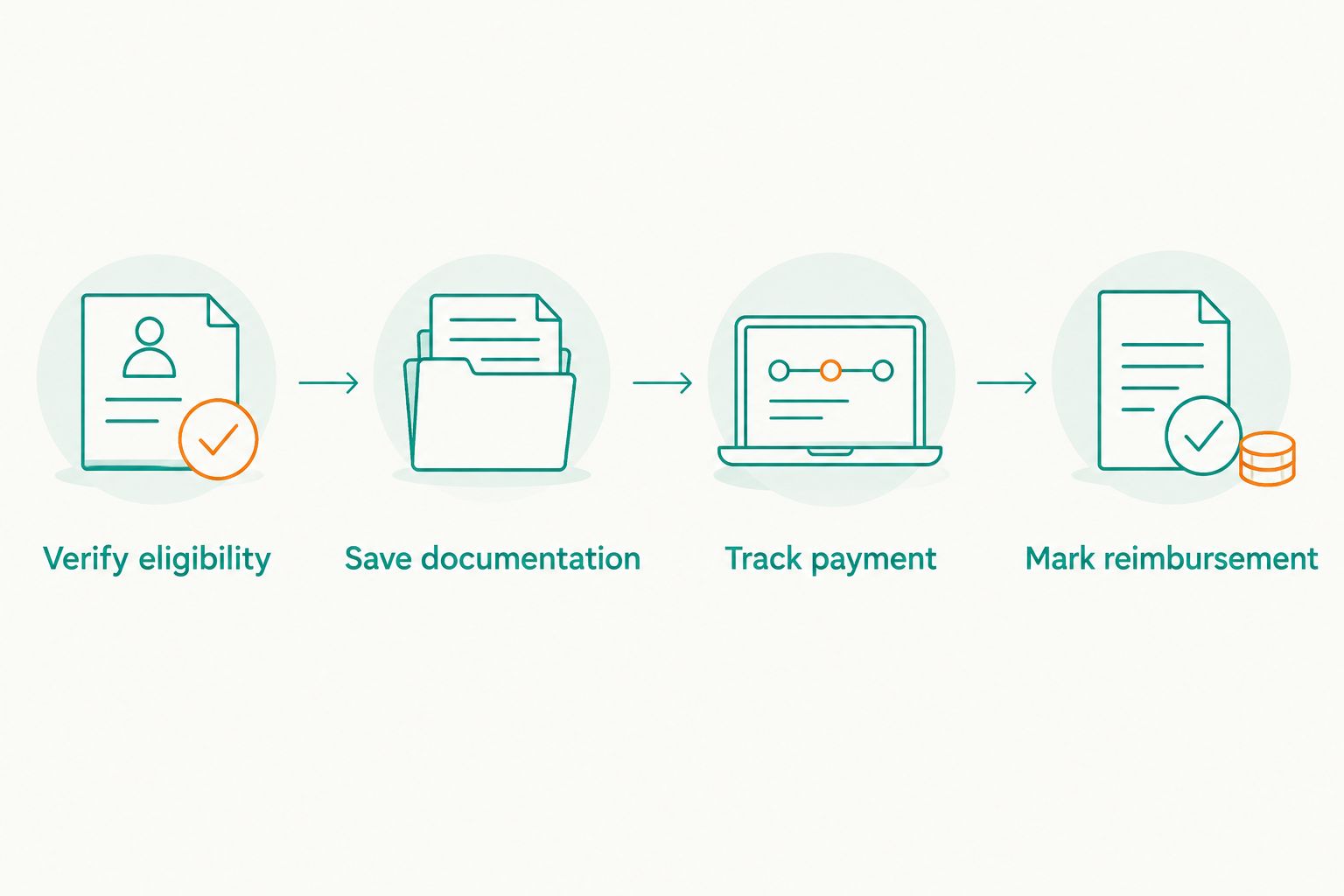
Use this sequence:
- Verify eligibility. Review the IRS medical-expense guidance and discuss unclear membership charges with your tax advisor before reimbursement.
- Save documentation. Keep relevant medical records or a physician's explanation, the itemized bill, and proof of payment. Record the service period rather than relying only on the bank transaction date.
- Track payment. Record the amount you paid, the expense date, and whether insurance, an employer benefit, or another account covered any portion.
- Mark reimbursement. Record when you reimburse yourself and which expense the distribution covers. Leave no ambiguity about whether the receipt remains unreimbursed.
This sequence separates the eligibility decision from the administrative task. A perfectly organized receipt is useful evidence of payment, but it is not evidence of medical necessity by itself.
Example: exercise advice versus a qualifying treatment expense
Suppose your physician recommends more activity during a routine visit, and you join a gym for general fitness. Keep that membership outside your HSA reimbursement list; the recommendation alone does not establish eligibility.
Now suppose you receive separately billed physical therapy to treat an injury. Evaluate that charge as physical therapy, not as ordinary gym dues, even if the provider operates inside a fitness facility. Keep the therapy bill separate from any membership charge.
How should you track receipts without overcomplicating it?
Choose a recordkeeping method you will actually maintain. You do not need a paid subscription to obtain tax-free reimbursement, and automation cannot decide whether a questionable membership qualifies.
| Tracking method | Best for | Useful feature | Trade-off or check |
|---|---|---|---|
| Spreadsheet with digital folders | People comfortable entering expenses manually | You can record expense details and organize supporting files | You must keep entries, files, and reimbursement status aligned |
| Paper receipts and a written log | People who prefer physical records | No app is required to maintain the records | Protect documents from loss and fading; consider backup copies |
| HSA-provider receipt tools | People who prefer their account provider's system | Keeps recordkeeping within an existing account relationship | Check the provider's actual storage, export, and access features |
| Reimbursable receipt tracking | HSA holders who want tracking alongside an eligibility directory | Free manual tracking is unlimited; Premium adds receipt scanning, bank sync, and email forwarding | Automation reduces receipt administration, not the need to verify eligibility |
Keep sensitive medical documentation protected regardless of the method. Before choosing a tool, check how you can retrieve your receipts and reimbursement history later.
If manual entry works for you, keep using it. Consider automation when collecting receipts is the problem—not as a way to make an ineligible expense qualify.
Can a doctor's letter make my gym membership HSA eligible?
A doctor's letter does not automatically make gym dues eligible. It can help document a qualifying treatment purpose, but the expense still must meet the IRS medical-care rules.
Ask whether the letter explains the actual treatment need and the role of the membership. A document that merely recommends exercise for general health does not establish the narrow exception.
Can I reimburse myself for an eligible expense years later?
There is no IRS deadline for reimbursing a qualified HSA expense incurred after your HSA was established. You must retain records showing that the expense qualified, was not reimbursed elsewhere, and was not taken as an itemized deduction.
For a qualifying expense incurred in 2026, saving the receipt now preserves the documentation needed for a later reimbursement. Waiting does not make an originally ineligible gym payment eligible.
Do the same timing rules apply to an FSA?
FSA reimbursement does not follow the HSA's open-ended timing rule. An FSA has plan-specific claim deadlines and rules governing unused funds; check the plan documents and administrator's requirements.
Do not move a receipt into an HSA reimbursement list if an FSA already reimbursed it. The same expense cannot support both reimbursements.
Which IRS sources should you check?
For a 2026 decision, consult IRS Publication 502, Medical and Dental Expenses, particularly its guidance on health club dues, weight-loss programs, and qualifying medical care. Also consult the IRS's Frequently asked questions about medical expenses related to nutrition, wellness and general health, which directly addresses gym memberships.
Use IRS Publication 969, Health Savings Accounts and Other Tax-Favored Health Plans, for HSA distribution and recordkeeping rules. IRS Notice 2004-50, question and answer 39, addresses delayed reimbursement of eligible expenses incurred after an HSA is established.
These sources serve different purposes. Publication 502 helps you assess the medical expense; the HSA guidance adds account-specific conditions. Do not assume every medical-expense deduction rule transfers unchanged to HSA reimbursement.
FAQ
Can I use my HSA card for a regular gym membership?
A regular gym membership for general fitness is generally not eligible for tax-free HSA payment. A successful card transaction does not establish eligibility.
Does a letter of medical necessity guarantee my gym membership qualifies?
No. A letter can support the medical purpose, but the membership must independently satisfy the IRS medical-expense rules.
Can I use my HSA for a gym membership if I have obesity?
An obesity diagnosis does not automatically qualify ordinary gym dues. IRS Publication 502 distinguishes qualifying disease-treatment weight-loss expenses from excluded health club membership dues; discuss the specific charge with your tax advisor.
Can I reimburse gym dues I paid before opening my HSA?
No. HSA reimbursement requires an otherwise eligible expense incurred after your HSA was established. Opening an account later does not make an earlier expense eligible.
What if I already paid for an ineligible membership with my HSA?
Contact your HSA custodian promptly about its procedure for handling a mistaken distribution, and consult your tax advisor. Do not assume an ordinary contribution automatically corrects the payment.
Do I need a paid receipt app to reimburse myself?
No. Reimbursable offers unlimited free manual tracking, and spreadsheets, folders, paper records, or suitable HSA-provider tools are legitimate alternatives. Your records must support eligibility and prevent duplicate reimbursement.
Can I claim the same expense through my HSA and FSA?
No. You cannot reimburse the same expense from both accounts, or use HSA reimbursement for an expense already reimbursed elsewhere.
One last thing
Your most useful record is not always the payment receipt. For a treatment-related expense, an itemized bill can distinguish qualifying care from ordinary membership dues that appear in the same transaction history.
Keep uncertain charges separate from your confirmed eligible expenses. Resolve the eligibility question before reimbursement rather than relying on a receipt-tracking total.
Not tax advice. Always consult your tax advisor about your circumstances.