
There is no IRS deadline to reimburse yourself from an HSA in 2026: you can withdraw money tax-free for a qualified medical expense years after paying it. The expense must have occurred after your HSA was established, and you must keep records showing that it was eligible, was not reimbursed elsewhere, and was not claimed as an itemized medical deduction. An FSA follows different deadlines; its claim rules do not apply to your HSA.
- The HSA reimbursement deadline has no IRS time limit; qualified expenses must occur after your HSA was established.
- Save receipts, payment evidence, and reimbursement records for delayed withdrawals; filing your tax return does not expire eligible expenses.
- FSA claim deadlines are separate from HSA rules and depend on your employer’s plan.
- Reimbursable fits HSA holders who want receipt tracking; spreadsheets and organized folders are legitimate alternatives.
Why this matters
The calendar does not expire an eligible HSA expense. Missing documentation can prevent you from substantiating the withdrawal. If you pay medical bills out of pocket, your job is to preserve the evidence and avoid claiming the same expense twice.
You can use Reimbursable for receipt tracking, or maintain your own records. Either way, separate unpaid reimbursement balances from expenses already covered by insurance, an FSA, or your HSA.
Is there a deadline to reimburse yourself from an HSA?
No. Federal HSA rules do not impose a time limit between incurring a qualified medical expense and reimbursing yourself. IRS Notice 2004-50, Q&A 39, directly addresses delayed reimbursement and the records you must maintain. IRS Publication 969 explains HSA distributions and recordkeeping; Publication 502 provides guidance on medical expenses, subject to HSA-specific rules.
For your 2026 records, distinguish these account rules:
| Question | HSA | Health FSA |
|---|---|---|
| When must you reimburse yourself? | No IRS time limit for an otherwise qualified expense | Claims must meet the plan’s submission deadline |
| When must the expense occur? | After the HSA was established | During the applicable coverage period, including any permitted grace period |
| Does unused money expire annually? | No; HSA funds remain in the account | Use-it-or-lose-it rules apply, subject to permitted plan provisions |
| What needs attention? | Eligibility, documentation, and duplicate reimbursement | Those requirements plus plan deadlines |
An HSA contribution deadline is not a reimbursement deadline. Filing your income tax return also does not close the reimbursement window for an eligible expense that remains unreimbursed.
Does reimbursement have to happen in the same tax year?
No. An HSA reimbursement does not have to occur in the same tax year as the medical expense. You report the distribution for the year you take it, not by amending the return for the year you originally paid the bill.
That distinction lets you keep a documented expense pending without treating it as a current withdrawal.
Can you reimburse an expense from before opening your HSA?
No. A medical expense incurred before your HSA was established does not qualify for tax-free HSA reimbursement. Paying an old bill after opening the account does not change when the care occurred.
Save evidence of the original establishment date. If you moved accounts, distinguish a transfer of an existing HSA from the establishment of your first HSA.
How to reimburse yourself later without losing the paper trail
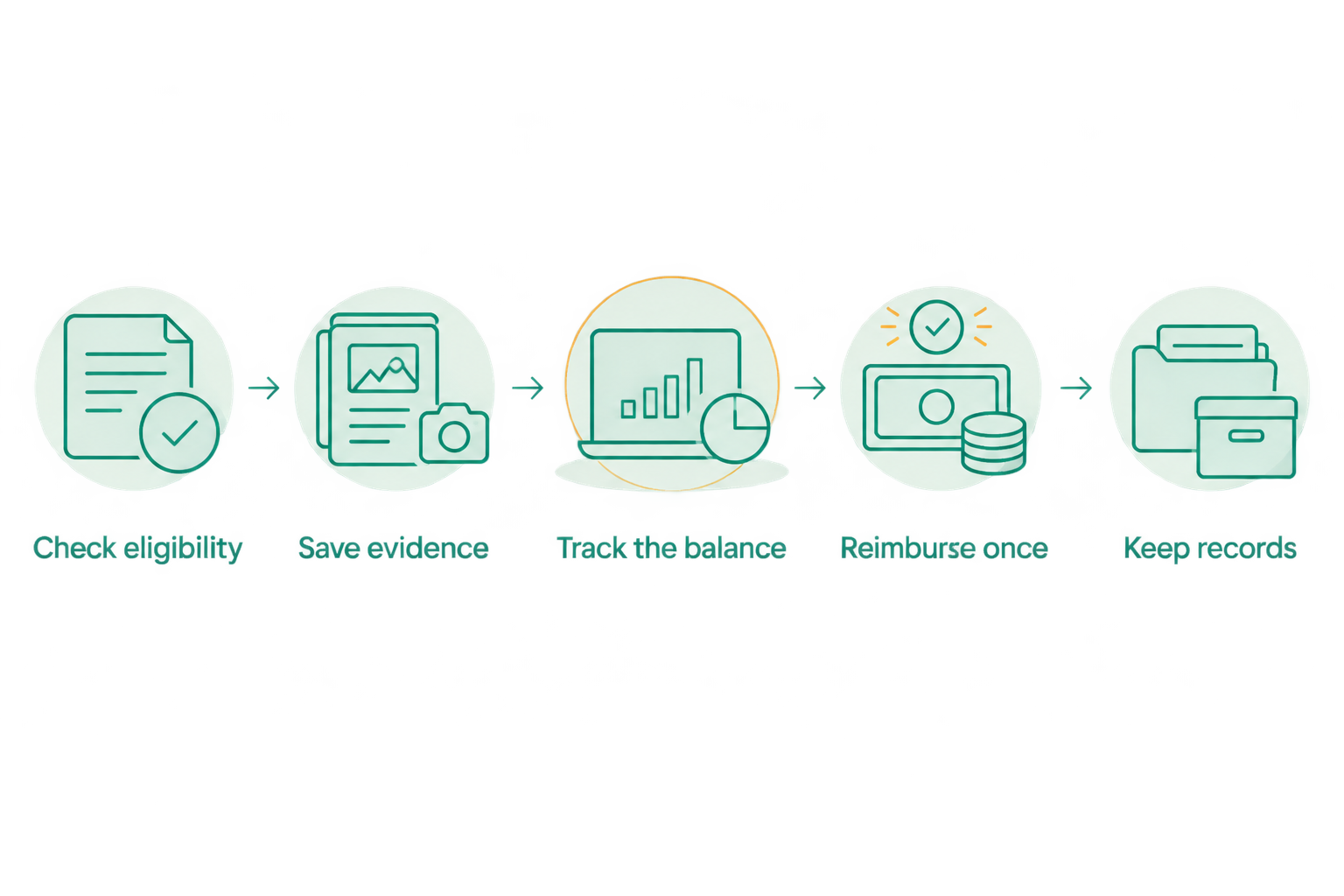
Use the same process for each bill. A repeatable record is easier to check than a collection of unexplained receipt photos.
- Check eligibility. Confirm that the expense qualifies under HSA rules and occurred after the HSA was established. Identify whose care it covered; eligible expenses can include your own, your spouse’s, and qualifying dependents’ care.
- Save evidence. Keep an itemized receipt or provider statement showing the patient, service or item, date, and amount. Add proof of payment and the insurance explanation of benefits when relevant.
- Track the balance. Record what you paid, what insurance or another source covered, and what remains eligible for HSA reimbursement. Separate qualified items from nonqualified items on mixed receipts.
- Reimburse once. Request the withdrawal through your HSA provider when you want the money. Record the date and amount against the matching expense.
- Keep records. Retain the supporting documents and distribution records for as long as needed to substantiate the tax treatment. A completed transfer is not a reason to delete the receipt.
For a bill paid out of pocket in 2026, keep the expense date separate from the payment date and eventual HSA withdrawal date. Those dates answer different questions: when care occurred, whether you paid, and when reimbursement happened.
Why the right reimbursement timing varies
There is no universal best withdrawal date. Your decision depends on your finances and your ability to maintain reliable records, not a year-end HSA deadline.
- Cash needs. Reimbursement puts money back into your checking account. Delaying is optional, not a requirement for receiving favorable HSA tax treatment.
- Documentation quality. A clear itemized receipt is easier to substantiate than an unexplained card transaction. Resolve missing details while the provider can still supply them.
- Insurance adjustments. Wait until you understand your actual responsibility before claiming a bill that insurance is still processing.
- Account balance. You can reimburse part of an eligible expense and leave the rest pending. Track the remaining balance precisely.
- Investment risk. Leaving money invested exposes it to market changes. Delayed reimbursement does not guarantee growth or a better financial outcome.
- Administrative effort. A long delay means maintaining accessible files and avoiding duplicate claims over a longer period.
For a 2026 decision, do not delay reimbursement merely because someone calls it a tax strategy. Compare the benefit of having cash now with the responsibility of keeping the expense documented.
What records should you save for delayed reimbursement?
Save enough evidence to establish the medical expense, your payment, and the amount still eligible for reimbursement. A credit card statement can support payment, but it generally does not identify the medical service or prove that every item on a purchase qualified.
Keep these details together:
- The patient and medical provider or merchant.
- The date of service or purchase and an itemized description.
- The amount paid and supporting payment evidence.
- Insurance payments, refunds, or other reimbursements.
- Any supporting medical documentation needed for conditional eligibility.
- HSA reimbursements already taken and the remaining eligible balance.
A doctor’s letter does not automatically make a general-health expense eligible. The underlying expense must still meet the applicable medical-expense rules; documentation supports eligibility rather than replacing it.
You normally keep HSA receipts in your records rather than attaching them to your tax return. Form 8889 reports HSA activity, while your supporting files explain why a distribution qualifies for tax-free treatment.
Which receipt-tracking method should you use?
Choose the method you will maintain and be able to retrieve later. A paid app is not required for tax-free HSA reimbursement, and automation does not decide whether an expense qualifies.
| Method | Best for | Practical benefit | Limitation |
|---|---|---|---|
| Spreadsheet and digital folders | People comfortable updating their own ledger | You control the fields and file organization | You must enter reimbursements and maintain document links yourself |
| Paper receipts and folders | People who prefer physical records | No app is needed | Paper can fade, be misplaced, or become difficult to search |
| HSA-provider receipt tools | People who prefer account-based records | Receipt tracking can stay with account activity where the provider offers it | Features and access arrangements depend on the provider |
| Reimbursable free manual tracking | HSA holders who want a dedicated expense record | Unlimited manual tracking | You still enter and review records yourself |
| Reimbursable Premium | HSA holders whose receipt administration needs automation | AI receipt scanning, bank sync, and email forwarding reduce manual handling | You still must verify eligibility and prevent duplicate reimbursement |
Keep a separate backup of essential documents regardless of the method. Before switching tools or HSA providers, confirm that you can retain the records you need rather than assuming access will continue unchanged.
How delayed HSA reimbursement fits retirement withdrawals
Delayed reimbursement belongs in your broader cash-flow plan, not in a separate pile of forgotten receipts. When planning retirement withdrawals, distinguish documented tax-free HSA reimbursements from taxable withdrawals from other accounts; they do not have the same tax treatment.
Turning 65 years old does not end the receipt requirement for tax-free medical withdrawals. Qualified medical distributions remain tax-free when the requirements are met. Nonqualified distributions are generally taxable, although the 20% additional tax no longer applies after age 65.
You also do not need to remain eligible to contribute to an HSA to use an existing balance for qualified expenses. Contribution eligibility and distribution eligibility are separate questions.
For your 2026 planning, keep a clearly labeled total of documented, unreimbursed expenses. That total is a recordkeeping balance, not a promise of investment returns or permission to withdraw more than the qualified expenses support.
What changes if you also have an FSA?
An FSA’s submission deadline does not create an HSA reimbursement deadline. Health FSAs have plan-specific coverage and claim-submission rules, so read the employer’s plan documents rather than applying HSA flexibility to an FSA claim.
Some health FSAs offer a grace period of up to 2.5 months to incur eligible expenses; others offer a permitted carryover. These provisions are optional and different from a run-out period, which gives you time to submit claims for expenses already incurred.
Two safeguards matter when the accounts overlap:
- Do not reimburse the same expense from both accounts. Mark the funding source against each bill.
- Check contribution eligibility. General-purpose health FSA coverage generally prevents HSA contributions, while certain limited-purpose arrangements can be compatible.
Your employer’s FSA administrator handles the plan’s deadline questions. Your HSA records should still show which expenses were paid elsewhere and are therefore unavailable for another tax-free reimbursement.
Can you take partial reimbursements or correct duplicate claims?
You can reimburse only part of a qualified expense and leave the remaining eligible balance for later. Record each withdrawal against the same bill so you never treat the full original amount as still available.
The workflow for HSA reimbursement rules for partial withdrawals centers on that running balance. Separate the original qualified amount, prior reimbursements, and remaining amount rather than keeping disconnected copies of the receipt.
A later insurance refund can change how much you ultimately paid. If an expense has already been reimbursed from the HSA, contact the HSA custodian and your tax advisor about the appropriate correction; do not assume every custodian permits the same process.
FAQ
What is the HSA reimbursement deadline in 2026?
There is no IRS time limit for reimbursing an otherwise qualified HSA expense in 2026. The expense must have occurred after your HSA was established, and you must substantiate eligibility and avoid duplicate reimbursement or an itemized deduction.
Can I reimburse myself years after paying a medical bill?
Yes, you can reimburse yourself years after paying a qualified medical bill. Keep the itemized receipt, payment evidence, and records showing that the expense remains unreimbursed and was not claimed as an itemized deduction.
Does filing my tax return close the HSA reimbursement window?
No, filing your tax return does not close the HSA reimbursement window. Report an HSA distribution in the year you take it and retain the records supporting its tax-free treatment.
Can I reimburse a bill from before I established my HSA?
No, expenses incurred before your HSA was established do not qualify for tax-free HSA reimbursement. A later payment date does not make earlier medical care eligible.
Do I have to reimburse myself before changing jobs?
No, changing jobs does not create an IRS deadline to reimburse qualified HSA expenses. Preserve your receipts, reimbursement history, and evidence of when the HSA was originally established.
Do I need a paid receipt app to reimburse myself later?
No, a paid receipt app is not required for delayed HSA reimbursement. Spreadsheets, organized digital folders, paper records, and HSA-provider receipt tools can work if they preserve the necessary evidence.
Can I claim a tax deduction and reimburse the same expense from my HSA?
No, you cannot claim an itemized medical deduction and also take a tax-free HSA reimbursement for the same expense. Keep the expense’s tax treatment in your records before authorizing the withdrawal.
One last thing
Save evidence of when your HSA was established, not just evidence of what you bought. An itemized receipt establishes the expense; the account’s establishment date helps establish whether that expense falls inside the reimbursement rules.
Keep both with your 2026 expense records and carry the establishment evidence forward when accounts change.
Not tax advice. Always consult your tax advisor.