
Best overall: adhesive bandages for routine first aid. Best for recurring needs: menstrual products. Best for occasional use: a digital thermometer. For FSA eligible items Amazon shoppers can evaluate in 2026, start with medical supplies you need—not products chosen just to empty an account.
- For FSA eligible items Amazon shoppers need, prioritize bandages, menstrual products, and other clearly medical purchases.
- Reimbursable is best for shoppers who want an eligibility directory alongside receipt tracking.
- An Amazon eligibility label helps you shop; your FSA administrator decides whether your claim meets plan requirements.
- FSA deadlines differ from HSA rules: save itemized receipts and submit claims within your plan’s deadlines.
Use Reimbursable to research eligibility and organize receipts. The directory covers 890+ HSA/FSA-eligible items; check the exact product and your plan’s requirements before purchasing.
Why this matters
A product’s medical purpose matters more than its placement in an Amazon search result. Bandages and pregnancy tests serve recognizable medical purposes; a supplement marketed for general wellness needs a different eligibility analysis.
For 2026 purchases, use IRS Publication 502 for medical-expense definitions and Publication 969 for HSA and health FSA rules. Neither an online badge nor a successful card transaction replaces the documentation your administrator requires.
This guide ranks product categories, not specific Amazon listings. Listings change, and different versions of a similarly named product can have different ingredients, functions, or eligibility requirements.
What makes the best FSA-eligible Amazon purchase?
Choose your 2026 purchases against these criteria:
- Clear medical purpose: Favor products that treat, diagnose, prevent, or manage a medical condition rather than support general wellness.
- Actual household need: Choose something you expect to use during its useful life. Avoid unnecessary quantities.
- Identifiable product: The listing and receipt should identify what you bought, not merely describe a generic household purchase.
- Manageable documentation: Prefer purchases you can substantiate with an itemized receipt and any required supporting records.
- Correct timing: Confirm your coverage period, purchase deadline, and claim-submission deadline before ordering.
A low-effort claim is useful, but it is not the only test. A blood pressure monitor prescribed for your care deserves priority over an easier purchase you do not need.
Best FSA-eligible Amazon items at a glance
| Rank and item | Best for | Standout feature | Key limitation |
|---|---|---|---|
| 1. Adhesive bandages and sterile gauze | Routine first aid | Clearly identifiable wound-care supplies | A bundled kit can include items needing separate review |
| 2. Menstrual products | Recurring personal care | Federal rules expressly include menstrual care products | Other personal-care products do not qualify automatically |
| 3. Digital thermometer | Checking body temperature | A direct medical measurement | Extra app features do not establish medical value |
| 4. OTC pain relievers | Occasional pain treatment | Eligible medicines do not require a prescription for FSA reimbursement | Ingredients and safe use still matter |
| 5. Blood pressure monitor | Clinician-directed home monitoring | Helps record readings between appointments | Fit and measurement technique affect readings |
| 6. Pregnancy tests | At-home pregnancy testing | A defined diagnostic purpose | A home result does not replace follow-up care |
| 7. Contact lens solution | Care of vision-correcting lenses | Supports medically necessary lens care | Must suit your lenses and care instructions |
| 8. Qualifying sunscreen | Sun protection | Broad-spectrum SPF 15 or higher is a common eligibility standard | Not every cosmetic with SPF qualifies |
1. Adhesive bandages: best for routine first aid
Adhesive bandages and sterile gauze protect wounds and absorb drainage. They are a practical default when your first-aid supplies need replacing.
Adhesive bandage pros:
- Serve a clear wound-care purpose.
- Come in formats for different wound locations.
- Are straightforward to identify on an itemized receipt.
Adhesive bandage cons:
- Adhesives can irritate sensitive skin.
- Assorted kits can contain nonmedical extras requiring separate review.
Best for: Replacing supplies you already use for minor injuries. Check materials and expiration dates where applicable, rather than choosing the largest assortment.
Verdict: Buy for a real first-aid need; skip unnecessary bulk quantities.
2. Menstrual products: best for recurring needs
Tampons, pads, liners, cups, and similar menstrual care products are eligible under federal HSA/FSA rules. Their eligibility does not depend on obtaining a prescription.
Menstrual product pros:
- Meet a recurring, predictable need.
- Include disposable and reusable options.
- Have an expressly recognized eligibility category.
Menstrual product cons:
- Fit, materials, and comfort differ.
- Adjacent hygiene products do not inherit menstrual-product eligibility.
Best for: Replenishing the menstrual supplies you already prefer. Check the exact product description instead of treating an entire personal-care bundle as eligible.
Verdict: Buy your usual supplies in a sensible quantity.
3. Digital thermometer: best for checking body temperature
A medical thermometer measures body temperature. Choose the measurement method you can use correctly, particularly when buying for a child or another household member.
Digital thermometer pros:
- Has a direct medical purpose.
- Can support symptom monitoring at home.
- Does not require choosing a medicine or active ingredient.
Digital thermometer cons:
- Technique affects readings.
- Different measurement sites require different interpretation.
Best for: A household without a working medical thermometer. Read the instructions and age guidance; a connected app is not necessary for the thermometer to serve its basic purpose.
Verdict: Buy if you need a reliable way to check temperature.
4. OTC pain relievers: best for occasional pain treatment
Over-the-counter medicines can qualify for health FSA reimbursement without a prescription. Choose the active ingredient appropriate for your needs, not simply the package displaying an eligibility label.
OTC pain reliever pros:
- Treat a specific symptom.
- Do not require a prescription solely for FSA eligibility.
- Have labeled ingredients and directions to check before use.
OTC pain reliever cons:
- Drug interactions and health conditions affect suitability.
- Combination products can duplicate ingredients in other medicines.
Best for: Replenishing medicine you can safely use. Ask a pharmacist or clinician when you are unsure about an ingredient, dose, or interaction.
Verdict: Buy an appropriate medicine; skip unfamiliar combinations chosen only for eligibility.
5. Blood pressure monitors: best for home monitoring
A home blood pressure monitor helps you record readings outside a medical appointment. Choose a validated device with a cuff that fits your arm and follow your clinician’s monitoring instructions.
Blood pressure monitor pros:
- Supports an ongoing medical monitoring task.
- Lets you record readings for clinical discussions.
- Can serve a defined need beyond a single purchase.
Blood pressure monitor cons:
- Incorrect cuff fit can distort measurements.
- Home readings do not replace diagnosis or treatment advice.
Best for: Someone whose clinician recommends home blood pressure checks. Look for device validation and suitable cuff dimensions, rather than prioritizing connectivity.
Verdict: Buy when home monitoring fits your care plan.
6. Pregnancy tests: best for at-home pregnancy testing
Pregnancy test kits are medical diagnostic supplies. Follow the package instructions for when to test and how to interpret the result.
Pregnancy test pros:
- Have a specific diagnostic purpose.
- Provide a private testing option at home.
- Are easy to distinguish from general wellness products.
Pregnancy test cons:
- Testing too early can produce a negative result despite pregnancy.
- Results can require repeat testing or clinical follow-up.
Best for: Someone who needs an at-home pregnancy test. Keep the itemized purchase record, but do not add sensitive test results to a reimbursement file unless required.
Verdict: Buy when testing is relevant; skip speculative stockpiling.
7. Contact lens solution: best for lens-care routines
Solutions needed to clean and care for vision-correcting contact lenses can qualify as medical expenses. Match the product to your lenses and your eye-care professional’s instructions.
Contact lens solution pros:
- Supports an established vision-care need.
- Fits a recurring replenishment routine.
- Has a recognizable medical-care purpose.
Contact lens solution cons:
- Different solutions are not automatically interchangeable.
- Some systems require a specific neutralization process.
Best for: Contact lens wearers replacing the solution their care routine requires. Never substitute another product just because its listing displays an FSA label.
Verdict: Buy the correct solution for your lenses.
8. Qualifying sunscreen: best for sun protection
Broad-spectrum sunscreen with SPF 15 or higher is a common HSA/FSA eligibility category. Confirm the exact product’s classification with your administrator, especially for cosmetics or moisturizers containing sunscreen.
Qualifying sunscreen pros:
- Serves a preventive medical purpose.
- Comes in different application formats.
- Displays labeled sun-protection information you can check.
Qualifying sunscreen cons:
- An SPF claim alone does not settle every product’s eligibility.
- Correct application and reapplication remain necessary.
Best for: Replacing sunscreen you will actually use. Check broad-spectrum labeling, expiration, and directions; do not assume a cosmetic bundle qualifies as a whole.
Verdict: Buy qualifying sunscreen; verify mixed-purpose cosmetics first.
How these categories are ranked
The 2026 order prioritizes clear medical purpose, ordinary household usefulness, and straightforward documentation. It is not a claim that every listing in a category qualifies or that specific products underwent hands-on testing.
Your medical needs override the ranking. A clinician-recommended monitor belongs ahead of bandages if that is the expense you actually need to cover.
How to document an Amazon FSA purchase
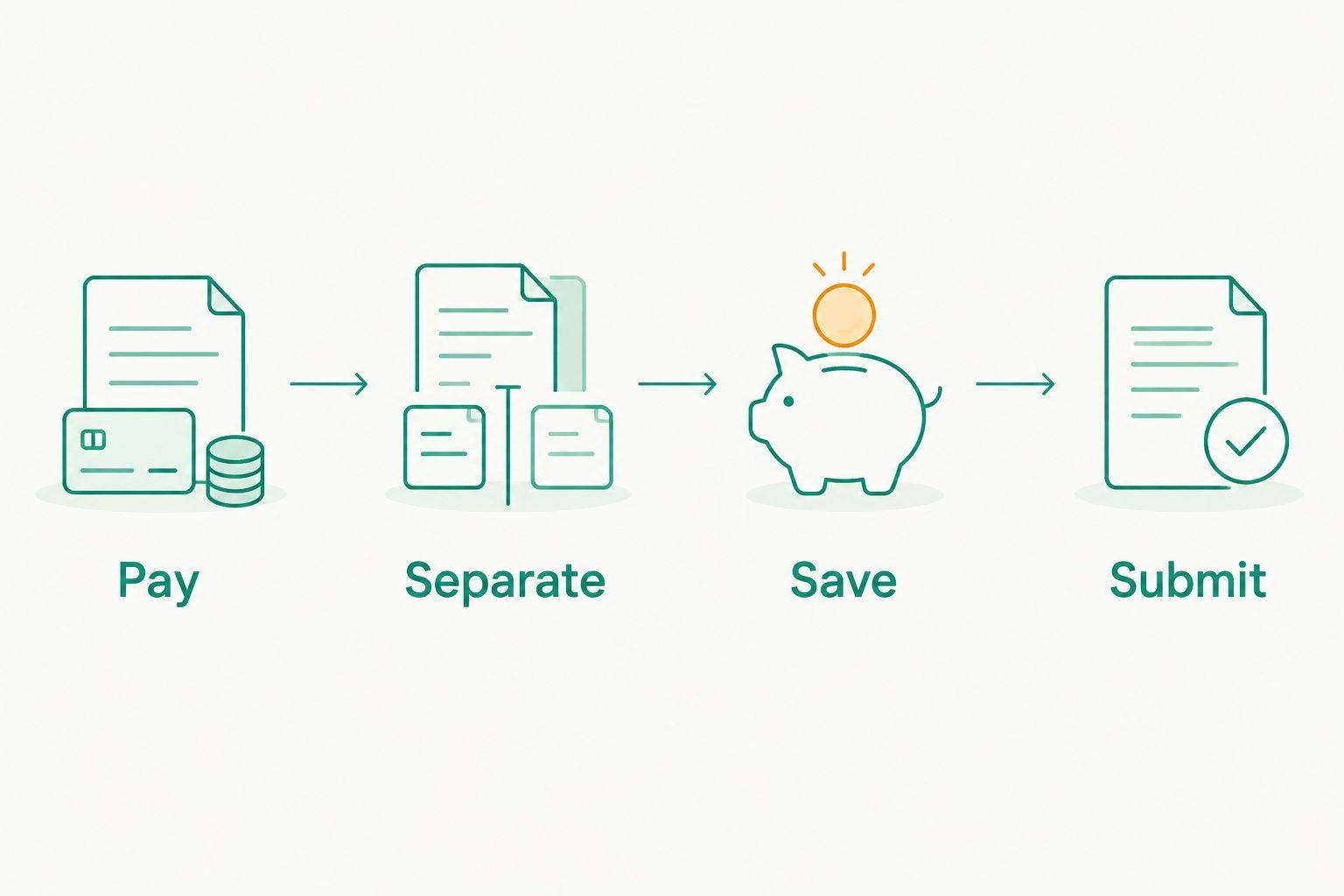
Pay
Check your plan’s expense-incurrence rules before ordering near a deadline. Paying with a personal card does not by itself prevent reimbursement; you still need an eligible expense and a timely, supported claim.
Separate
Keep medical purchases distinct from household purchases in your records. For mixed orders, use the same basic discipline described in this guide to separating qualified medical expenses on mixed bills: identify eligible lines rather than claiming the entire total.
Save
Save an itemized receipt showing the merchant, product, purchase date, and amount. Keep supporting eligibility documentation when needed; a bank transaction alone does not identify the medical item purchased.
Submit
Send the claim through your administrator’s process before its submission deadline. Track whether it was approved, partially paid, denied, or later refunded so you do not claim the same expense twice.
Reimbursable offers unlimited free manual tracking. Premium adds receipt scanning, bank sync, and email forwarding for less receipt administration; automation is optional, not a requirement for tax-free reimbursement.
Spreadsheets, digital folders, paper receipts, and HSA-provider receipt tools are legitimate alternatives. Whatever you choose, keep records accessible and distinguish paid claims from unreimbursed expenses.
FSA deadlines are not HSA reimbursement rules
A health FSA generally covers expenses incurred during its coverage period. An employer plan can offer a carryover or a grace period of up to 2 months and 15 days; these provisions are not automatic. A run-out period is time to submit claims, not extra time to incur expenses.
An HSA works differently. There is no federal deadline for reimbursing a qualified expense incurred after the HSA was established, provided you retain adequate records. The expense cannot also be reimbursed elsewhere or claimed as an itemized medical deduction.
Do not submit the same Amazon purchase to both accounts. If an FSA reimburses part of an eligible expense, only an otherwise eligible, unreimbursed portion belongs in an HSA reimbursement calculation.
Which FSA-eligible Amazon items should you choose?
Choose the eligible medical item you need most, then solve the paperwork. For an undecided shopper, bandages are the default only when first-aid supplies need replacing; recurring menstrual or lens-care supplies take priority when those are your actual needs.
Reimbursable helps with FSA-eligible item research and receipt tracking, but your administrator’s requirements still govern your FSA claim. Check unclear products before purchasing, not after a denial.
FAQ
What are the best FSA-eligible items to buy on Amazon in 2026?
The best choices are eligible medical supplies you need, such as bandages, menstrual products, thermometers, and appropriate OTC medicines. Check the exact product and your plan’s documentation requirements before purchasing.
Does an Amazon FSA-eligible label guarantee reimbursement?
No, an Amazon eligibility label does not guarantee your administrator will approve a claim. Keep an itemized receipt and meet your plan’s eligibility, timing, and substantiation requirements.
Can I get reimbursed if I use my own credit card?
Yes, paying with a personal credit card does not by itself disqualify an eligible FSA expense. Submit the required records through your administrator before the claim deadline.
Are vitamins on Amazon FSA eligible?
Vitamins taken for general health generally do not qualify. Treatment of a specific medical condition requires a separate eligibility review; a prescription or doctor’s letter does not automatically make a general-health expense eligible.
Can I buy eligible items now and submit the FSA claim next year?
Only if the expense falls within your coverage rules and your plan permits submission by that later date. A claim run-out period allows paperwork submission, not new purchases after coverage ends.
Can I save an FSA receipt for reimbursement years later like an HSA receipt?
No, FSA claims follow your plan’s submission deadlines. HSA reimbursement has no federal time limit for otherwise qualified expenses incurred after the HSA was established, with adequate records and no double reimbursement or deduction.
Do I need a paid receipt-tracking app?
No, a paid app is not required for tax-free reimbursement. Reimbursable offers unlimited free manual tracking, and spreadsheets, folders, paper records, or provider tools can also support your recordkeeping.
One last thing
A returned item is no longer the same unreimbursed medical expense. If a merchant refunds a purchase after your FSA has paid the claim, contact your administrator about correcting the reimbursement and update your records.
Not tax advice. Always consult your tax advisor. Use current IRS guidance and your plan documents for your specific circumstances.