
Best overall: prescription eyeglasses. Best for contact lens wearers: prescription contacts and contact lens solution. Best for reading correction: reading glasses. The best FSA eligible vision care products address an actual vision or treatment need; this 2026 guide compares six categories and explains what to save for reimbursement.
- The best FSA eligible vision care products include prescription glasses, contacts, lens solution, reading glasses, prescription sunglasses, and artificial tears.
- Choose vision products for a documented need, not just to spend an FSA balance.
- Reimbursable pairs eligibility lookup with receipt tracking; folders, spreadsheets, and provider tools are legitimate alternatives.
- FSA deadlines follow your plan. HSA reimbursement has no federal deadline when the expense satisfies the rules.
Why this matters
A vision purchase can qualify as medical care without being the right purchase for you. Start with your prescription, symptoms, and existing supplies—not a retailer's eligibility badge.
IRS Publication 502 identifies eyeglasses and contact lenses needed for medical reasons as medical expenses, including contact lens supplies. For 2026 purchases, use that guidance alongside IRS Publication 969 and your FSA administrator's documentation requirements. The tax definition and your plan's reimbursement process are separate checks.
Reimbursable offers an eligibility directory and receipt tracking. Reimbursable is best for HSA holders who want eligibility lookup and receipt tracking in one place. Tracking supports your records; it does not make an otherwise ineligible purchase qualify.
What makes the best FSA eligible vision care products?
These criteria put medical purpose ahead of shopping convenience:
- Clear medical use: The product corrects vision, maintains prescribed contacts, or treats an eye condition.
- Personal suitability: Your prescription, lens type, or clinician's instructions support the choice.
- Straightforward documentation: An itemized receipt identifies what you bought, when, and the amount.
- Practical usefulness: You have a reason to use the product, rather than buying an unnecessary duplicate.
- Manageable limitations: You understand fitting requirements, compatibility restrictions, and any need for professional care.
No product earns a recommendation solely because a checkout system accepts an FSA card. Card acceptance does not replace substantiation, and card rejection does not by itself determine tax eligibility.
FSA eligible vision care products at a glance
| Product category | Best for | Standout benefit | Key limitation |
|---|---|---|---|
| Prescription eyeglasses | Everyday vision correction | Corrective lenses fitted to your prescription | Prescription and fit must suit you |
| Prescription contact lenses | Correction without eyeglass frames | An alternative to wearing glasses | Require fitting and appropriate care |
| Contact lens solution | Maintaining reusable contacts | Cleaning, disinfecting, or storing compatible lenses | Products and care systems are not interchangeable |
| Reading glasses | Near-vision correction | Corrective lenses for close work | Do not address every cause of reading difficulty |
| Prescription sunglasses | Outdoor prescription correction | Combine corrective lenses with sun protection | Ordinary nonprescription sunglasses generally do not qualify |
| Artificial tears | Dry-eye symptom relief | Lubricate the eye | Not every drop is compatible with contacts |
The ranking separates use cases rather than treating every product as a substitute. Contact lens solution cannot replace corrective lenses; prescription sunglasses do not replace an eye evaluation.
1. Prescription eyeglasses: best for everyday vision correction
Prescription eyeglasses are the default recommendation when you need corrective lenses and prefer glasses. IRS Publication 502 expressly includes eyeglasses needed for medical reasons.
For a 2026 purchase, choose the prescription and fit first. Ask the seller to identify the prescription eyeglasses clearly on the receipt instead of leaving you with a generic merchandise description.
Prescription eyeglasses pros:
- Serve a direct vision-correction purpose.
- Do not require contact lens insertion or cleaning.
- Have a clearly recognized medical-expense category.
Prescription eyeglasses cons:
- An unsuitable prescription or fit limits usefulness.
- Frames can interfere with some activities or protective equipment.
Best for: Everyday correction when you prefer wearing glasses.
Verdict: Buy prescription eyeglasses when they meet your current correction needs; skip unnecessary duplicates bought only to exhaust an account.
2. Prescription contact lenses: best for correction without frames
Prescription contact lenses correct vision without eyeglass frames. They require a contact lens prescription and fitting; an eyeglass prescription is not a substitute.
Medical-purpose contact lenses fall within IRS Publication 502's vision-expense guidance. Keep the purchase record separate from any insurance reimbursement so you claim only your eligible, unreimbursed portion.
Prescription contact lenses pros:
- Offer an alternative to wearing eyeglasses.
- Avoid eyeglass frames during activities.
- Have explicit recognition in IRS medical-expense guidance.
Prescription contact lenses cons:
- Require proper handling and care.
- Need an appropriate fit and replacement schedule.
Best for: People who have a contact lens prescription and prefer contacts for some or all activities.
Verdict: Buy prescribed contact lenses that match your fitted product; skip substitutions based only on an eligibility label.
3. Contact lens solution: best for reusable lens care
Contact lens solution supports cleaning, disinfection, or storage, depending on the product. IRS Publication 502 specifically includes supplies such as saline solution and enzyme cleaner needed for contact lenses.
Match the care product to your lenses and instructions. Saline does not disinfect lenses, and a hydrogen peroxide system requires its prescribed neutralization process before lenses touch your eyes.
Contact lens solution pros:
- Supports the care of reusable lenses.
- Has a direct connection to medical-purpose contacts.
- Addresses a recurring need for applicable lens systems.
Contact lens solution cons:
- Not every solution works with every lens.
- Incorrect use can cause eye injury.
Best for: Reusable contact lens wearers following a compatible care routine.
Verdict: Buy the correct care solution; skip any product whose instructions do not match your lens system.
4. Reading glasses: best for near-vision correction
Reading glasses used to correct vision can qualify as a medical expense, including nonprescription readers. An over-the-counter purchase does not automatically make an item ineligible.
Choose readers for an actual correction need. Persistent headaches, sudden changes, unequal vision, or unexplained blur call for an eye evaluation rather than repeated guesses at lens strength.
Reading glasses pros:
- Correct near vision when appropriate for your needs.
- Do not necessarily require a custom prescription.
- Provide a distinct use case from distance glasses.
Reading glasses cons:
- Standard readers do not correct every vision problem.
- Matching lens strengths in both eyes will not suit everyone.
Best for: Near-vision correction when standard readers are appropriate.
Verdict: Buy reading glasses for a genuine correction need; hold off when unexplained symptoms need assessment.
5. Prescription sunglasses: best for outdoor correction
Prescription sunglasses combine vision correction with sun protection. Their eligibility rests on their medical-purpose corrective lenses—not simply on being sunglasses.
Ordinary nonprescription sunglasses generally do not qualify just because they reduce glare or feel more comfortable. Likewise, a general eye-health claim does not establish that fashion eyewear is a medical expense.
Prescription sunglasses pros:
- Correct vision outdoors.
- Combine prescription lenses and sun protection.
- Offer a separate use case from clear corrective lenses.
Prescription sunglasses cons:
- Are not a substitute for clear lenses in every setting.
- Require a prescription appropriate to your needs.
Best for: People who need prescription correction outdoors.
Verdict: Buy prescription sunglasses when you need outdoor correction; skip ordinary sunglasses as an assumed FSA expense.
6. Artificial tears: best for dry-eye symptom relief
Artificial tears lubricate the eyes to relieve dryness. Over-the-counter medicines can qualify for health FSA reimbursement without a prescription; choose a product intended to treat symptoms rather than relying on a broad wellness claim.
Read the label, especially if you wear contacts. Persistent symptoms, eye pain, discharge, or vision changes need professional attention rather than a different bottle chosen at random.
Artificial tears pros:
- Address dry-eye symptoms directly.
- Include formulations for different usage needs.
- Do not require a prescription solely because reimbursement involves an FSA.
Artificial tears cons:
- Not every formulation is suitable with contacts in place.
- Symptom relief does not identify the underlying cause.
Best for: Dry-eye symptom relief with an appropriate product.
Verdict: Buy suitable artificial tears for dryness; hold off on self-treatment when symptoms suggest a problem requiring care.
How the ranking works
This ranking prioritizes medical purpose, everyday usefulness, documentation, and clear limitations. Prescription eyeglasses lead as the default correction option; the remaining categories win distinct jobs rather than competing for the same need.
These are category recommendations, not claims that specific brands perform better. For 2026, your prescription, care instructions, and plan requirements remain more useful than a generic best-seller label.
Choose the product, then check the details
Before paying, make 3 checks: confirm the medical purpose, confirm personal suitability, and confirm what documentation your administrator requires. If insurance contributes, identify your remaining responsibility before submitting a claim.
Product details matter most when categories overlap. Artificial tears and contact lens solution both come in bottles, but they perform different jobs. A lens disinfectant is not an eye drop, and a lubricating drop does not disinfect contacts.
For contact wearers, choosing preservative-free eye drops for contacts still requires checking whether the specific label permits use while lenses are in place. Preservative-free does not, by itself, establish compatibility.
Keep the package directions until you know the routine. If your eye-care professional gives instructions that differ from how you planned to use a product, resolve that question before using it.
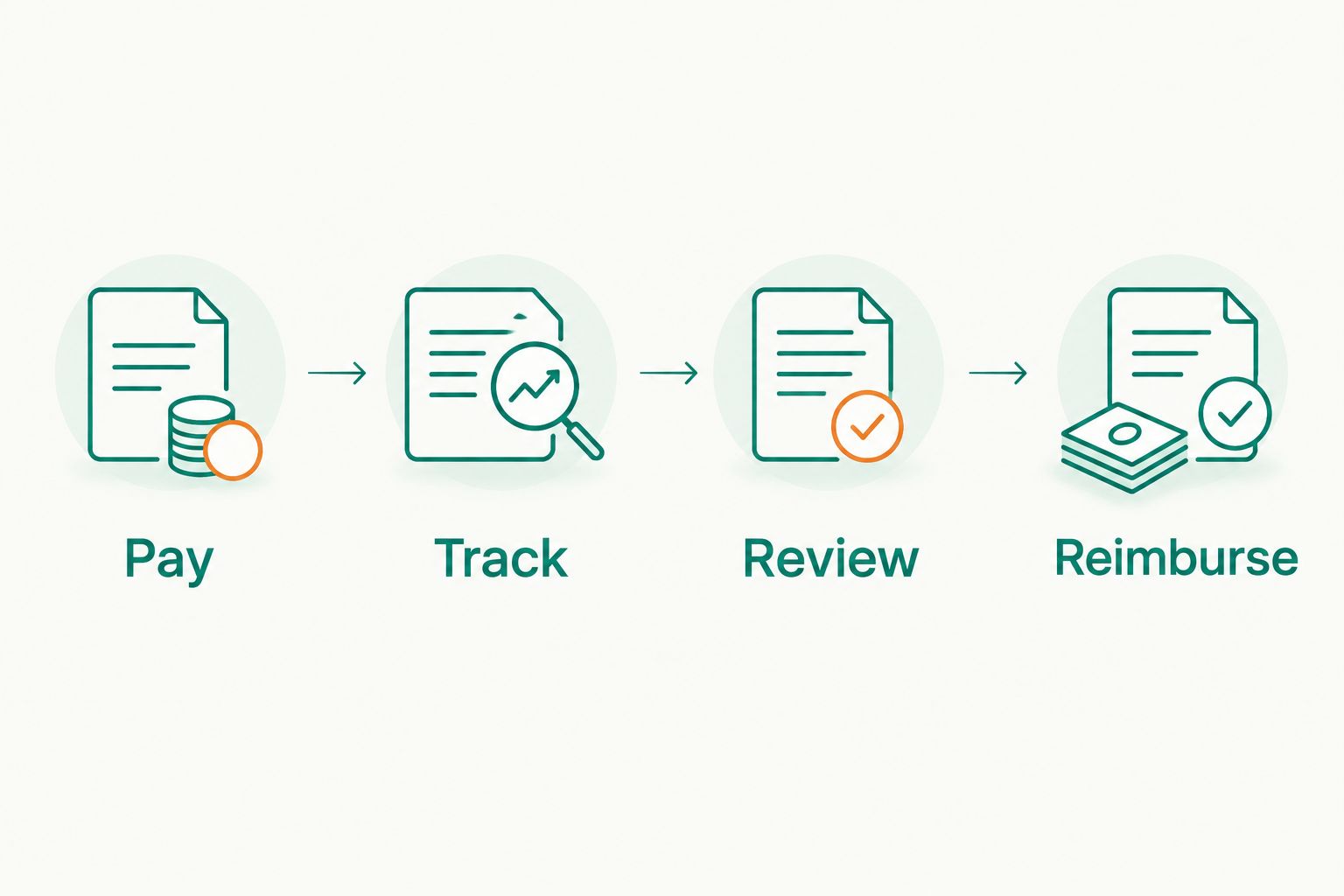
Pay, track, review, reimburse
A simple recordkeeping sequence works whether you use software or a folder. The goal is to connect each reimbursement to an eligible expense without claiming it twice.
- Pay: Keep the itemized receipt and proof of your payment. Separate eligible vision products from unrelated purchases on a mixed receipt.
- Track: Record the patient, product or service, relevant dates, amount, and insurance payments. Attach supporting prescription or claim documents when needed.
- Review: Check eligibility, account timing, and whether another account or insurer already covered the expense.
- Reimburse: Submit through the appropriate account process and record the amount received. Preserve the supporting documents afterward.
For example, a receipt containing contact lens solution and ordinary sunglasses needs line-by-line treatment. Save the full receipt, identify the qualifying solution, and exclude the nonqualifying sunglasses rather than submitting the entire total.
Reimbursable offers unlimited free manual tracking. Premium adds receipt scanning, bank sync, and email forwarding to reduce receipt administration; those features are not necessary to obtain tax-free reimbursement. A spreadsheet, labeled folders, paper receipts, or your HSA provider's receipt tools can also support a workable system.
Choose automation when entering and finding records is the problem. Choose a simpler method when you already maintain complete, accessible records consistently.
FSA deadlines and HSA timing are different
For a 2026 FSA claim, check both the expense-incurrence deadline and the submission deadline. A run-out period gives you time to submit eligible claims; it does not extend the period for incurring new expenses.
Some health FSAs offer a grace period of up to 2.5 months, while others offer a permitted carryover. These features are plan-dependent, and a health FSA generally cannot offer both. Confirm your own rules rather than assuming unused funds remain available.
An HSA has no federal deadline for reimbursing an eligible expense incurred after the HSA was established. Keep records showing the expense qualified, was not reimbursed elsewhere, and was not taken as an itemized deduction. IRS Publication 969 explains these recordkeeping conditions.
A doctor's letter does not automatically qualify a general-health expense. For an uncertain item, establish the applicable medical-expense rule before relying on a letter or submitting the purchase.
Which vision care products should you choose?
Choose prescription eyeglasses as the default if you need everyday correction and prefer glasses. Choose contacts for frame-free correction, compatible solution for reusable lens care, readers for appropriate near-vision correction, prescription sunglasses for outdoor correction, and artificial tears for suitable symptom relief.
Do not buy all 6 product categories just because they appear here. The best purchase solves a real need and leaves a clear record; an unnecessary purchase still spends your money.
FAQ
What's the best FSA eligible vision care product to buy?
Prescription eyeglasses are the default choice when you need everyday vision correction and prefer glasses. Contacts, reading glasses, prescription sunglasses, lens solution, and artificial tears serve different needs rather than replacing one another.
Are reading glasses FSA eligible without a prescription?
Reading glasses used to correct vision can qualify without a custom prescription. Keep an itemized receipt and follow your FSA administrator's substantiation requirements.
Can I use my FSA for ordinary sunglasses?
Ordinary nonprescription sunglasses generally do not qualify merely because they provide sun protection. Prescription sunglasses used for vision correction are a different category.
Is contact lens solution FSA eligible?
Contact lens supplies needed for medical-purpose contacts can qualify. IRS Publication 502 includes supplies such as saline solution and enzyme cleaner; choose a product compatible with your lenses.
Do artificial tears need a prescription for FSA reimbursement?
Over-the-counter medicines do not need a prescription solely to qualify for health FSA reimbursement. Choose an appropriate treatment product and retain the itemized purchase record.
Can I save a vision receipt and reimburse myself from my HSA later?
Yes, there is no federal HSA reimbursement deadline for an otherwise eligible expense incurred after the HSA was established. The expense cannot also be reimbursed elsewhere or taken as an itemized deduction, and you must retain supporting records.
Can I submit the same vision expense to my FSA and HSA?
No, you cannot receive duplicate tax-free reimbursement for the same expense. Track insurance payments and account reimbursements so you claim only an eligible, unreimbursed amount.
One last thing
An eligible expense and an approved reimbursement are not the same event. Before filing away a receipt, record whether you paid personally, used an account card, or already received reimbursement—your future self needs that distinction more than another shopping list.
Not tax advice; consult your tax advisor.