
Apply HSA reimbursement rules to your expense ledger by recording when each expense occurred, whether it qualifies, what you paid out of pocket, and whether you already recovered any of it. Only treat an expense as available for tax-free reimbursement if it occurred after your HSA was established and was not reimbursed elsewhere or claimed as an itemized deduction. Keep the supporting receipt with the entry; a spreadsheet row alone does not establish eligibility.
- HSA reimbursement rules require eligible expenses incurred after your HSA was established, with no duplicate reimbursement or deduction.
- Reimbursable combines HSA eligibility lookup and receipt tracking; verify each expense before marking it reimbursable.
- HSA receipt storage supports delayed reimbursement; FSA claim deadlines follow separate plan rules.
- Record insurance payments, prior reimbursements, and supporting documents before calculating your remaining eligible balance.
How do you apply HSA reimbursement rules to an expense ledger?
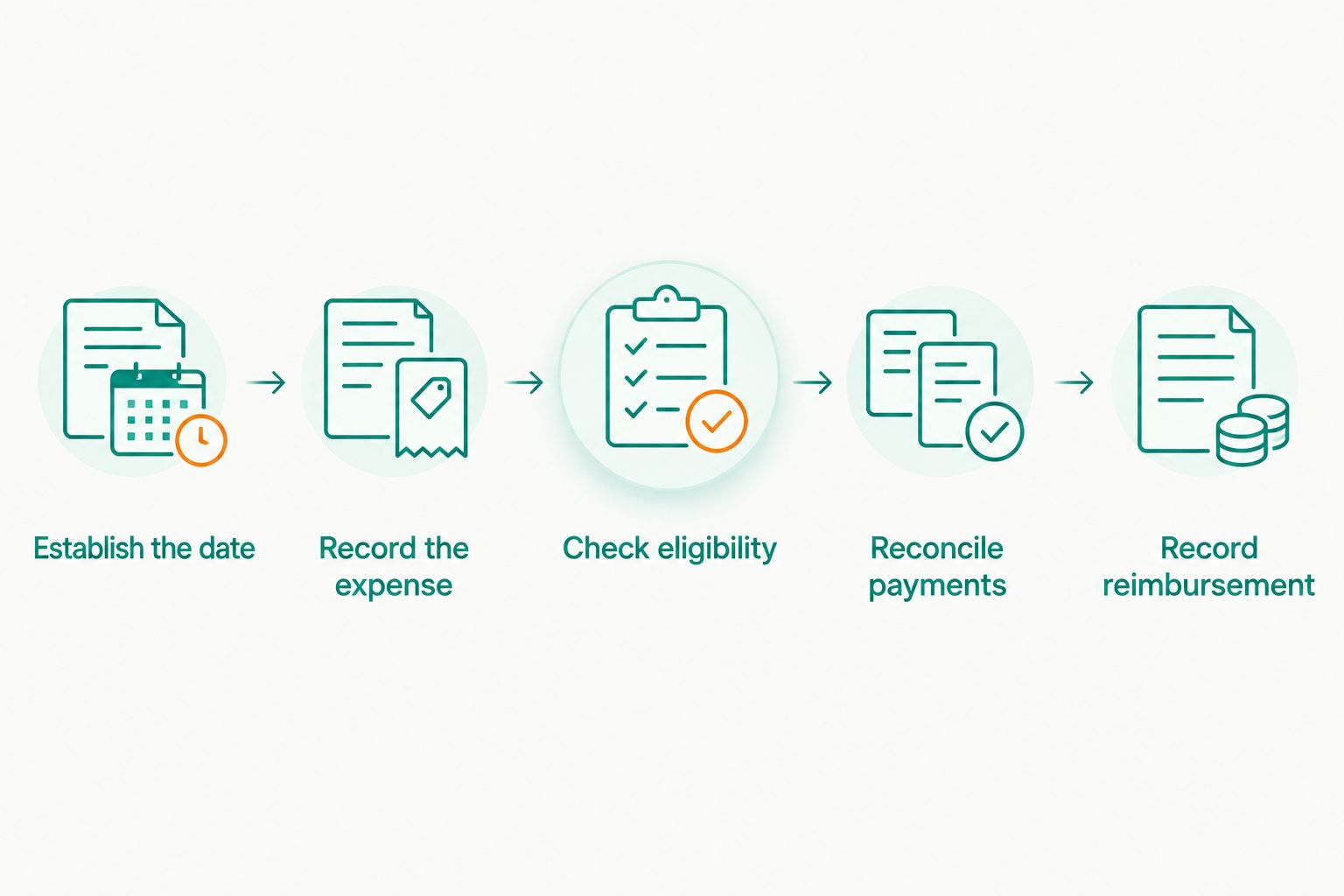
Use a separate entry for each expense, then move it through eligibility review, payment reconciliation, and reimbursement. Do not use the total on a medical bill as your reimbursable balance. Insurance adjustments, refunds, and earlier reimbursements change what remains eligible.
For 2026 recordkeeping, use IRS Publication 969 for HSA distribution rules and Publication 502 for medical-expense guidance, subject to HSA-specific differences. Reimbursable offers an eligibility directory and receipt tracking, but your ledger still needs the facts behind each claim.
Establish the date
Record your HSA establishment date separately from individual expenses. IRS Publication 969 explains that state law determines when an HSA is established; ask your provider if the date is unclear.
Then compare each expense's incurred date with that establishment date. For medical care, capture the service date rather than relying only on the invoice date or the date you paid a statement. For purchased medical items, retain the purchase record.
An expense from before your HSA was established does not become eligible simply because you pay it later. Keep it out of the HSA reimbursement balance.
Record the expense
Create an entry identifying the patient, provider or merchant, service or item, relevant dates, and amount you paid. Store the itemized receipt or provider statement alongside it.
A card statement supports proof of payment, but it generally does not describe the medical service or item sufficiently on its own. Pair payment evidence with documentation showing what the expense covered and who received the care.
Check eligibility
Determine whether the expense qualifies under HSA rules and whether the patient is an eligible person. Qualified expenses generally include medical care for you, your spouse, and qualifying dependents, with specific dependency rules explained in Publication 969.
Separate medical treatment from general wellness. A doctor's letter does not automatically turn a general-health expense into an eligible medical expense. Record the medical purpose and retain supporting documentation when the eligibility test requires it.
Reconcile payments
Match your receipt against insurance processing, refunds, and other reimbursements. An explanation of benefits helps establish patient responsibility, but it is not itself proof that you paid that amount.
Keep unresolved insurance claims out of your ready-to-reimburse total until you can identify the amount you actually owe and paid. If you paid using your HSA debit card, that payment is already an HSA distribution; do not also list it as an unpaid reimbursement opportunity.
Record reimbursement
When you reimburse yourself, record the distribution date, amount, and linked expense entry. If one distribution covers several expenses, preserve the allocation rather than marking a collection of receipts as paid without detail.
For a partial reimbursement, leave only the unreimbursed eligible portion open. This makes the ledger useful both for today's withdrawal and for a later tax-record review.
Why this matters
HSA reimbursement has no federal deadline when the underlying expense meets the rules. IRS guidance requires records showing that the expense qualified, was not previously paid or reimbursed from another source, and was not taken as an itemized deduction.
That flexibility makes recordkeeping more important, not less. If you save a receipt in 2026 and reimburse yourself much later, you need enough context to explain the transaction without relying on memory.
FSA rules are different. FSA expenses and claims follow the plan's coverage period and submission deadlines, with any grace period or carryover governed by applicable rules and plan terms. Do not apply the HSA's delayed-reimbursement approach to an FSA.
Which fields belong in an HSA expense ledger?
Use fields that answer a tax question or prevent a duplicate claim. A receipt filename alone cannot show whether an expense remains available for reimbursement.
| Ledger field | What to record | What it establishes |
|---|---|---|
| Expense identifier | A unique reference shared with the receipt | Which documents belong to the entry |
| Patient and relationship | Who received the care | Whether the person's expenses qualify |
| Incurred date | Service date or relevant purchase date | Whether the expense followed HSA establishment |
| Expense description | Specific care or purchased item | The basis for medical eligibility |
| Payment evidence | Amount paid, payment date, and payment method | What you paid and whether HSA funds were used |
| Adjustments | Insurance payments, refunds, and other reimbursements | What must be excluded |
| Deduction status | Whether the expense was claimed as an itemized deduction | Whether a conflicting tax benefit exists |
| HSA reimbursement history | Distribution dates and amounts | What has already been reimbursed |
| Supporting records | Receipts, statements, and relevant medical documentation | Evidence supporting the entry |
| Review status | Needs review, ready, partially reimbursed, or closed | Whether the entry belongs in the available balance |
Calculate the remaining balance from eligible out-of-pocket payments, not gross charges. Subtract amounts already reimbursed and exclude any portion used for an itemized deduction. Do not subtract insurance payments twice if your starting figure already reflects the insurer's adjustments.
Why an expense's reimbursable balance varies
The same category of expense does not always produce the same ledger result. These factors determine whether an entry belongs in your available balance:
- Timing: The expense must occur after your HSA was established.
- Patient eligibility: The recipient must meet the HSA rules for whose medical expenses qualify.
- Medical purpose: General-health purchases do not automatically qualify as medical treatment.
- Insurance and refunds: Your final out-of-pocket responsibility can differ from the original charge.
- Prior benefits: Other reimbursements and itemized deductions restrict what you can claim.
- Earlier HSA distributions: Partial reimbursements reduce the remaining balance; full reimbursement closes it.
A missing document is a reason to review an entry, not a reason to assume it qualifies. Keep uncertain expenses visible but outside the ready-to-reimburse total.
How do you handle common ledger situations?
You pay a dental bill before insurance finishes processing
Save the payment record and itemized dental statement, then mark the entry as needing reconciliation. Once insurance processing is complete, compare the final patient responsibility with what you paid.
If the provider refunds an overpayment, update the entry before reimbursing yourself. Your ledger should reflect the eligible expense you ultimately bore, not a temporary payment amount.
You reimburse only part of an eligible expense
Record the partial distribution against the original entry. Keep the receipt attached and show the remaining eligible amount separately from the original payment.
Do not create another copy of the full expense as a new reimbursement opportunity. A single expense can support multiple partial reimbursements, but their combined total cannot exceed its eligible, unreimbursed amount.
You find a receipt from before your HSA existed
Keep the receipt with your general records, but exclude it from your HSA reimbursement balance. Paying the bill after opening the account does not fix an expense incurred before establishment.
You discover an error after taking a distribution
Preserve the original entry and add a correction explaining what changed. Contact your HSA custodian and tax advisor about the distribution; do not assume moving money back or relabeling the expense resolves the tax treatment.
The correct response depends on the facts and available correction procedures. A visible correction history is more useful than silently overwriting the original record.
Which tracking method fits your receipt workload?
Reimbursable is best for HSA holders who want eligibility lookup and receipt tracking together. Its free manual tracking is unlimited; Premium adds receipt scanning, bank sync, and email forwarding to reduce receipt administration. Automation is optional, not a requirement for tax-free reimbursement.
Compare methods by how reliably you will maintain the records. The IRS substantiation requirement does not require a particular app.
| Method | Best for | Strength | Limitation |
|---|---|---|---|
| Spreadsheet with digital folders | People comfortable maintaining their own system | Flexible fields and direct control over records | You enter details and reconcile balances manually |
| Paper receipts with a written ledger | People who consistently organize physical records | No software workflow to learn | Physical records need protection and are harder to search |
| HSA-provider receipt tools | People whose provider offers suitable recordkeeping | Can keep records near account activity | Features and access depend on the provider; check export options |
| Reimbursable | People wanting eligibility lookup and receipt tracking together | Unlimited free manual tracking, with optional receipt automation | You still review eligibility, completeness, and duplicate claims |
Before choosing any system, check how you will retrieve records, preserve copies, and match receipts to distributions. A folder you maintain consistently is more useful than an automated system you never review.
Can you reimburse yourself years after paying an expense?
There is no federal HSA reimbursement deadline for an otherwise qualified expense incurred after the HSA was established. Keep evidence that it was eligible, was not reimbursed elsewhere, and was not claimed as an itemized deduction.
For a 2026 ledger, distinguish the expense date from the later distribution date. Preserve both rather than moving an old expense into the year you withdraw the money.
Does the medical-expense deduction threshold apply to HSA claims?
The 7.5% of adjusted gross income threshold applies to the itemized medical-expense deduction, not to qualified HSA reimbursements. Do not exclude an otherwise eligible HSA expense merely because your medical spending falls below that threshold.
Publication 502 helps explain medical expenses, while Publication 969 addresses their HSA treatment. You cannot use the same expense for both a tax-free HSA reimbursement and an itemized deduction.
What happens if an HSA distribution is not qualified?
A 20% additional tax generally applies to nonqualified HSA distributions before age 65, on top of inclusion in income, unless an exception applies. After age 65, the additional tax no longer applies, but nonmedical distributions remain taxable.
Disability and death also affect the additional-tax rules. Use the Form 8889 instructions when preparing your 2026 tax records, and get advice before treating an uncertain distribution as qualified.
FAQ
What receipts do I need for an HSA reimbursement?
Keep records identifying the patient, provider or merchant, service or item, relevant date, and amount paid. Retain payment evidence and insurance records where needed to establish the eligible out-of-pocket amount.
Can I use a credit card statement instead of a medical receipt?
A credit card statement alone generally does not establish what medical care or item you purchased. Keep an itemized receipt or provider statement alongside proof of payment.
Can I reimburse myself if I paid with a regular credit card?
Yes, paying with a regular credit card does not prevent HSA reimbursement. The expense must meet HSA eligibility rules, occur after HSA establishment, and remain unreimbursed and undeducted.
Can I claim an expense through both my HSA and my FSA?
No, you cannot reimburse the same expense amount through both an HSA and an FSA. Record any FSA reimbursement before calculating the amount still available for HSA reimbursement.
Does a doctor's letter make a wellness purchase HSA eligible?
No, a doctor's letter does not automatically qualify a general-health purchase. The expense must satisfy the applicable medical-care rules, and supporting documentation must establish the relevant facts.
Do I send my receipt ledger with Form 8889?
You generally retain the receipt ledger and supporting records rather than submitting them with Form 8889. Report HSA distributions as required and keep documentation supporting their tax treatment.
Do I need a paid app to get tax-free HSA reimbursement?
No, a paid app is not required for tax-free HSA reimbursement. Spreadsheets, digital folders, paper records, and suitable HSA-provider tools can support recordkeeping if they preserve the necessary evidence.
One last thing
Your most useful ledger total is the amount ready for reimbursement, not the amount of receipts stored. Before your next withdrawal, filter out unresolved insurance claims, missing documentation, previous reimbursements, and deducted expenses.
For your 2026 review, check Publication 969, Publication 502, and the applicable Form 8889 instructions together. Keep the receipt, eligibility decision, and distribution record connected.
Not tax advice. Always consult your tax advisor.