
Yes—you can reimburse an eligible HSA expense after losing the original receipt if you recover sufficient records to substantiate the expense, payment, and tax-free treatment. Losing the receipt does not erase eligibility, but an HSA withdrawal or credit-card statement alone does not establish that the expense qualifies.
- HSA reimbursement rules lost receipt: recover supporting records before treating a withdrawal as tax-free.
- An itemized replacement bill and payment evidence can document different parts of the same expense.
- Reimbursable supports receipt tracking; saved records still need to establish eligibility and prevent duplicate reimbursement.
- HSA reimbursement has no IRS time limit for qualifying expenses incurred after the HSA was established.
Can you reimburse an HSA expense if you lost the receipt?
Yes, provided you can substantiate the qualified expense with replacement or other supporting records. IRS Publication 969 requires records showing that HSA distributions paid qualified medical expenses, those expenses were not reimbursed elsewhere, and you did not take an itemized deduction for them.
The original paper receipt is not the only useful record. A replacement itemized receipt, provider statement, insurer explanation of benefits, and payment record can establish different parts of the transaction. Your HSA expense ledger should connect those documents to the same expense.
| Record | Best for | What it does not establish by itself |
|---|---|---|
| Duplicate itemized receipt | Identifying purchased items or services and recorded payment | Whether another account already reimbursed you |
| Itemized provider statement | Identifying the patient, service, and service date | Payment, unless the statement records it |
| Explanation of benefits | Understanding insurance adjustments and patient responsibility | That you paid the patient balance |
| Bank or credit-card statement | Supporting the amount and date paid | What you purchased or whether it qualifies |
| Expense ledger | Connecting documents and tracking reimbursements | Independent substantiation of the underlying expense |
For a 2026 reimbursement decision, focus on what the records prove—not whether you still have the original piece of paper. No single document in this table automatically makes every expense eligible.
Why this matters
An HSA custodian processing a withdrawal does not certify its tax treatment. You remain responsible for keeping the supporting records, even when the withdrawal clears without a receipt request.
That distinction matters when you pay out of pocket and reimburse yourself later. IRS Publication 969 says you do not send these expense records with your tax return; you keep them with your tax records. The absence of an upload requirement is not permission to skip documentation.
Replace the evidence before you replace your out-of-pocket money. Recovering a record while the provider can still identify the transaction is more practical than reconstructing it after years of account activity.
How do you replace a lost HSA receipt?
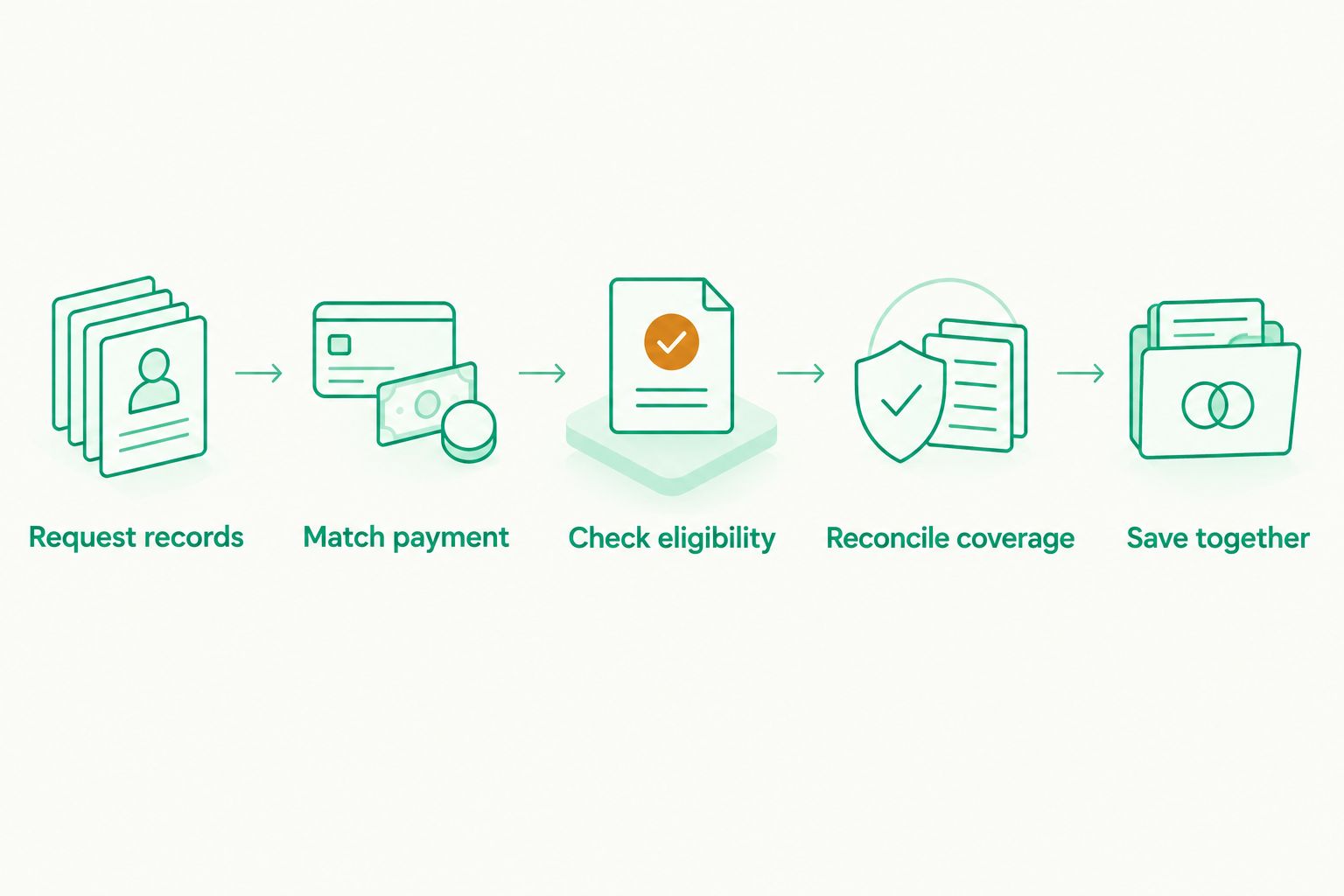
Use this process for an expense you want to reimburse in 2026. Start with the business that supplied the care or item, then fill any gaps with supporting records.
Request records
Ask the provider, pharmacy, retailer, or billing office for a duplicate itemized receipt or account statement. Give enough information to locate the transaction, such as your name, approximate service date, and payment method.
Request the item or service description, patient or purchaser information where applicable, date, amount, and payment status. A statement showing only an outstanding balance does not prove you paid it. If the office can provide a paid invoice or payment history, save that too.
Match payment
Compare the replacement record with your bank statement, credit-card transaction, canceled check, or provider payment history. Make sure the payment belongs to the expense you intend to reimburse.
The payment date and medical-service date can differ. Keep both rather than substituting one for the other, because the service date helps establish when the expense was incurred. A card charge identifies a payment; it does not necessarily identify the underlying treatment.
Check eligibility
Confirm that the expense qualifies under HSA rules and occurred after your HSA was established. IRS Publication 502 explains medical-expense categories, while Publication 969 explains HSA-specific requirements and exceptions.
Do not assume that a doctor's letter turns a general-health purchase into qualified medical care. The purpose and circumstances of the expense still matter. If the record simply says supplies or membership, request a more useful description rather than filling in the missing detail yourself.
Reconcile coverage
Check the insurer's final explanation of benefits and any reimbursement from another account or source. Your reimbursable amount must exclude amounts already covered elsewhere.
If a receipt includes both eligible and ineligible purchases, identify the qualifying portion before withdrawing money. Follow the same approach when separating qualified medical expenses on mixed bills. Saving the whole receipt does not make the whole total reimbursable.
Save together
Store the replacement receipt, payment evidence, insurance records, and reimbursement history together. Mark whether the expense remains unreimbursed, partly reimbursed, or fully reimbursed.
Keep the documents themselves, not just a note saying you once checked them. A ledger entry helps organize evidence; it does not replace evidence that has gone missing.
Why lost-receipt documentation varies
The records you need depend on what is missing from the transaction history. A detailed pharmacy receipt and a hospital balance notice leave different questions unanswered.
- Item or service detail: A merchant name does not identify the treatment or product. An itemized record supplies that missing context.
- Timing: You need to establish that the expense occurred after the HSA was established, not merely that you paid the bill afterward.
- Insurance adjustments: An initial bill can differ from the final patient responsibility after insurance processes the claim.
- Mixed purchases: A single transaction can include qualified medical expenses and purchases that do not qualify.
- Prior reimbursement or deduction: Otherwise eligible care cannot support another tax-free reimbursement if the same expense was reimbursed elsewhere or deducted.
- Medical purpose: Some expenses require evidence connecting the purchase to medical care rather than general health.
In 2026, the useful question is not whether a document looks official. It is whether your combined records establish the facts required for your expense.
What if you have an explanation of benefits but no receipt?
An explanation of benefits helps establish insurance processing, not payment. Pair it with a provider's itemized record and evidence showing what you actually paid.
For example, a dental explanation of benefits can show the treatment and the amount assigned to you. A provider payment history can then show that you settled that balance. Keep both if neither document tells the full story alone.
Do not treat an insurer's patient-responsibility figure as proof that the balance left your pocket. A later adjustment, refund, or payment from another source changes the amount you need to reconcile.
Can you use a bank statement instead of an HSA receipt?
A bank statement alone generally does not establish that an expense qualifies. It can support payment, but a charge from a pharmacy or medical office does not explain every item or service included.
Use the statement to help locate the transaction with the seller. Then attach the itemized replacement record to the statement or payment confirmation.
A handwritten explanation is useful context, but it does not turn a merchant total into independent evidence of medical care. If you cannot recover enough detail, do not assume the withdrawal is tax-free simply because the merchant usually sells healthcare services.
Is there a deadline to recover the receipt and reimburse yourself?
There is no IRS time limit for HSA reimbursement of an otherwise qualified expense incurred after the HSA was established. IRS guidance permits delayed reimbursement when you maintain the required records and satisfy the other conditions.
An expense incurred in 2026 does not have to be reimbursed in 2026. That flexibility gives you time to request replacement records instead of rushing an unsupported withdrawal. It does not make expenses from before HSA establishment eligible.
FSA rules are different. An FSA has plan-specific coverage periods and claim-submission deadlines; do not apply HSA reimbursement timing to an FSA claim.
What happens if you already withdrew the money?
First, try to recover the records. A lost receipt does not automatically mean the expense was nonqualified, but you still need to substantiate the withdrawal's treatment.
If you cannot support the distribution as qualified, discuss the withdrawal with your tax advisor before filing. Form 8889 reports HSA distributions and calculates the taxable portion and any applicable additional tax.
Under IRS Publication 969, distributions not used for qualified medical expenses generally enter taxable income and face an additional 20% tax. The additional tax does not apply after age 65, or in the specified disability or death circumstances, but a nonqualified distribution can still be taxable income.
Ask your custodian and tax advisor whether any correction procedure applies to your facts. Do not assume that transferring money back into the account automatically reverses the distribution or fixes its reporting.
How should you track the recovered expense?
Record enough information to distinguish the expense from every other bill. Include the patient, provider or seller, service or purchase date, payment date, qualified amount, document location, and reimbursement status.
Separate what you paid from what remains eligible for reimbursement. Insurance payments, refunds, prior HSA withdrawals, and other reimbursements belong in the reconciliation—not in a note you will have to interpret later.
Reimbursable is best for HSA holders who want unlimited free manual receipt tracking. Premium adds AI receipt scanning, bank sync, and email forwarding to reduce receipt administration; those features are not requirements for tax-free reimbursement.
Spreadsheets, digital folders, paper files, and HSA-provider receipt tools are legitimate alternatives. A spreadsheet requires you to maintain the entries and document locations yourself; paper files require physical organization. Whatever system you choose, it must preserve readable evidence and prevent the same expense from being reimbursed twice.
Automation also has limits. A scanned receipt or matched transaction still needs an eligibility check, and imported payment data does not establish medical purpose on its own. Choose automation when it reduces work you actually face, not because it appears necessary for IRS compliance.
Start organizing your HSA records
Keep receipts and reimbursement history together with unlimited free manual tracking.
FAQ
Can I reimburse myself from my HSA if I lost the original receipt?
Yes, if replacement or other supporting records substantiate the qualified expense and its payment. You must also establish that it occurred after HSA establishment and was not reimbursed elsewhere or deducted.
Is a credit-card statement enough for HSA reimbursement?
A credit-card statement alone generally does not establish a qualified medical expense. Pair the payment record with itemized documentation identifying the purchase or care.
Can an explanation of benefits replace a paid receipt?
An explanation of benefits does not prove you paid the patient balance. Combine it with a provider payment record and itemized service information where needed.
Do I have to upload receipts to the IRS with my tax return?
You do not submit HSA expense receipts with your tax return, according to IRS Publication 969. Keep the records with your tax documents so you can substantiate the distributions if needed.
Can I reimburse a medical bill from before I opened my HSA?
An expense incurred before your HSA was established does not qualify for tax-free HSA reimbursement. Paying that older bill after establishing the account does not change when the expense was incurred.
Does a doctor's letter make any health purchase HSA eligible?
A doctor's letter does not automatically make a general-health expense HSA eligible. The expense must meet the applicable medical-care requirements, and supporting documentation must reflect its actual purpose.
Does Reimbursable make receipt scanning necessary for reimbursement?
Reimbursable receipt scanning is optional, not a condition of tax-free HSA reimbursement. Manual tracking, spreadsheets, folders, paper records, and HSA-provider tools can also organize your supporting evidence.
One last thing
A recovered receipt is not permission to reimburse the expense twice. Before making a withdrawal, check whether an HSA debit card already paid the bill, another account reimbursed it, or you previously claimed it as an itemized deduction.
Mark the recovered record as a replacement and attach it to the existing expense entry. Creating a new entry without checking the old one can turn a successful record recovery into a duplicate reimbursement.
For 2026 decisions, consult IRS Publication 969 for HSA recordkeeping and distribution rules, Publication 502 for medical-expense categories, and Form 8889 instructions for reporting. Not tax advice; consult your tax advisor.