
Yes, you can use your HSA to pay your spouse’s qualified medical bills, even if your spouse has different insurance or you have self-only health coverage. The expense must be incurred after your HSA was established, and you cannot reimburse an amount already covered by insurance, another account, or a tax deduction.
- Can I use my HSA for my spouse? Yes—qualified medical expenses qualify even with separate insurance.
- Self-only HSA coverage does not prevent you from paying your spouse’s eligible medical bills.
- Reimbursable supports HSA receipt tracking; eligibility still depends on IRS rules, timing, and avoiding duplicate reimbursement.
- Your spouse’s general-purpose FSA can affect your ability to contribute, even when spending existing HSA funds remains allowed.
Can I use my HSA for my spouse?
Yes. Your spouse does not need an HSA or coverage under your health plan for you to pay their qualified medical expenses from your HSA. IRS Publication 969 identifies a spouse’s qualified medical expenses as eligible for tax-free HSA distributions.
For your 2026 records, separate two questions: whether you can contribute new money and whether you can spend money already in the account. They follow different rules.
| Your situation | Can your HSA pay your spouse’s qualified bill? | Main condition |
|---|---|---|
| You have self-only HSA-qualified coverage | Yes | The bill must satisfy the medical-expense and timing rules |
| Your spouse has a separate employer health plan | Yes | Reimburse only the amount not covered elsewhere |
| Your spouse has their own HSA | Yes | Only one account can reimburse each portion of the bill |
| You no longer qualify to contribute | Yes | Existing HSA funds remain available for qualified expenses |
| Treatment occurred before your HSA was established | No | Paying the invoice later does not change the treatment date |
| Insurance already paid the entire bill | No | You have no remaining expense to reimburse |
If you save bills for later, Reimbursable offers HSA receipt tracking. A tracking tool organizes your evidence; it does not make an otherwise ineligible expense qualify.
Why this matters
Marriage does not create a joint HSA. Each HSA belongs to one individual, but that individual can use it for qualifying expenses incurred by their spouse.
That distinction helps when you and your spouse divide household bills. The person receiving care, the person paying initially, and the HSA owner do not have to be the same person for an otherwise qualified expense.
The practical risk is duplicate reimbursement. If you keep separate accounts and separate receipt folders, the same dental or prescription bill can accidentally enter both reimbursement queues. Choose the account that will reimburse the bill and record that decision.
Does my spouse need to be on my insurance?
No. Your spouse’s insurance arrangement does not determine whether their medical expense qualifies for payment from your HSA.
For example, your spouse can use their employer’s insurance, pay a qualified office-visit copayment, and have that unreimbursed copayment paid from your HSA. Save the itemized receipt and the insurance explanation of benefits when applicable.
Self-only coverage describes the insurance coverage used to determine your HSA contribution limit. It does not restrict HSA distributions to your own medical bills.
The reverse distinction matters, too: paying your spouse’s expenses does not turn self-only coverage into family coverage or increase your contribution limit.
Can my spouse’s FSA affect my HSA?
Yes. A spouse’s general-purpose health FSA generally makes you ineligible to contribute to an HSA if that FSA can reimburse your medical expenses, even if you never submit a claim.
A limited-purpose FSA restricted to permitted benefits, such as dental and vision expenses, generally does not create the same contribution problem. Ask the benefits administrator what the plan covers rather than relying on the account’s nickname.
A contribution restriction does not freeze your existing HSA balance. You can still spend existing funds on qualified medical expenses, including your spouse’s, subject to the normal distribution rules.
For 2026 benefits enrollment, review both spouses’ elections together. An FSA election through one employer can change HSA contribution eligibility through the other employer.
Which of my spouse’s expenses qualify?
Your spouse’s qualifying expenses generally follow the same medical-expense rules as your own. IRS Publication 502 explains medical care categories, while Publication 969 explains their application to HSA distributions and relevant exceptions.
Common categories include:
- Medical treatment: Eligible office visits, diagnostic services, and treatment expenses not paid by insurance.
- Dental care: Qualifying treatment such as examinations, fillings, and other eligible dental services; purely cosmetic procedures generally do not qualify.
- Vision care: Qualifying eye examinations, prescription glasses, and contact lenses.
- Medicines: Prescription medicines and eligible over-the-counter medicines under HSA rules.
Do not assume every health-related purchase qualifies. General-health vitamins, ordinary wellness spending, and cosmetic services require a different analysis from medical treatment.
A doctor’s letter does not automatically turn a general-health purchase into a qualified expense. The underlying medical purpose and the applicable IRS rules still control.
Insurance premiums also have separate restrictions. Most health insurance premiums are not HSA-qualified, although specific statutory exceptions exist. Do not treat an insurance premium like a routine medical copayment.
How do I reimburse my spouse’s medical bill?
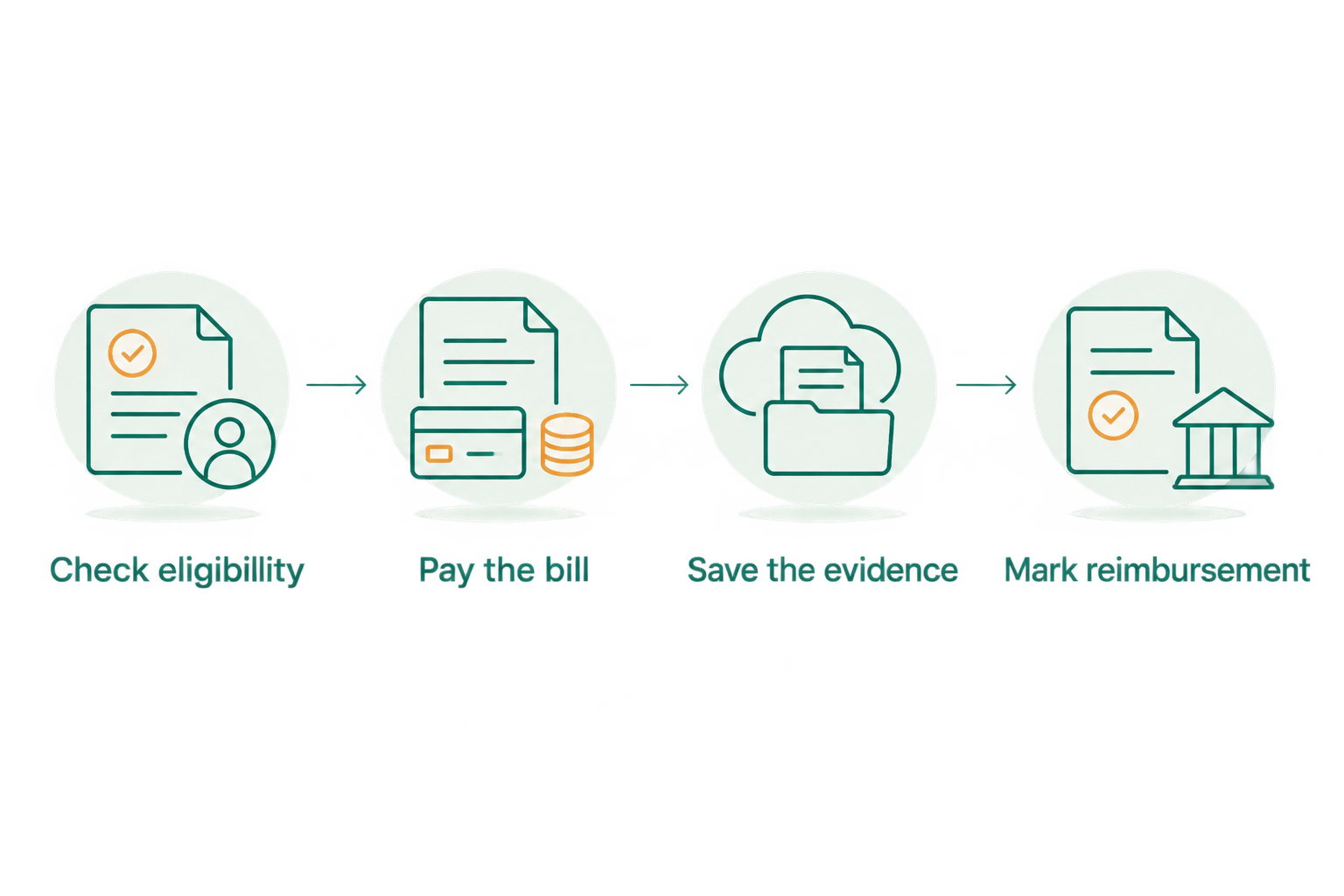
Use the same process whether you reimburse promptly or save the receipt for a later year. The important part is connecting an eligible expense to a documented, unreimbursed amount.
Check eligibility
Confirm that the bill is for qualified medical care for your spouse. Check the date the care occurred against the date your HSA was established—not simply the date you received the invoice.
For ongoing treatment or bills covering multiple services, review the individual service dates. A later payment plan does not move earlier care into the eligible period.
Pay the bill
You can pay an eligible bill directly from your HSA or pay out of pocket and reimburse yourself later. If insurance is processing the claim, establish your final responsibility before deciding how much to reimburse.
A payment confirmation alone does not explain what medical care you purchased. Keep the underlying itemized bill as well.
Save the evidence
Save the patient’s name, provider, service date, description of the care, amount, and proof of payment. Include the explanation of benefits when it helps establish the portion insurance did not cover.
An explanation of benefits is not necessarily proof that you paid. Keep documents that establish both the qualified expense and the payment.
Mark reimbursement
Record which account paid or reimbursed the expense, the distribution date, and any unreimbursed balance. If you reimburse only part of a bill, leave a clear record of the remainder.
Before either spouse requests another reimbursement, check this record. The same expense cannot be reimbursed from both HSAs or from an HSA and an FSA.
Why your spouse’s reimbursement eligibility varies
The relationship alone does not make every bill eligible. These factors determine whether a particular payment qualifies:
- Medical purpose: The expense must meet the applicable medical-care rules, not simply support general well-being.
- HSA establishment date: Care must occur after the HSA was established. Keep evidence of that date with your permanent account records.
- Insurance payment: Reimburse only your eligible out-of-pocket responsibility after insurance payments and adjustments.
- Other reimbursement: Amounts paid by another HSA, FSA, employer arrangement, or other source cannot be reimbursed again.
- Tax treatment: You cannot also claim an itemized medical deduction for an expense paid or reimbursed tax-free from your HSA.
If your spouse receives a provider refund or additional insurance payment after reimbursement, reconcile the record rather than leaving the original amount marked as fully eligible. Ask your HSA custodian or tax advisor how to correct the distribution.
Can I reimburse my spouse’s bill years later?
Yes. There is no federal deadline for reimbursing a qualified expense from your HSA, provided the expense occurred after the HSA was established and you retain the required records.
A qualified expense paid in 2026 does not have to be reimbursed in 2026. Save proof that it was eligible, paid, and not reimbursed elsewhere or claimed as an itemized deduction.
This is different from a health FSA. FSA expenses and claims are subject to plan-year and claim-submission rules, with any permitted carryover or grace period determined by the plan. Do not apply an FSA deadline to an HSA receipt.
Delaying reimbursement is optional. It also means keeping reliable records longer; investment growth is not guaranteed, and you do not need to delay reimbursement to use an HSA correctly.
What happens if I pay an ineligible bill?
An HSA distribution used for a nonqualified expense is generally included in taxable income. Before age 65 years, it generally also carries a 20% additional tax, unless an exception applies.
At age 65, the age-based exception removes that additional tax, but a nonqualified distribution generally remains taxable. Age does not turn ordinary household spending into qualified medical care.
The itemized medical deduction is a separate rule: generally, only qualifying unreimbursed medical expenses above 7.5% of adjusted gross income are deductible when you itemize. That threshold is not a minimum you must reach before taking a qualified HSA reimbursement.
For your 2026 return, reconcile HSA distributions using Form 8889 and its instructions. Keep supporting receipts in your records rather than assuming the account statement proves medical eligibility.
What is the simplest way to track both spouses’ receipts?
Reimbursable is best for HSA holders who want a dedicated receipt tracker. Free manual tracking is unlimited; Premium adds AI receipt scanning, bank sync, and email forwarding to reduce receipt administration.
Automation is optional. It does not replace reviewing medical eligibility or checking whether your spouse already submitted the bill elsewhere.
| Tracking option | Best for | Practical benefit | Limitation |
|---|---|---|---|
| Spreadsheet plus digital folders | Couples comfortable updating records manually | You control the fields and filing structure | You must maintain receipt links and reimbursement status |
| Paper receipt folder | Households that prefer physical records | No app is required | Receipts need protection from loss and fading |
| HSA-provider receipt tool | People who prefer their existing account workflow | Keeps records within the provider’s available tools | Features and export options vary by provider |
| Reimbursable | HSA holders wanting dedicated receipt tracking | Unlimited free manual tracking; optional Premium automation | Automation does not establish tax eligibility |
Whichever method you choose, use consistent patient names and reimbursement labels. A folder full of receipts is less useful if neither spouse knows which bills have already been claimed.
FAQ
Can I use my HSA for my spouse if we file taxes separately?
Yes. Filing separately does not by itself prevent you from using your HSA for your spouse’s qualified medical expenses. The expense must still meet the timing, eligibility, and no-double-reimbursement rules.
Can I use my HSA for my spouse if I have self-only coverage?
Yes. Self-only coverage does not limit qualified HSA distributions to your own medical expenses. It affects contribution limits, not whether your spouse’s qualified bills can be paid.
Can both spouses reimburse the same medical bill?
No. Both spouses cannot reimburse the same portion of a medical bill. You can divide an eligible expense between accounts only if the records show that each portion was reimbursed once.
Can I use my HSA for my unmarried partner?
Not automatically. An unmarried partner is not a spouse under HSA rules, although expenses can qualify if the partner meets the applicable dependent rules. Ask your tax advisor before treating a partner’s bill as eligible.
Can I reimburse my spouse’s medical care from before I opened my HSA?
No. Care received before your HSA was established does not qualify for tax-free reimbursement from that HSA. A later invoice or payment date does not change when the care occurred.
Do I have to reimburse my spouse’s bill in the same year?
No. HSA rules impose no federal reimbursement deadline for an otherwise qualified expense incurred after the account was established. Retain evidence that the expense was paid and was not reimbursed elsewhere or deducted.
One last thing
Label the receipt with the patient’s name before filing it. When both spouses use the same provider or pharmacy, a merchant name and payment amount alone do not tell you whose care the receipt documents.
For 2026 guidance, use IRS Publication 969 for HSA distribution rules, Publication 502 for medical-expense categories, and the Form 8889 instructions for reporting. Not tax advice; always consult your tax advisor.