An Apple Watch bought for general fitness or wellness does not become HSA- or FSA-eligible just because you obtain a letter of medical necessity. If you want reimbursement for a specific medical use, a clinician’s explanation can support your records, but the expense must independently meet the IRS definition of medical care. A letter supports the medical-purpose argument; it does not guarantee eligibility.
- A letter of medical necessity for Apple Watch does not automatically establish HSA or FSA eligibility.
- General fitness and wellness use is not enough; document the specific medical purpose.
- HSA reimbursement requires an expense after account establishment, with no duplicate reimbursement or deduction.
- Reimbursable supports HSA receipt tracking; saving a receipt does not establish eligibility.
Does an Apple Watch need a letter of medical necessity?
For general-health use, a letter does not solve the eligibility problem. For a claimed medical use, ask your clinician to document the purpose and ask your tax advisor whether the actual expense qualifies. If you have an FSA, also ask the plan administrator what documentation and substantiation the plan requires.
The governing distinction is medical care versus general health—not whether the device has health-related features. IRS Publication 502 explains the medical-expense standard, while Publication 969 covers HSA and health FSA rules. Neither a seller’s description nor payment-card acceptance replaces that analysis.
For your 2026 purchase decision, separate these situations:
| Purchase purpose | What a letter establishes | Practical next move |
|---|---|---|
| Tracking workouts or everyday activity | A recommendation alone does not turn general fitness into medical care | Treat the watch as a personal expense |
| General reassurance about health | A health-related purpose alone does not establish qualification | Do not assume reimbursement is tax-free |
| A clinician-directed use connected to a medical condition | The letter can explain the medical connection, but does not settle eligibility | Obtain individualized tax guidance and supporting records |
| An FSA claim involving a stated medical purpose | The letter supplies evidence for the administrator to review | Ask about documentation before submitting the claim |
For broader context, read the guide to HSA-eligible wearables and fitness trackers. Keep the distinction clear: a product category is not blanket approval for every purchase within it.
Why this matters
A watch receipt proves a purchase. It does not prove that the purchase qualifies as medical care, and neither does a clinician’s signature by itself.
That distinction matters when you pay out of pocket and save receipts for later HSA reimbursement. You need evidence of eligibility as well as evidence of payment. Waiting to reimburse yourself does not strengthen an unsupported claim.
Before treating a 2026 Apple Watch purchase as an HSA expense, resolve the medical-purpose question—not just the paperwork question. If the basis remains unclear, keep the expense outside your eligible reimbursement total while you seek advice.
What should a letter of medical necessity explain?
A useful letter describes the actual clinical reasoning. It should not merely repeat that exercise is healthy or that a watch can collect health-related information.
Ask your treating clinician to explain, where applicable:
- The condition: Identify the disease or medical condition involved.
- The medical purpose: Explain how the recommended use relates to diagnosis, treatment, mitigation, or prevention of disease.
- The device connection: Explain why the watch is relevant to the care recommendation rather than general convenience.
- The intended use: Describe what you are expected to do with the device as part of that care.
- The relevant timing: Identify when the recommendation applies and any follow-up the clinician considers appropriate.
This is a practical documentation checklist, not an IRS-mandated Apple Watch letter template. Your clinician should document the facts accurately, and your FSA administrator can specify any plan-required form.
For example, a recommendation to become more active describes a general-health goal. A documented use connected to treatment of a specific condition provides more relevant evidence, but that connection still does not automatically make the entire watch purchase deductible or reimbursable.
Do not ask for stronger wording than the medical facts support. The question is whether the expense qualifies, not whether the letter sounds persuasive.
What should you do before requesting reimbursement?
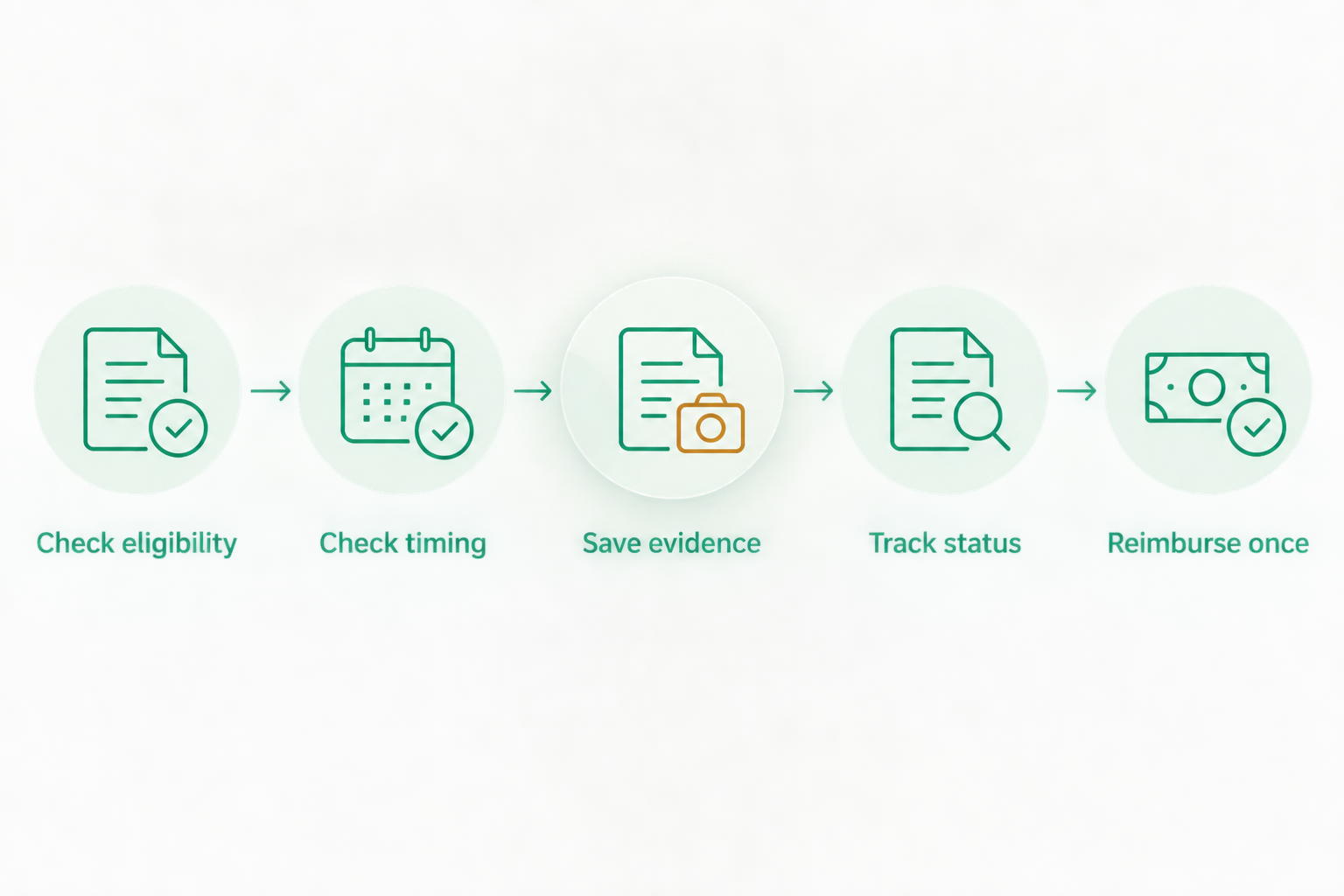
Use this sequence for a 2026 purchase. It keeps eligibility review separate from receipt storage and payment.
- Check eligibility. Discuss the medical purpose with your clinician and the tax treatment with your tax advisor. For an FSA, ask the administrator about the claim requirements.
- Check timing. Confirm that an HSA expense occurred after your HSA was established. For an FSA, check the coverage period and submission deadline instead.
- Save evidence. Keep the itemized receipt, payment evidence, clinician documentation, and relevant claim correspondence together.
- Track status. Record whether eligibility is unresolved, reimbursement is pending, or reimbursement is complete. Keep unresolved expenses out of your eligible total.
- Reimburse once. Confirm that insurance, an FSA, or another source has not already reimbursed the same expense and that you have not claimed it as an itemized deduction.
Paying with an ordinary credit card does not itself disqualify an otherwise qualified HSA expense. Conversely, paying with an HSA card does not establish eligibility. The tax treatment follows the expense and its circumstances, not the payment method.
Why Apple Watch eligibility decisions differ
An Apple Watch is not automatically a medical expense because someone uses it while managing their health. These factors explain why the answer depends on the underlying facts:
- Primary purpose: General fitness, convenience, and everyday wellness differ from medical care under the IRS standard.
- Clinical connection: A documented relationship to a specific medical condition supplies different evidence from a broad recommendation to exercise.
- Actual use: Your records should accurately reflect how the purchase relates to the stated care purpose.
- Account type: HSA recordkeeping and FSA claim administration follow different procedures and timing rules.
- Other reimbursement: An otherwise qualified expense cannot support duplicate tax-free reimbursement or an additional medical-expense deduction.
A diagnosis alone does not establish that everything purchased afterward qualifies. Likewise, a letter does not automatically convert a general-health item into medical care.
For a 2026 claim, ask for an explanation tied to your circumstances rather than relying on someone else’s reimbursement result. Another person’s accepted claim is not an IRS determination about your purchase.
What records should you save for a possible HSA claim?
Keep 5 record types together: the itemized receipt, proof of payment, medical-purpose documentation, account-timing evidence, and reimbursement history. Each answers a different question.
The receipt identifies what you bought. Payment evidence shows what you paid, while medical documentation explains the claimed connection to care. Account records establish timing, and reimbursement history helps prevent a duplicate claim.
Compare 2 dates before adding the expense to your HSA reimbursement ledger: the expense date and the date your HSA was established. An expense incurred before establishment does not become qualified merely because you reimburse yourself later.
For each 1 expense, maintain a single reimbursement status. If insurance or another source later pays part of it, update the amount you are treating as unreimbursed.
Keep the original records rather than relying only on a spreadsheet description or a bank transaction. A merchant name and transaction amount generally do not explain the item purchased or its medical purpose.
Which receipt-storage method should you use?
Choose the method you will maintain and can retrieve later. No storage method makes an ineligible expense eligible.
| Method | Best for | Benefit | Limitation |
|---|---|---|---|
| Spreadsheet and digital folders | People comfortable maintaining their own system | You control the fields and file organization | You must connect documents and update statuses manually |
| Paper receipts and a written log | People who prefer physical records | No dedicated software is necessary | Paper can fade or become separated from supporting documents |
| HSA-provider receipt tools | People who prefer account-linked records | Records can sit alongside account activity where the provider supports that function | Features vary; check retrieval and export options |
| Reimbursable HSA receipt tracking | People who want an app to organize reimbursement records | Unlimited free manual tracking; Premium offers receipt scanning, bank sync, and email forwarding | Tracking and automation do not determine tax eligibility |
Reimbursable is best for HSA holders who want an app to organize receipts for later reimbursement. Premium addresses receipt administration; it is not necessary to obtain tax-free reimbursement. Spreadsheets, folders, paper records, and provider tools remain legitimate alternatives.
Can I reimburse myself years after buying an Apple Watch?
An otherwise qualified HSA expense has no IRS reimbursement deadline, provided it occurred after the HSA was established and meets the applicable requirements. The delay does not remove the need for supporting records or cure an ineligible purchase.
For an expense incurred in 2026, retain evidence of qualification, payment, and reimbursement status until those records are no longer needed to support the later distribution. Do not assume that the passage of time makes a questionable watch purchase acceptable.
This timing rule is specific to HSAs. Health FSAs have plan-year rules and claim-submission deadlines; check your plan documents rather than applying the HSA rule.
Does a prescription make an Apple Watch HSA-eligible?
A prescription does not automatically make an Apple Watch HSA-eligible. It can document a clinician’s recommendation, but the actual expense still must meet the medical-care standard.
Ask what medical purpose the prescription supports and whether the proposed reimbursement is justified under your facts. Do not treat a prescription, diagnosis, or letter as a substitute for that analysis.
Does FSA approval settle the HSA tax question?
FSA approval does not establish that every similar Apple Watch purchase qualifies for HSA reimbursement. An administrator reviews the submitted claim under the plan’s process; your own purchase still requires a supportable medical basis.
Keep any approval and the documents submitted with it. Those records explain the claim history, but they are not blanket approval for other devices, other buyers, or future purchases.
FAQ
Do I always need a letter of medical necessity for Apple Watch reimbursement?
A letter is not a universal route to Apple Watch reimbursement. For a claimed medical use, ask your clinician for supporting documentation, your tax advisor about qualification, and your FSA administrator about any plan-required letter.
Can I use my HSA to buy an Apple Watch for fitness?
General fitness use does not make an Apple Watch a qualified HSA medical expense. Health-related features and activity tracking do not, by themselves, establish a qualifying medical purpose.
Will a doctor's note guarantee that my Apple Watch qualifies?
A doctor's note does not guarantee that an Apple Watch qualifies. The expense must independently meet the medical-care standard; a general recommendation to improve health is not enough.
Can I pay out of pocket and decide about HSA reimbursement later?
You can defer reimbursement of an otherwise qualified HSA expense, but you should resolve eligibility before treating the purchase as reimbursable. Save the receipt and supporting documents, and keep uncertain expenses outside your eligible total.
Can I reimburse a watch bought before I opened my HSA?
An expense incurred before your HSA was established does not qualify for later tax-free HSA reimbursement. A later medical letter or reimbursement request does not change the expense date.
Does my FSA have the same reimbursement deadline as my HSA?
An FSA does not follow the HSA's no-IRS-reimbursement-deadline rule. Check your FSA's coverage period, claim deadline, and any applicable carryover or grace-period provisions.
Can Reimbursable approve my Apple Watch as HSA-eligible?
Reimbursable's receipt tracking does not establish IRS eligibility or replace an FSA administrator's review. Use your clinician's documentation and individualized tax advice to assess a disputed medical-purpose expense.
One last thing
The most useful receipt-tracking status for an uncertain purchase is “not yet eligible,” not “ready to reimburse.” Saving the documents now preserves your evidence without committing you to a tax position.
For your 2026 records, identify unresolved purchases clearly and exclude them from the amount you plan to withdraw tax-free. IRS Publication 502 supplies the general medical-expense framework; Publication 969 explains HSA and health FSA treatment. Consult the applicable IRS guidance and your plan documents before acting.
Not tax advice; consult your tax advisor.