
Fees reduce your HSA investment calculator results by lowering the amount that stays invested and earns future returns. For a useful 2026 projection, subtract costs the calculator excludes, keep account charges separate from fund expenses, and check whether its return assumption already includes either.
- HSA investment calculator fees belong in the projection, but subtracting an expense twice understates your result.
- Fund expenses reduce investment returns; account charges reduce the balance or your outside cash, depending on payment.
- Reimbursable supports HSA receipt tracking, not a substitute for your provider’s investment fee disclosures.
- Compare identical contributions, withdrawals, investment assumptions, and time horizons before judging fees.
How do fees change your HSA investment calculator results?
Fees lower the projected balance through both direct charges and lost future growth on those charges. A calculator that ignores costs overstates what remains under its stated assumptions; one that subtracts costs already included in returns understates it.
Start with the assumptions in your HSA investment calculator. Check what its return field means before changing it. A label such as annual return does not, by itself, tell you whether fund expenses or account charges are included.
| Cost or constraint | How it affects your projection | Best modeling approach | Main limitation |
|---|---|---|---|
| Fund expense ratio | Reduces the fund’s investment return | Use a return assumption with consistent expense treatment | Subtracting it from an already net return counts it twice |
| Fixed account charge | Removes a stated amount from the account if charged there | Deduct it on the provider’s actual schedule | A fixed charge is not equivalent to a constant percentage across changing balances |
| Balance-based account charge | Changes with the balance subject to the charge | Apply it to the balance defined in the agreement | Applying it to the wrong balance distorts the cost |
| Required cash balance | Leaves part of the HSA outside the investment allocation | Model cash and investments separately | Treating all HSA money as invested overstates investment exposure |
A required cash balance is not itself a fee. It belongs in this review because a calculator can misstate results even when every explicit charge is entered correctly.
Why this matters
An HSA projection helps you compare choices, not predict a guaranteed ending balance. If you pay medical bills out of pocket and leave HSA money invested, the distinction between gross returns and returns after costs matters throughout the holding period.
For your 2026 comparison, hold everything except fees constant first. Changing the investment mix, contribution schedule, and fee assumptions together makes it impossible to tell which change caused the different result.
Lower costs also do not remove investment risk. You still need cash for bills, an investment allocation you can tolerate, and records supporting any later qualified reimbursement.
How to enter fees without counting them twice
Use the provider’s current fee schedule, the fund prospectus, and the calculator’s own explanations. Each answers a different question: what the account charges, what the fund deducts, and what the projection assumes.
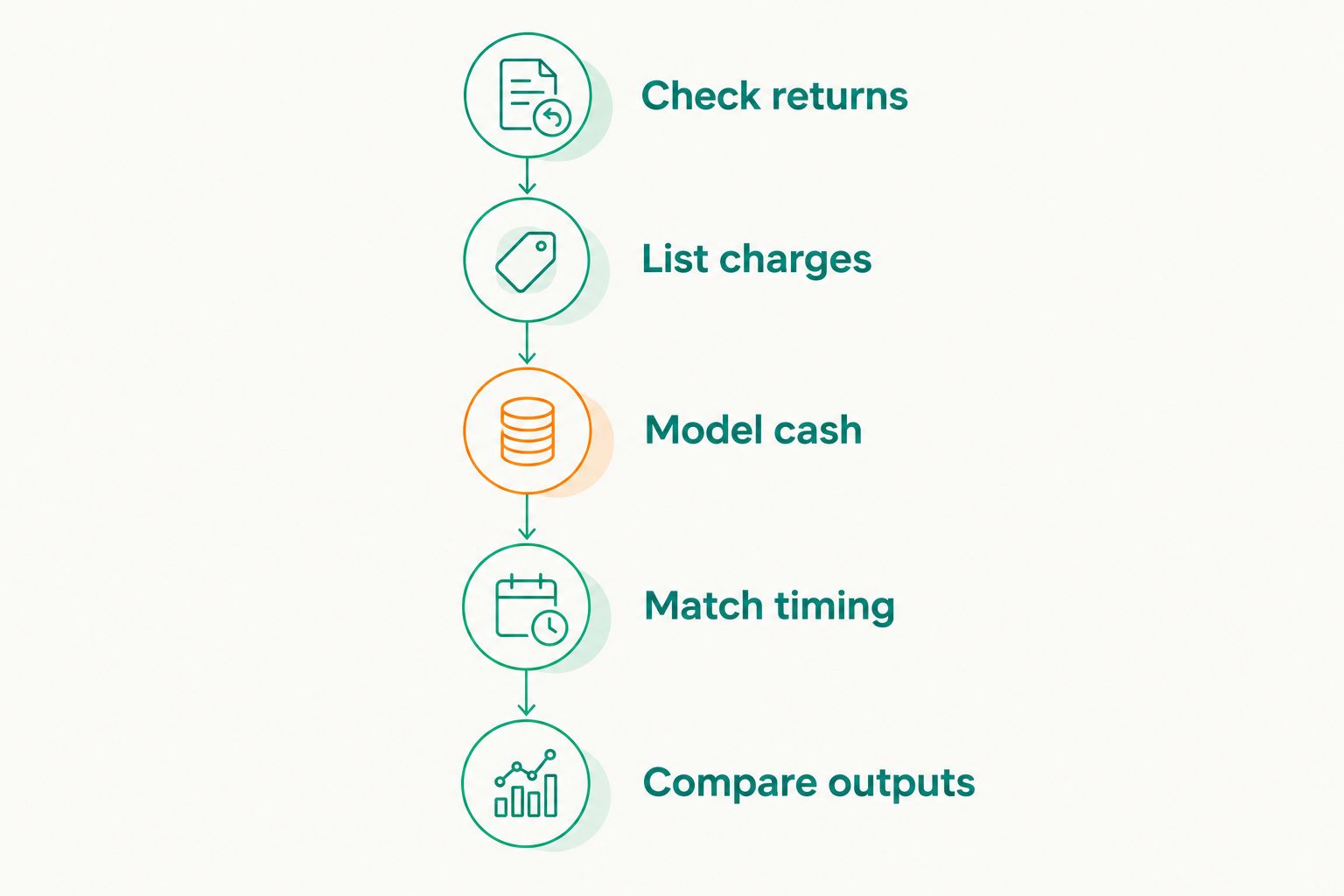
Check returns
Find out whether the return assumption is before or after fund expenses. Published fund performance generally reflects fund operating expenses, but it does not automatically include separate charges imposed by your HSA provider.
A broad market return assumption and a specific fund’s reported performance are not interchangeable inputs. Read the methodology rather than assuming both use the same treatment.
List charges
Separate fixed account charges, balance-based charges, and transaction-related costs that actually apply to your account. Record any waiver conditions alongside them so you do not model a waived charge as unavoidable.
Use your own agreement. A fee schedule for a different account arrangement is not evidence of what your HSA costs.
Model cash
Divide the starting balance into invested money and money held in cash. Apply the relevant return assumption to each portion rather than assigning investment growth to the entire account.
If a charge comes from the cash portion, reflect that deduction there. If it comes from investments, reflect the reduction in invested assets and any transaction mechanics your provider specifies.
Match timing
Apply contributions, withdrawals, and charges on a consistent schedule. A deduction early in the projection removes money from growth sooner than the same deduction at the end.
If the calculator only accepts an annual fee percentage, recognize its limits. A separate spreadsheet can model fixed deductions without pretending they remain the same share of a changing balance.
Compare outputs
Run the same scenario with and without the applicable costs. The difference shows the modeled effect of fees under those assumptions, including the growth those deducted amounts no longer earn.
Keep the assumptions beside the result. An ending balance without its contribution, withdrawal, return, and fee assumptions is difficult to interpret later.
Why the effect of HSA fees varies
The same fee arrangement can affect different projections differently. Review these drivers before comparing results:
- Account balance: A fixed charge consumes a larger share of a smaller balance than of a larger balance.
- Holding period: Money removed for fees no longer participates in subsequent gains or losses.
- Contribution timing: Contributions change the balance available to invest and, where applicable, the balance used to calculate charges.
- Reimbursement timing: A withdrawal reduces invested assets independently of fees. Keep that effect separate.
- Cash allocation: A required or chosen cash reserve changes how much receives the investment return assumption.
- Fee conditions: Waivers, eligible balances, and payment methods determine which disclosed costs actually apply.
For a 2026 planning worksheet, date the fee schedule you used. Update the assumptions when the provider changes its terms rather than treating the original projection as permanent.
Should you subtract the expense ratio from your return assumption?
Subtract fund expenses only when the return assumption excludes them. If the return already reflects those expenses, another deduction counts the same cost twice.
The fund expense ratio is an ongoing fund operating cost reflected in fund assets and performance. It is not necessarily a separate withdrawal you will see on an HSA statement.
Account administration or investment-platform charges are different. A fund’s reported return does not establish whether your particular HSA’s additional charges are included, so check them separately.
Avoid stacking every percentage you find into a single deduction without checking its basis. Different charges can apply to different balances or periods, and a simplified calculator cannot always represent those distinctions.
Is a fixed account charge the same as a percentage fee?
A fixed account charge is not the same as a percentage fee. The fixed amount stays constant under its stated terms, while its share of your balance changes as that balance rises or falls.
For a snapshot, you can divide an annual fixed charge by the balance you are comparing. That gives an effective percentage for that balance, not a permanent rate for the entire projection.
For a longer projection, deduct the fixed amount according to the actual schedule. If you instead use the snapshot percentage every year, the modeled charge changes with the balance even though the real fixed charge does not.
Should you pay HSA fees outside the account?
Paying a fee outside the HSA, when permitted, preserves more money inside the account but still costs you cash. It changes where the cost appears; it does not eliminate it.
If your calculator deducts every fee from the HSA, it will not represent an arrangement where you pay applicable charges separately. Track the outside payment alongside the projection so an apparently larger HSA balance does not hide the cost.
Check the provider’s payment options and the tax treatment with your tax advisor. Do not assume an administrative charge is a qualified medical expense simply because it relates to an HSA.
Keep reimbursement assumptions separate from investment fees
A fee-adjusted balance does not tell you how much you can withdraw tax-free. Qualified reimbursement depends on the underlying expense and your records, not on the calculator’s projected growth.
For your 2026 review, use IRS Publication 969 for HSA distribution and recordkeeping rules and IRS Publication 502 for medical-expense guidance. Publication 502’s discussion of itemized deductions is not interchangeable with every HSA rule; use Publication 969 for the HSA-specific requirements.
Eligible expenses must occur after your HSA was established. They cannot also be reimbursed by insurance or another source, and you cannot both deduct the expense and use it for tax-free HSA reimbursement.
There is no IRS deadline for reimbursing an otherwise eligible HSA expense incurred after the account was established, provided you satisfy the applicable requirements and retain supporting records. That is not an FSA rule: FSA claim deadlines, carryovers, and grace periods follow the plan’s terms and applicable rules.
A doctor’s letter also does not automatically make a general-health expense eligible. Confirm the expense’s medical purpose and applicable requirements before treating its receipt as support for a future qualified withdrawal.
When you model delayed reimbursement, keep two records separate:
- Investment projection: What the account balance would become under stated contributions, returns, costs, and withdrawals.
- Expense ledger: Which documented expenses remain eligible and unreimbursed.
Neither record replaces the other. Investment growth does not create additional medical receipts, and a receipt does not guarantee a particular future investment balance.
Choose a receipt system you will maintain
Reimbursable is best for HSA holders who want a dedicated place to track receipts for later reimbursement. Its free manual tracking is unlimited; Premium adds receipt scanning, bank sync, and email forwarding to reduce receipt administration.
Those features are optional. You do not need a paid app to obtain tax-free reimbursement, and software does not make an ineligible expense qualified.
| Method | Best for | Practical advantage | Trade-off |
|---|---|---|---|
| Reimbursable HSA receipt tracking | People who want dedicated expense tracking | Unlimited free manual tracking, with optional receipt automation | Automation is a Premium feature; you still need to check eligibility |
| Spreadsheet and digital folders | People who want a self-managed record | You choose the fields and filing structure | You maintain entries, document links, and backups |
| Paper receipts and folders | People comfortable with physical records | No app is required | You must protect receipts from loss, damage, and fading |
| HSA-provider receipt tools | People whose provider offers suitable tools | Records can sit within the provider’s account workflow | Features and access arrangements depend on the provider |
Reimbursable’s directory covers 890+ HSA/FSA-eligible items, but a lookup does not replace the requirements for your particular expense. Keep the itemized receipt, proof of payment, insurance adjustments where applicable, and reimbursement status together.
Choose the method you will actually maintain. Consistent records matter more than a particular app or folder structure.
FAQ
Do HSA investment calculators automatically include fees?
Do not assume an HSA investment calculator includes fees. Read its assumptions to identify whether fund expenses, account charges, and cash requirements are represented.
Will subtracting the expense ratio make my projection more accurate?
Subtracting the expense ratio improves accuracy only when the return assumption excludes it. Subtracting it from a return already net of fund expenses counts the cost twice.
Can a required HSA cash balance affect investment results?
A required cash balance changes how much of the HSA receives the investment return assumption. Model cash separately instead of treating the entire account as invested.
Does paying account fees separately make them disappear?
Paying account fees separately does not eliminate the cost. It preserves more money inside the HSA while reducing your outside cash, if your provider permits that payment arrangement.
Do I need a paid receipt app to reimburse myself later?
You do not need a paid receipt app for tax-free HSA reimbursement. Paper records, digital folders, spreadsheets, and suitable provider tools are legitimate alternatives when they preserve the required documentation.
Is there an IRS deadline to reimburse an old HSA expense?
There is no IRS deadline for reimbursing an otherwise eligible expense incurred after your HSA was established. Keep records showing that the expense was qualified, not reimbursed elsewhere, and not also deducted.
Does a doctor’s letter make any health purchase HSA eligible?
A doctor’s letter does not automatically qualify a general-health purchase. The expense must satisfy the applicable medical-expense requirements; consult your tax advisor when eligibility is uncertain.
One last thing
Before comparing providers in 2026, save a copy of each fee schedule beside your calculator inputs. Then ask a separate question: can you still retrieve the receipts supporting your planned reimbursements?
A lower-fee projection is useful only when you understand its assumptions; a tax-free reimbursement needs its own evidence. Keep both records current.
Not tax advice. Always consult your tax advisor.