
Document HSA medical mileage with a dated trip log showing where you went, why the travel was for medical care, and how many qualifying miles you drove. Keep supporting appointment records and receipts for parking or tolls, then record the calculation used for reimbursement. The travel must qualify as medical transportation, occur after your HSA was established, and not be reimbursed elsewhere or claimed as an itemized deduction.
- HSA qualified medical expenses mileage records should connect each trip to eligible care and a documented reimbursement calculation.
- Use the IRS medical mileage rate for the travel year, not the business mileage rate.
- Keep parking and toll receipts separately; exclude personal detours and amounts reimbursed elsewhere.
- Reimbursable suits HSA holders who want receipt tracking alongside a separate medical mileage log.
How do you document mileage for HSA medical expenses?
Keep a trip log, evidence of the medical purpose, and a reimbursement history together. A mileage total alone does not explain which medical appointment required the travel or whether you already reimbursed yourself.
Use your HSA expense ledger to connect transportation with the underlying care. Give the trip its own entry rather than burying it inside the provider's bill.
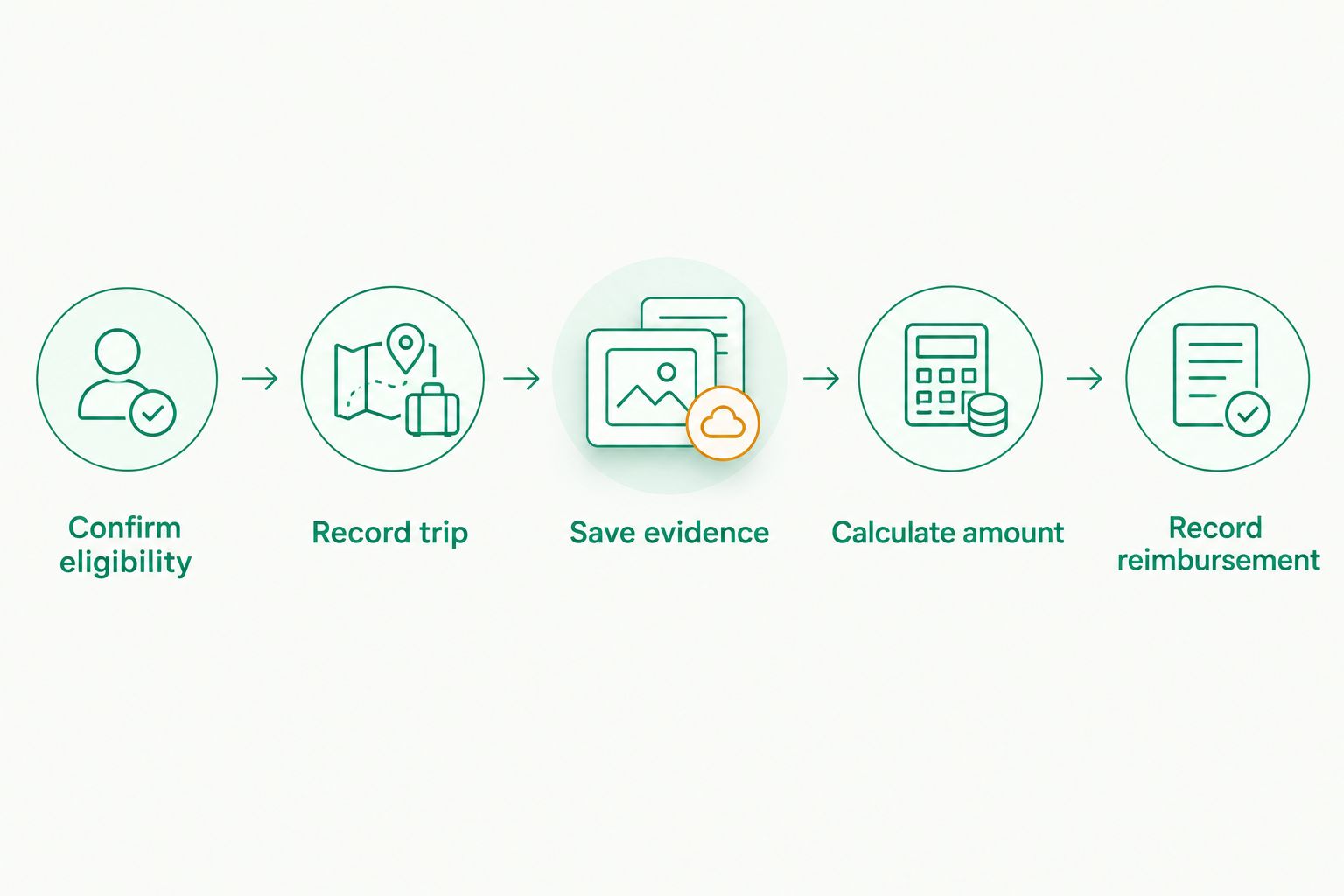
1. Confirm that the trip qualifies
IRS Publication 502 describes qualifying transportation as travel primarily for, and essential to, medical care. A drive to receive qualifying treatment is different from a personal outing that happens to include a health-related purchase.
Check the underlying expense first. Travel does not turn a general-health activity into qualified medical care, and a doctor's letter does not automatically make a general-health expense eligible.
2. Record the trip while the details are fresh
For each trip, record these 6 core fields:
- Travel date: When the medical travel happened.
- Patient: Who received the care.
- Destination: The provider or facility and location.
- Medical purpose: A short description connecting the trip to qualifying care.
- Qualifying miles: The medical portion of the journey.
- Distance evidence: Odometer readings, a saved route, or another reliable basis for the distance.
These fields are a practical recordkeeping recommendation, not a claim that the IRS requires a particular spreadsheet layout. Add notes when a route includes a personal stop or a distance differs from the usual journey.
3. Save evidence of the medical visit
Keep an appointment confirmation, provider statement, explanation of benefits, or other record that supports the visit. Pair that evidence with your trip entry so you can explain both the destination and the reason for traveling.
An appointment reminder supports a planned visit, but it does not establish every other part of the claim. Preserve records showing that the care occurred and keep payment evidence for expenses you plan to reimburse.
4. Calculate and label the transportation amount
Choose a permitted calculation method and document it. For a 2026 trip using the standard medical mileage method, save the applicable 2026 IRS rate with your calculation rather than relying on memory years later.
Record parking and tolls separately. Do not add gasoline to a standard-mileage calculation: that would combine overlapping methods for the same vehicle use.
5. Record reimbursement status
Mark each transportation entry as unreimbursed, partially reimbursed, or fully reimbursed. Record the withdrawal date and amount when you take an HSA distribution.
A saved receipt is not the same as an unreimbursed expense. Your records must also show which eligible amounts remain available for reimbursement.
Why this matters for delayed HSA reimbursement
There is no IRS deadline for reimbursing yourself from an HSA for an otherwise qualified expense incurred after the HSA was established. That flexibility makes durable records essential: a bank withdrawal years later still needs a defensible connection to the original medical expense.
For 2026 travel, preserve the travel-year calculation now. A later reimbursement does not change which year's mileage rate applies to the original trip.
HSA rules are different from health FSA rules. FSAs have plan-specific claim deadlines and coverage-period requirements; do not apply the HSA's delayed-reimbursement rule to an FSA claim.
Which medical transportation calculation should you use?
IRS Publication 502 describes 2 approaches for qualifying use of your car: the standard medical mileage rate or actual qualifying out-of-pocket vehicle expenses. Neither approach makes personal travel eligible.
| Calculation method | Best for | What to retain | Main limitation |
|---|---|---|---|
| Standard medical mileage rate | Drivers who want a distance-based calculation | Qualifying miles, trip purpose, travel date, and applicable IRS rate | Requires reliable mileage records; gasoline is not added separately |
| Actual qualifying vehicle expenses | Drivers who keep detailed gasoline and oil records | Receipts and a reasonable allocation to medical travel | Does not permit every vehicle ownership expense |
Parking fees and tolls connected to qualifying medical travel can be included separately under either approach. Keep those receipts identifiable rather than combining them with unrelated parking charges.
Standard medical mileage: save the rate and the miles
Multiply qualifying miles by the IRS medical mileage rate applicable to the travel date. Save the calculation, including the rate source, alongside the trip entry.
The IRS business mileage rate is not the medical mileage rate. For your 2026 records, label the rate as medical transportation so a later spreadsheet update does not accidentally substitute a different rate.
Actual vehicle expenses: separate use from ownership
Under the actual-expense approach described in Publication 502, qualifying out-of-pocket vehicle expenses include gasoline and oil attributable to medical transportation. General vehicle costs such as depreciation, insurance, maintenance, and repairs are not included as medical transportation expenses.
This method requires more than a fuel receipt. You still need evidence connecting the claimed portion to qualifying medical travel, rather than to commuting or personal errands.
Why your reimbursable mileage amount varies
Your calculation depends on the trip and the evidence, not simply on how far your car traveled that day. Review these factors before marking a transportation entry eligible:
- Medical purpose: The transportation must be primarily for and essential to medical care.
- Qualifying distance: Exclude extra driving for personal errands or unrelated stops.
- Travel-year rate: Use the applicable medical mileage rate for the year of travel, not the reimbursement year.
- Calculation method: Keep a distance-based calculation separate from an actual gasoline-and-oil calculation.
- Separate charges: Track qualifying parking and tolls with their supporting receipts.
- Other reimbursement: Remove amounts paid back by insurance, another benefit account, or another source.
A longer route needs an explanation if the distance is not otherwise clear. Record the reason while you remember it rather than trying to reconstruct the journey when preparing a tax return.
How should you handle a medical trip with personal stops?
Claim the medical transportation, not the extra mileage created by personal plans. Keep a route note showing which part of the drive belongs to the medical visit.
For example, suppose you drive from home to a qualifying appointment, then make a separate shopping detour before returning home. Document the medical route and exclude the additional distance caused by shopping; do not treat the entire day's odometer change as medical mileage.
A pharmacy stop also needs a qualifying medical purpose. Buying general household goods during the same visit does not make the shopping portion a medical expense.
For a complicated itinerary, ask your tax advisor how to allocate the travel before reimbursing yourself. A route screenshot helps establish distance, but it does not decide eligibility.
What should a complete mileage entry look like?
Build each entry so someone unfamiliar with the trip can follow it. Keep the description factual and brief; you do not need to write a detailed medical history into a general-purpose spreadsheet.
| Record component | What your entry should explain |
|---|---|
| Trip identity | Travel date, patient, destination, and medical purpose |
| Distance | Qualifying miles and how you established them |
| Calculation | Selected method, applicable rate or actual-expense allocation |
| Extra transportation charges | Parking and tolls, with receipt references |
| Eligibility check | Expense occurred after HSA establishment and qualifies as medical care |
| Reimbursement history | Amount already reimbursed and eligible balance remaining |
Use a consistent reference name to connect the trip log with supporting documents. A folder name containing the visit date and provider is easier to match than an unexplained scan filename.
Before a reimbursement, check the appointment record, transportation calculation, and payment history together. That final review helps prevent duplicate claims when medical bills and mileage are stored in separate places.
Where should you keep HSA mileage records?
Choose a system you can maintain and retrieve later. Paper records, folders, spreadsheets, HSA-provider receipt tools, and dedicated receipt apps are all legitimate options; none changes the underlying tax requirements.
| Recordkeeping option | Best for | Practical advantage | Limitation to address |
|---|---|---|---|
| Paper log and receipt folder | People who maintain handwritten records consistently | Keeps original documents together | Requires organized storage and protection against loss |
| Spreadsheet and digital folders | People comfortable entering and checking calculations | Lets you define mileage fields and reimbursement status | Requires manual updates and matching files |
| HSA-provider receipt tools | People who prefer their account provider's workflow | Keeps records within the provider's available system | Verify supported fields, exports, and access before relying on it |
| Reimbursable | HSA holders seeking receipt tracking alongside a mileage log | Offers unlimited free manual tracking and optional receipt automation | Does not replace your responsibility to establish eligible travel and accurate mileage |
Reimbursable is best for HSA holders who want receipt tracking alongside a separate medical mileage log. Keep the mileage calculation with the related expense documentation rather than assuming a scanned medical receipt proves the distance traveled.
Reimbursable Premium offers AI receipt scanning, bank sync, and email forwarding to reduce receipt administration. Those features are optional conveniences, not requirements for tax-free reimbursement; a carefully maintained spreadsheet and folder system remains valid.
If manual tracking already works, keep using it. Consider automation when collecting and organizing documents is the part you consistently postpone, not because an app changes what the IRS permits.
How long should you keep medical mileage records?
Keep unreimbursed HSA expense records until you claim reimbursement, then retain the supporting records for the applicable tax-record retention period. IRS Publication 969 explains the need to substantiate qualified distributions; reimbursement does not make the underlying documentation disposable.
Do not discard a 2026 mileage log just because you finished filing that year's return if you still plan to reimburse the travel later. The expense record and the later HSA distribution need to remain connected.
Keep a backup you can access independently of a phone or a single account login. Check that exported records include the underlying documents, not just a list of expense totals.
What if you forgot to record the trip?
Reconstruct the trip from reliable evidence rather than guessing. Start with the visit date, provider location, appointment or billing records, and a saved route or other support for distance.
Label a reconstructed entry honestly and retain the materials used to create it. A calendar entry alone does not prove mileage, and a route estimate alone does not prove that you attended the appointment.
If you cannot substantiate the travel, do not treat an unsupported number as an established qualified expense. Ask your tax advisor what evidence is sufficient for your circumstances.
FAQ
Can I reimburse medical mileage from my HSA?
Yes, transportation primarily for and essential to qualifying medical care can qualify for HSA reimbursement. The expense must occur after your HSA was established and cannot also be reimbursed elsewhere or claimed as an itemized deduction.
Do I need odometer readings for every medical trip?
Odometer readings are useful evidence, but a reliable mileage log supported by route information can also help substantiate distance. Record the date, destination, medical purpose, qualifying miles, and how you determined the distance.
Which mileage rate should I use for a 2026 medical trip?
Use the IRS medical mileage rate applicable to the 2026 travel date, not the business mileage rate. Save the rate source and calculation even if you reimburse yourself in a later year.
Can I claim gasoline and medical mileage for the same drive?
Do not add gasoline expenses to a standard medical mileage calculation for the same drive. Publication 502 describes the mileage method and an alternative based on qualifying actual vehicle expenses.
Can I add parking and tolls to medical mileage?
Yes, qualifying parking fees and tolls can be included separately from the medical mileage calculation. Keep receipts connecting those charges to the medical trip.
Does my spouse need to be on my health insurance for medical mileage to qualify?
HSA-qualified expenses can include eligible medical transportation for your spouse even when your spouse is not covered by your health plan. The transportation must still meet the medical-purpose and other HSA reimbursement rules.
Do I have to use Reimbursable to track medical mileage?
No, Reimbursable is optional; paper logs, spreadsheets, folders, and suitable HSA-provider tools are legitimate alternatives. Whatever system you choose must preserve the trip evidence, calculation, and reimbursement history.
Where can I check the IRS rules for HSA mileage records?
Use IRS Publication 502 for medical transportation rules, Publication 969 for HSA distribution recordkeeping, and IRS standard mileage guidance for the applicable travel-year rate. Check the guidance applicable to your travel and tax circumstances.
One last thing
Preserve the calculation, not just the distance. A mileage log that says where you drove is incomplete as a reimbursement record if you cannot explain the rate, excluded personal travel, and amounts already repaid.
Before archiving a trip, make sure another person could follow the evidence from medical visit to mileage calculation to HSA withdrawal. That is a more useful test than whether your folder looks organized.
Not tax advice. Always consult your tax advisor.