
To get a letter of medical necessity for your HSA, ask the clinician treating your condition to document why a specific expense is needed for medical care rather than general health. The letter supports your records; it does not make an otherwise ineligible purchase tax-free. Before reimbursing yourself in 2026, confirm that the expense occurred after your HSA was established and was not reimbursed elsewhere or deducted on your tax return.
- A letter of medical necessity supports HSA eligibility; it does not override IRS medical-expense rules.
- Ask your treating clinician to connect the specific expense to your diagnosed condition and treatment.
- Keep the letter, itemized receipt, and payment evidence together for later HSA reimbursement.
- Reimbursable suits HSA holders who want eligibility lookups and receipt tracking; you remain responsible for tax eligibility.
Why this matters
Medical need and tax eligibility are separate tests. A clinician can recommend something that benefits your health without making it a qualified HSA expense. That distinction matters especially for purchases with both everyday and medical uses.
For decisions in 2026, use IRS Publication 502 to understand medical-expense categories and exclusions, and Publication 969 for HSA distribution and recordkeeping rules. Publication 502's income-tax deduction threshold does not apply to qualified HSA reimbursements. The general-health versus medical-treatment distinction for vitamins illustrates why the reason for a purchase matters more than a wellness label.
How do you get a letter of medical necessity for your HSA?
Follow these 6 steps before treating a questionable purchase as eligible. You are building evidence for your tax records, not applying for an IRS approval certificate.
1. Identify the exact expense
Write down the item or service, who will use it, and the condition it is intended to treat. Avoid asking whether an entire category, such as fitness or supplements, is eligible without identifying the actual purchase.
Separate medical care from convenience or general wellness. If a purchase contains both medical and nonmedical components, identify those components before discussing reimbursement.
2. Check the underlying eligibility rule
Read the relevant category in Publication 502 and the HSA rules in Publication 969. Some expenses qualify without a special letter; others remain excluded even when a clinician recommends them.
Do not confuse a retailer's payment approval with a tax determination. An HSA card transaction records a payment, but it does not establish that the expense qualifies under federal tax rules.
3. Ask the treating clinician
Contact the clinician who understands your condition and treatment plan. Explain that you need documentation connecting the proposed expense to medical care, rather than a general statement that it would improve your health.
Ask whether the clinician can document that connection based on your actual care. The answer must reflect the clinician's medical judgment, not wording supplied solely to obtain reimbursement.
4. Explain what documentation you need
Tell the office which item or service you are considering and whether an account administrator has requested particular information. If the office uses a form, make sure it describes your situation rather than relying on broad, prefilled wellness language.
For an FSA claim, ask the administrator about its documentation requirements before purchasing. For an HSA distribution, you remain responsible for keeping records that support tax-free treatment.
5. Review the letter for accuracy
Check the patient's name, the expense description, the medical explanation, and the clinician's signature and date. If the letter describes a treatment period, make sure your records identify which purchases fall within it.
Correct factual mistakes before filing the letter away. Do not alter a signed clinical document yourself or ask anyone to backdate it.
6. Save it with the expense record
Keep the letter alongside the itemized receipt and evidence of payment. Record any insurance reimbursement, FSA reimbursement, refund, or previous HSA withdrawal connected to that expense.
The letter explains medical purpose; the receipt explains what you bought. You need both kinds of evidence when the expense's eligibility depends on its medical use.
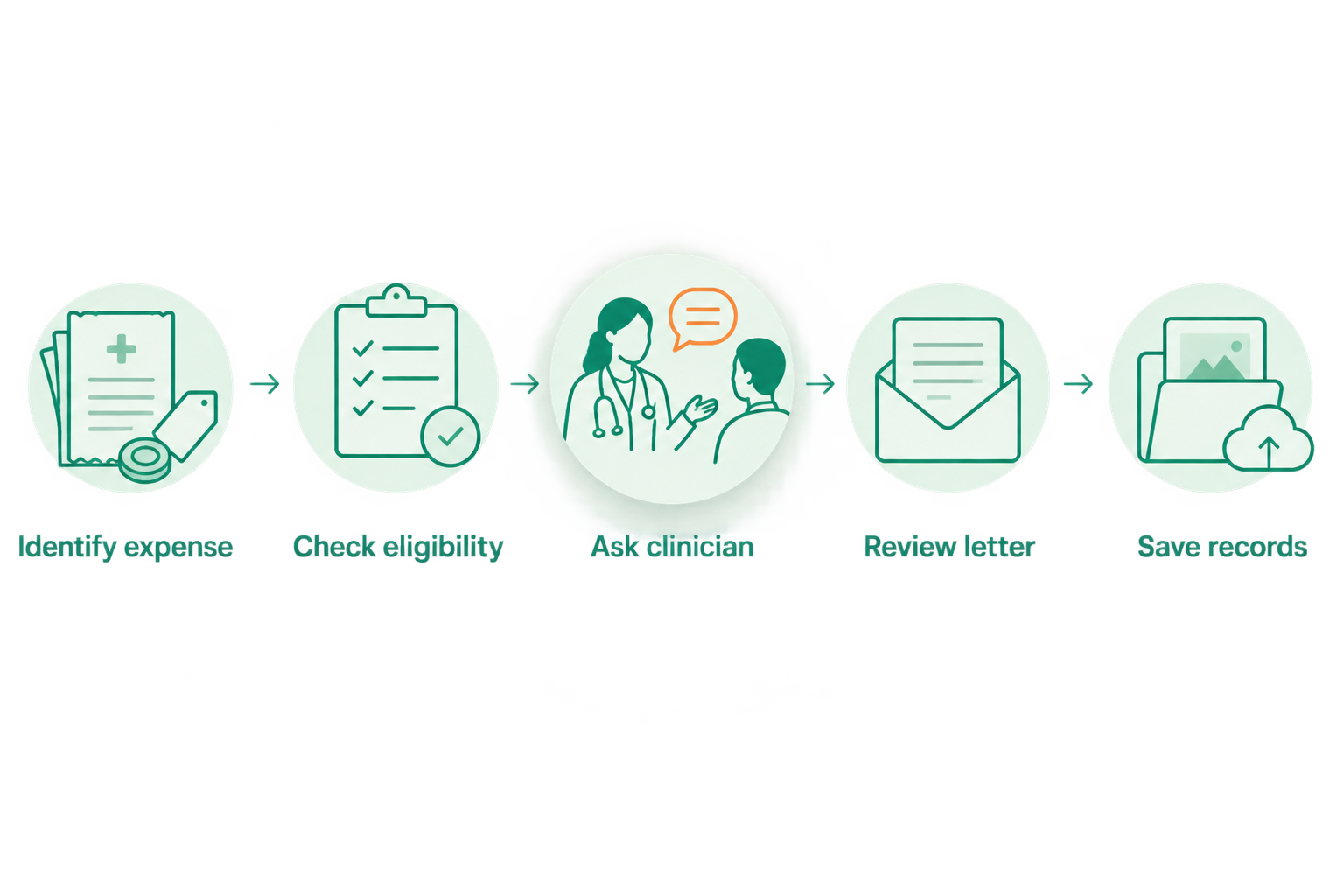
The workflow is straightforward: Identify expense, Check eligibility, Ask clinician, Review letter, Save records. Each step answers a different question before money leaves your HSA.
What should a letter of medical necessity include?
There is no universal IRS letter-of-medical-necessity form that approves every HSA purchase. A useful letter explains the medical connection clearly enough to support the particular expense.
Ask the clinician to address these points where relevant:
- Patient identification: Whose medical care the expense supports.
- Medical condition: The diagnosed condition or treatment need relevant to the expense.
- Specific expense: The item or service being recommended, rather than a broad shopping category.
- Treatment connection: How the expense treats, mitigates, or otherwise addresses the medical condition.
- Treatment period: When the recommendation applies, if duration matters.
- Clinician identification: The clinician's name, professional credentials, signature, and date.
These are practical documentation points, not a promise that every administrator uses an identical checklist. Share sensitive medical information only through an appropriate channel and only with parties that need it.
For example, a letter that merely says exercise is beneficial leaves the tax question unresolved. A more specific explanation describes the diagnosed condition and the prescribed treatment, but you must still apply the IRS rules for that expense.
Why letter requirements vary
The right documentation depends on the expense and the account. In 2026, do not assume that a form accepted for one purchase or one FSA claim establishes eligibility for another.
Five factors shape what you need:
- The expense category: Ordinary medical care and general-health purchases do not follow identical eligibility rules.
- The treatment purpose: A personal-use item needs a clear medical connection when eligibility depends on that use.
- The account type: An FSA administrator reviews claims under the plan; HSA owners retain responsibility for their distributions.
- The treatment period: An ongoing recommendation and a one-time treatment create different documentation questions.
- The reimbursement history: Insurance payments, refunds, and earlier reimbursements change the amount left to reimburse.
There is no universal annual expiration rule for every HSA medical-necessity letter. Follow any applicable plan requirements and obtain updated documentation when the treatment or relevant facts change.
Is a letter different from a prescription or receipt?
Yes. These documents answer different questions, and none replaces the entire expense record. Use the table to identify what each document contributes and what it leaves unresolved.
| Document | Best for | What it supports | Limitation |
|---|---|---|---|
| Letter of medical necessity | Explaining medical purpose | The connection between an expense and treatment | Does not override exclusions or establish payment |
| Prescription | Documenting a prescribed treatment | The clinician's treatment instruction | Does not automatically qualify a general-health purchase |
| Itemized receipt | Identifying the purchase | The item or service, date, and amount | Does not necessarily explain medical necessity |
| Payment record | Showing payment | Evidence that you paid the expense | Often lacks enough detail to identify eligible items |
A prescription is not a universal eligibility shortcut. For example, Publication 502 generally excludes nutritional supplements unless a medical practitioner recommends them as treatment for a specific medical condition diagnosed by a physician. A routine wellness recommendation is not the same thing.
Does a doctor's letter make a gym membership HSA-eligible?
A doctor's letter alone does not make a gym membership HSA-eligible. The IRS generally excludes health-club dues and exercise undertaken for general health. Its medical-expense guidance distinguishes narrowly qualifying treatment circumstances from ordinary fitness spending.
The IRS medical-expense FAQs explain that a gym membership can qualify when purchased for the sole purpose of treating a specific disease diagnosed by a physician, or affecting a body structure or function, such as prescribed physical therapy for an injury. General fitness, stress relief, and improved well-being do not satisfy that test by themselves.
Coordination with your doctor and tax eligibility answer different questions: medical fitness training still requires an expense-specific eligibility analysis rather than an assumption that doctor involvement makes every session reimbursable. Keep the treatment explanation separate from any provider's payment claims.
Before reimbursing a fitness-related expense in 2026, review the exact service with your tax advisor. Do not extend a recommendation for your treatment to a household membership or unrelated services without checking their eligibility separately.
How should you store the letter for later reimbursement?
Build one expense record around 3 core records: the medical explanation when needed, the itemized receipt, and payment evidence. Add related insurance statements, refunds, and reimbursement history so the record shows your remaining unreimbursed expense.
Use a consistent expense identifier in your ledger and document names. Record the service date separately from the payment date; an expense paid after opening your HSA does not qualify if the medical care occurred before the HSA was established.
Reimbursable is best for HSA holders who want eligibility lookups and receipt tracking in one place. Its free directory covers 890+ HSA/FSA-eligible items, and free manual tracking is unlimited. A directory entry helps you research an expense; it does not approve your individual tax treatment.
Choose the storage method you will maintain. The alternatives are legitimate, and each has a trade-off.
| Method | Best for | Practical advantage | Trade-off |
|---|---|---|---|
| Reimbursable HSA receipt tracking | Combining eligibility research and expense tracking | Directory access and unlimited free manual tracking | Manual tracking still requires your input and eligibility review |
| Spreadsheet and digital folders | Controlling your own filing system | You choose the fields and folder structure | You must keep entries and documents matched |
| Paper receipts and folders | Keeping physical records | No app is required | Receipts can fade or become separated from letters |
| HSA-provider receipt tools | Keeping records with your account | Uses tools your provider offers | Features and document access depend on the provider |
Premium offers receipt scanning, bank sync, and email forwarding to reduce receipt administration. Consider automation when entering expenses is the problem, not because a paid plan is required for tax-free reimbursement. Start with Reimbursable if its directory and tracking fit your workflow.
Can you get the letter after buying the item?
A later letter does not automatically fix an expense that was never eligible. Ask the treating clinician whether the existing medical record supports the treatment purpose at the time of purchase; do not assume a new recommendation proves an earlier medical need.
When the expense is questionable, getting documentation before purchasing creates a clearer record. If you already paid, preserve the original receipt and treatment records while you resolve eligibility with your tax advisor.
Can you wait to reimburse yourself from an HSA?
There is no IRS deadline for reimbursing a qualified expense incurred after your HSA was established. IRS Notice 2004-50, question 39, explains this timing rule and the need to retain records showing that the expense was not reimbursed elsewhere or taken as an itemized deduction.
For a 2026 expense reimbursed later, retain the documents until they have supported the distribution and for the applicable tax-record retention period afterward. Do not discard a letter simply because the treatment ended.
FSA rules are different: the plan's coverage period and claim-submission deadlines apply. An HSA's flexible reimbursement timing does not extend an FSA deadline or permit reimbursement from both accounts for the same expense.
FAQ
Who can write a letter of medical necessity for my HSA?
Ask the clinician treating your condition to document the medical need. The appropriate professional depends on the expense and applicable rules; a clinician's signature does not override an excluded expense.
Do I need a letter of medical necessity for every HSA purchase?
No, you do not need a letter of medical necessity for every HSA purchase. Keep records establishing eligibility, and obtain medical-purpose documentation when the expense depends on its treatment use.
Can an online clinician write my letter?
An online visit does not by itself establish or defeat HSA eligibility. The documentation must reflect legitimate clinical care, and the underlying expense must meet the applicable medical-expense rules.
Does a prescription make vitamins HSA-eligible?
A prescription alone does not make all vitamins HSA-eligible. IRS Publication 502 generally excludes supplements unless a medical practitioner recommends them as treatment for a specific medical condition diagnosed by a physician.
Do I send my medical-necessity letter to the IRS?
You generally keep the letter with your tax records rather than submitting it with your return. Retain the receipt, payment evidence, and reimbursement history so you can support the HSA distribution if requested.
How long does my letter of medical necessity last?
There is no universal expiration period for every HSA medical-necessity letter. Follow applicable plan requirements, the letter's treatment period, and changes in your medical circumstances.
Does Reimbursable decide whether my letter qualifies?
Reimbursable provides eligibility lookups and expense tracking, not an IRS eligibility determination. You remain responsible for documenting qualified expenses and should consult your tax advisor about uncertain purchases.
One last thing
Write down the remaining unreimbursed amount when you file the letter. Excellent medical documentation cannot prevent a duplicate reimbursement if your ledger fails to show an insurance payment or earlier withdrawal. When you open that record years later, the balance matters as much as the diagnosis.
Not tax advice. Always consult your tax advisor.