
The HSA last-month rule lets you use a full-year contribution limit if you are HSA-eligible on December 1, even if you were eligible for only part of 2026. To keep that benefit, you must remain eligible throughout a testing period ending December 31 of the following year; otherwise, the additional contribution becomes taxable and generally faces a 10% additional tax.
- The HSA last-month rule permits a full-year contribution based on your December 1 eligibility and coverage.
- IRS rules require continued eligibility through December 31 of the following year.
- Failing the testing period generally triggers income inclusion and a 10% additional tax on the extra contribution.
- The rule expands contribution room, not eligibility for medical expenses incurred before your HSA was established.
How does the HSA last-month rule work?
Under IRS Publication 969, an eligible individual on December 1 can generally use the annual HSA contribution limit associated with that day's coverage. The trade-off is continued eligibility during the testing period—not a requirement to spend the money.
Keep contribution calculations separate from your medical-expense records. The HSA receipts-to-Form 8889 workflow explains the reimbursement side of that distinction.
| Contribution method | How the limit works | Best for | Main drawback |
|---|---|---|---|
| Monthly calculation | Adds the applicable monthly limits for months you were eligible on the first day | Part-year contributors avoiding a future testing obligation | Usually provides less contribution room |
| Last-month rule | Uses the full-year limit associated with December 1 coverage, subject to applicable adjustments | December-eligible contributors who can maintain eligibility | Creates a testing-period obligation |
Choose the last-month rule based on your coverage plans, not just the larger contribution limit. Employer contributions count toward the same annual limit; the rule does not create a separate employee allowance.
Why this matters
A late-year move into HSA-eligible coverage can leave you with more contribution room than a monthly calculation allows. But a later insurance change can turn that extra contribution into taxable income.
For 2026, the standard annual HSA contribution limits are $4,400 for self-only coverage and $8,750 for family coverage, before any applicable catch-up contribution. Those are contribution limits, not required deposits or reimbursement limits.
The IRS's published 2026 HSA inflation adjustments establish those figures. IRS Publication 969 explains eligibility and the last-month rule; Form 8889 and its instructions explain reporting contributions, distributions, and testing-period failures.
Monthly calculation: count eligible months first
Start with the ordinary calculation so you know how much depends on the last-month rule. For each month, check your eligibility and coverage on the first day; then add the applicable monthly contribution amounts.
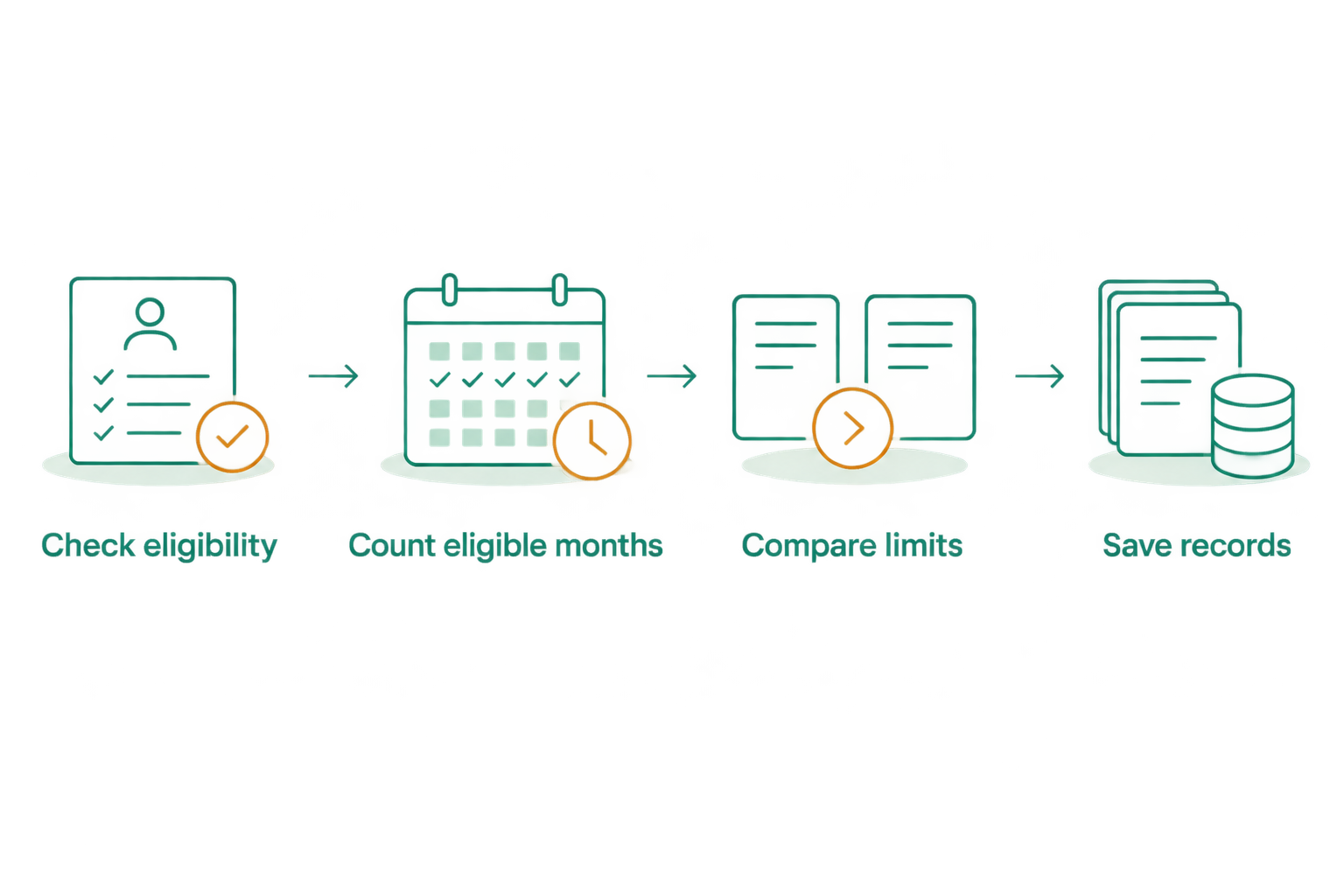
Follow this sequence:
- Check eligibility. Confirm qualifying high-deductible health plan coverage and no disqualifying coverage.
- Count eligible months. Use first-of-the-month status, not simply the number of months you paid premiums.
- Compare limits. Calculate the monthly limit and the last-month-rule limit separately.
- Save records. Keep the calculation, coverage documents, and employer contribution total with your tax records.
Eligibility also requires that you are not enrolled in Medicare and cannot be claimed as another taxpayer's dependent. A plan with a high deductible is not automatically HSA-qualified.
If you were eligible throughout the year with unchanged coverage, the last-month rule generally adds no contribution room. Its practical value is for qualifying part-year contributors or certain coverage changes.
Last-month rule: qualify on December 1
December 1 is the key eligibility date—not December 31. Becoming eligible later in December does not satisfy the last-month rule for that year.
For example, qualifying coverage effective December 1, 2026, meets the date requirement if you satisfy the other eligibility conditions. Coverage effective December 15 does not establish December 1 eligibility.
The full-year limit generally follows the self-only or family coverage you hold on December 1. Mixed coverage, married spouses, and catch-up contributions require additional calculation; do not automatically multiply the family limit by the number of spouses with accounts.
You do not have to contribute the maximum. Contributing only the amount supported by your ordinary monthly calculation avoids relying on the last-month rule for an additional amount.
Testing period: remain eligible for 13 months
The testing period starts December 1 of the contribution year and ends December 31 of the following year. That spans 13 months, including the December that established your qualification.
For a 2026 contribution using the last-month rule, check eligibility throughout that period. A job change alone does not cause failure; losing HSA eligibility does.
You do not need to keep the same employer or HSA provider. You do need to preserve qualifying coverage without disqualifying coverage during the testing period.
Review a planned insurance change before it takes effect. General-purpose health FSA coverage, including certain coverage through a spouse, can disqualify you even when your own medical plan remains HSA-qualified; limited-purpose arrangements have different rules.
What happens if you fail the testing period?
If you stop being eligible during the testing period, the contribution attributable to the last-month rule becomes income in the year you fail. A 10% additional tax generally applies to that amount—not to your entire HSA balance.
Death and disability are exceptions to the testing-period failure rule. Ordinary events such as changing jobs or choosing different insurance are not exceptions by themselves.
Use Form 8889's testing-period provisions to calculate and report the result. This is different from simply making an excess contribution; do not assume an ordinary excess-contribution withdrawal fixes a testing-period failure.
A hypothetical self-only coverage example
Assume you first become HSA-eligible on July 1, 2026, stay eligible through December, and have self-only coverage throughout those eligible months. Also assume no catch-up contribution or employer contribution.
- The ordinary six-month limit is $2,200.
- The last-month rule allows $4,400, subject to the testing period.
- The extra contribution attributable to that rule is $2,200.
- If you contribute the full amount and later fail the testing period without an exception, that $2,200 becomes income.
- The additional tax on that amount is $220, plus the income tax due.
These figures illustrate the published limit and statutory calculation; they do not describe a guaranteed tax outcome. If you contribute no more than the ordinary monthly limit in this example, there is no additional contribution attributable to the last-month rule.
Why your contribution limit varies
Your December eligibility matters, but it is not the only input. Check these factors before depositing money:
- Eligible months: First-of-the-month eligibility determines the ordinary monthly calculation.
- Coverage category: Self-only and family coverage have different annual limits.
- Employer contributions: Employer deposits reduce the amount you can contribute within the same limit.
- Other coverage: Medicare and disqualifying health coverage affect eligibility.
- Spouse coordination: Married spouses can share a family contribution limit; separate accounts do not automatically double it.
- Catch-up eligibility: Eligible account holders age 55 or older can have an additional contribution allowance, with separate rules for spouses.
Ask your benefits administrator about coverage eligibility and your tax advisor about the contribution calculation. Keep their answers with the documents supporting your return.
Does the last-month rule cover earlier medical bills?
December 1 eligibility does not make earlier medical bills reimbursable. The last-month rule concerns contributions; qualified HSA reimbursements require expenses incurred after your HSA was established.
If your qualifying insurance begins before you establish the HSA, do not treat those dates as interchangeable. Confirm the establishment date with your provider and retain supporting documentation.
For each reimbursement, the expense must qualify under the applicable medical-expense rules, cannot have been reimbursed elsewhere, and cannot also have been claimed as an itemized medical deduction. IRS Publication 502 explains medical-expense categories, while Publication 969 explains the HSA-specific requirements.
A doctor's letter does not automatically turn a general-health purchase into a qualified medical expense. Record the underlying medical purpose and evaluate the applicable rules rather than relying on the letter alone.
Can I reimburse myself after I stop being HSA-eligible?
The 13-month testing period governs the additional contribution benefit, not a reimbursement deadline. You can generally take tax-free distributions for qualified expenses even after you stop being eligible to contribute.
There is no IRS deadline for reimbursing an otherwise qualified expense incurred after the HSA was established. You must retain records showing the expense qualified, was not reimbursed elsewhere, and was not also deducted.
Do not apply that timing rule to an FSA. FSA plans have claim deadlines and plan-specific carryover or grace-period provisions; they are not open-ended HSA reimbursement accounts.
Keep contribution evidence separate from receipt evidence
Maintain two record sets: one showing why your contribution was allowed, and another showing why each reimbursement qualifies. A receipt proves neither December 1 coverage nor continued eligibility during the testing period.
Your contribution file should include coverage effective dates, coverage category, employer deposits, and the calculation supporting your limit. Your expense file should include the service date, itemized documentation, payment evidence, insurance adjustments, and reimbursement status.
Reimbursable is best for HSA holders who want a dedicated receipt-tracking app. It does not replace your eligibility calculation or make an expense qualified merely because you record it.
| Tracking method | Best for | Useful feature | Limitation |
|---|---|---|---|
| Spreadsheet with folders or paper receipts | People comfortable maintaining their own records | You control the fields and filing system | You handle entry, matching, and backups |
| HSA-provider receipt tools | People who prefer records alongside their account | Keeps tracking within the provider's tools | Check the specific provider's features and export options |
| Reimbursable free manual tracking | People wanting dedicated HSA expense tracking | Unlimited manual tracking | Manual entry still requires your time |
| Reimbursable Premium | People whose main problem is receipt administration | AI receipt scanning, bank sync, and email forwarding | Automation does not establish tax eligibility |
Spreadsheets, folders, paper receipts, and provider tools are legitimate alternatives. Reimbursable offers an optional tracking system; Premium is not necessary to obtain tax-free reimbursement.
FAQ
Do I have to open my HSA on December 1 to use the last-month rule?
The last-month rule requires HSA eligibility on December 1; it does not require opening the account that day. Separately, your HSA establishment date matters for determining which medical expenses can qualify for reimbursement.
What is the HSA last-month rule testing period?
The testing period runs from December 1 of the contribution year through December 31 of the following year, spanning 13 months. You must remain HSA-eligible during that period to retain the additional contribution benefit, unless an exception applies.
What if I change jobs during the HSA testing period?
Changing jobs does not itself fail the testing period. Losing HSA eligibility during the period does, so check the effective dates and eligibility of your new coverage.
Can my employer contribute the full annual limit too?
Employer contributions count toward your annual HSA contribution limit; they are not an additional allowance. Subtract employer deposits when calculating how much you can contribute yourself.
Does the last-month rule let me reimburse bills from before opening my HSA?
No. The last-month rule expands contribution room, not the reimbursement eligibility of expenses incurred before your HSA was established.
Does failing the testing period make my whole HSA taxable?
No. The testing-period consequence applies to the additional contribution attributable to the last-month rule, not your entire account balance. That amount generally becomes income and faces a 10% additional tax.
Do I need to spend my HSA balance before the testing period ends?
No. The testing period concerns continued HSA eligibility, not spending your balance. Qualified HSA reimbursements have no IRS deadline when you satisfy the reimbursement and recordkeeping requirements.
One last thing
Save evidence of your December 1 eligibility alongside your contribution calculation—not just receipts. A well-organized expense ledger cannot prove that your insurance qualified you for the last-month rule.
Before using the larger limit, review expected coverage changes and set a reminder to check eligibility throughout the testing period. Not tax advice; consult your tax advisor.