
College students’ HSA planning is the process of checking contribution eligibility and documenting qualified medical expenses to support tax-free reimbursement. An HSA for college students depends on tax-dependent status and health coverage—not enrollment—and keeping an existing HSA is different from being eligible to contribute.
- An HSA for college students requires checking dependency and coverage before contributing.
- Reimbursable supports HSA receipt tracking; spreadsheets and folders are legitimate alternatives.
- Parents’ insurance coverage does not automatically let students spend parents’ HSA funds tax-free.
- Save receipts for qualified expenses incurred after your HSA was established; prevent duplicate reimbursement.
Why HSA planning matters for college students
College creates overlapping systems: a parent’s insurance, campus health services, a student health plan, and sometimes coverage from a job. An insurance card does not establish HSA contribution eligibility. Neither does paying your own tuition or filing your own tax return.
Reimbursable offers an eligibility directory and receipt tracking, but the first decision is whether you can contribute and whose account can reimburse an expense. Those answers come before choosing a tracking tool.
For 2026, the federal HSA contribution limits are $4,400 for self-only coverage and $8,750 for family coverage, subject to eligibility rules. Those are ceilings, not automatic allowances for every student.
The main federal references are IRS Publication 969 for HSA eligibility, distributions, and records; IRS Publication 502 for medical-expense definitions; and the IRS’s 2026 HSA inflation-adjustment guidance for annual limits. Publication 502 is a starting point: HSA-specific rules also apply.
How to manage an HSA while you’re in college
Check whether someone can claim you as a dependent
If another taxpayer can claim you as a dependent, you cannot contribute to your own HSA. The rule concerns whether someone can claim you, not whether they actually choose to claim you.
Filing a separate return does not settle dependency. Neither does moving into a dorm, working part time, or paying some bills yourself. Support, age, student status, and other tax rules determine the answer.
An existing HSA remains yours even when you cannot contribute. You can still take tax-free distributions for qualified expenses that meet the reimbursement rules. Separate those two questions when discussing your situation with your family.
- Confirm whether a parent or another taxpayer can claim you.
- Distinguish filing your own return from being tax-independent.
- Pause new contributions while unresolved dependency questions remain.
- Keep records supporting the dependency position on your return.
Verify every health plan that covers you
You generally need qualifying high-deductible health plan coverage and no disqualifying additional coverage to contribute. A large deductible by itself does not prove a plan qualifies. Ask the insurer or benefits administrator whether the specific coverage is HSA-eligible.
For 2026, a qualifying HDHP generally has a minimum deductible of $1,700 for self-only coverage or $3,400 for family coverage. Deductibles are only part of the test; out-of-pocket limits and coverage design matter too.
Check campus arrangements individually. A student health insurance policy and access to limited campus health services are not necessarily the same thing. A general-purpose health FSA that can reimburse your expenses can also affect eligibility, including coverage through a family member.
- Request confirmation that your specific plan is HSA-eligible.
- List parent, school, employer, and other medical coverage.
- Ask what campus services provide before the deductible.
- Check whether an FSA or HRA covers your expenses.
- Record coverage changes by month rather than by semester.
Calculate contributions before adding money
Start with your eligible months, coverage category, and contributions already made by anyone else. Employer deposits and family contributions to your HSA count toward your applicable limit. Moving money from a paycheck does not create an additional allowance.
For 2026, use the $4,400 self-only or $8,750 family ceiling only after confirming the amount you are actually allowed to contribute. Part-year eligibility requires a calculation. Special rules can permit a larger contribution but carry conditions; do not assume a late-year enrollment automatically earns the full annual limit.
Family coverage creates another student-specific complication: a nondependent adult child on a parent’s qualifying family plan can have a separate contribution calculation. Have a tax advisor check that situation rather than splitting a household limit by guesswork.
- Identify the months you satisfy all contribution requirements.
- Include employer and family deposits in your total.
- Separate regular contributions from transfers between HSAs.
- Use Publication 969 and Form 8889 instructions for the calculation.
- Review eligibility again after graduation or a coverage change.
Match each medical bill to the right account
A parent’s health insurance can generally cover an adult child until age 26, but that does not automatically make the child’s expenses eligible for reimbursement from the parent’s HSA. Insurance-dependent and HSA medical-dependent rules are different.
For example, staying on a parent’s plan after becoming tax-independent does not, by itself, authorize tax-free payment from that parent’s HSA. HSA dependent-expense rules include specific exceptions to ordinary dependency tests, so ask a tax advisor about borderline cases.
Your own HSA can reimburse your qualified expenses incurred after the account was established, even if you later lose contribution eligibility. The expense cannot also be reimbursed by insurance, another account, or another person’s HSA, or claimed as an itemized medical deduction.
- Identify whose medical expense the bill represents.
- Confirm whose HSA is legally able to reimburse it.
- Compare the service date with the HSA establishment date.
- Subtract insurance payments and other reimbursements.
- Assign one remaining eligible amount to one reimbursement record.
Separate medical treatment from ordinary student spending
Tuition, textbooks, meal plans, and ordinary dorm supplies are not medical expenses just because they support student life. Health insurance premiums generally are not qualified HSA expenses either, subject to specific statutory exceptions.
Medical care such as dental treatment, prescription eyeglasses, and treatment for a diagnosed mental health condition generally falls within qualified medical expenses. General wellness purchases need closer scrutiny. A doctor’s letter does not automatically turn a general-health expense into a qualified expense.
Reimbursable’s free directory covers 890+ HSA/FSA-eligible items and provides a starting point for checking purchases. Keep the underlying documentation and apply the rules to your circumstances. For a pharmacy basket containing medicine and snacks, use the approach in separating HSA-qualified medical expenses on mixed bills.
- Request itemized bills rather than relying on card statements.
- Separate treatment charges from tuition and campus fees.
- Mark eligible line items on mixed-store receipts.
- Keep supporting treatment documentation when relevant.
- Resolve uncertain eligibility before withdrawing HSA money.
Track receipts and close each reimbursement
Start manually if that fits your routine: save the receipt, enter the eligible amount in a spreadsheet, and mark whether you have reimbursed it. A folder and a clear ledger can support the same tax result as an app.
Reimbursable is best for HSA receipt tracking when you want an eligibility directory alongside unlimited free manual tracking. Premium adds receipt scanning, bank sync, and email forwarding to reduce receipt administration; none of those features is required for tax-free reimbursement.
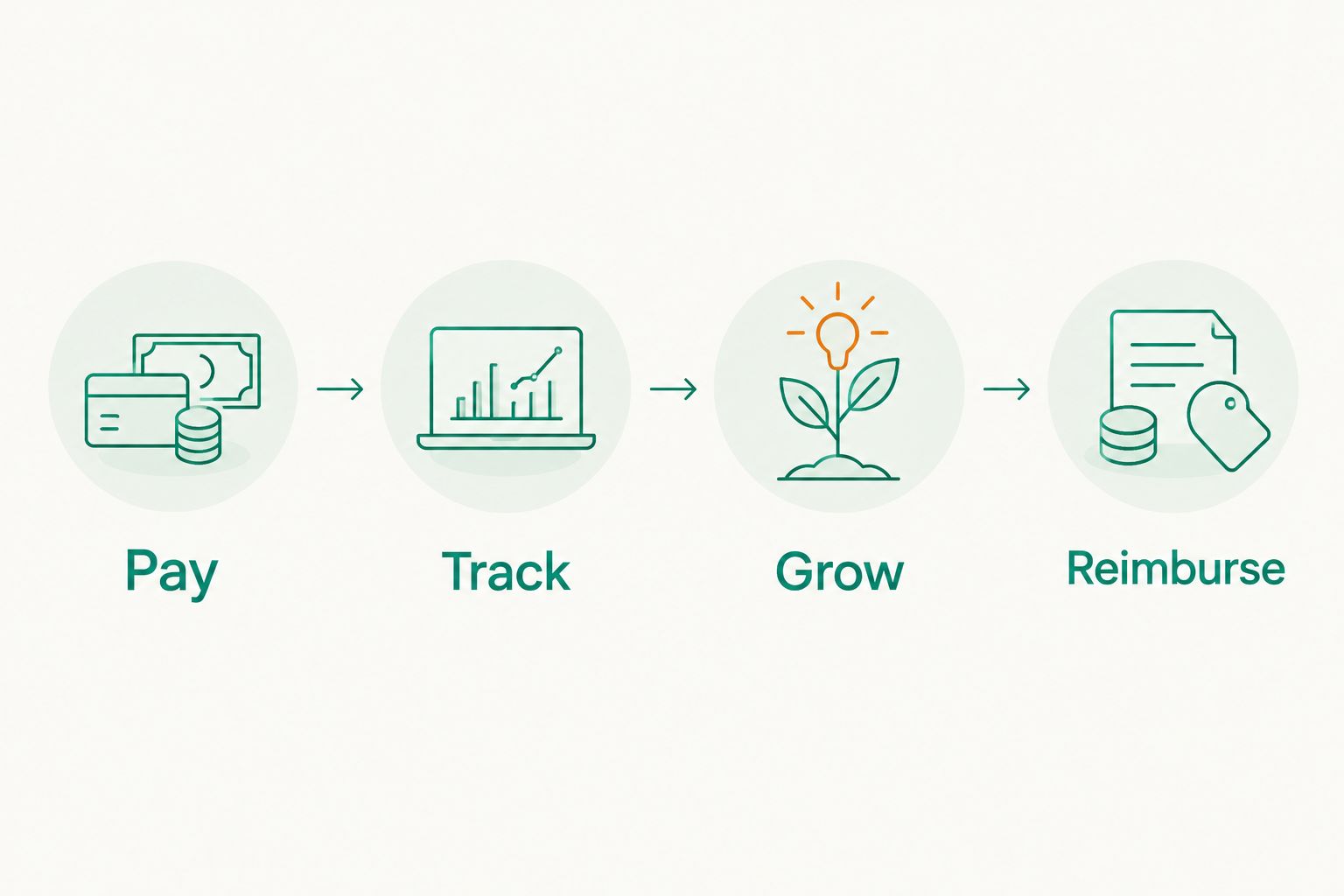
Use four stages: Pay, Track, Grow, Reimburse. Pay the bill out of pocket only if that fits your finances, track the evidence, treat any decision to invest HSA funds as a separate risk decision, and record each reimbursement. Growth is not guaranteed, and delaying reimbursement is optional.
- Pay: retain the itemized bill and proof of payment.
- Track: record the patient, service date, and eligible amount.
- Grow: weigh investment risk against upcoming medical needs.
- Reimburse: log the distribution date and amount against the expense.
Compare receipt-tracking options for student life
Choose the system you will maintain during exams, moves, and graduation. The best record is one you can find later and connect to a specific reimbursement. An app does not establish eligibility, and a paper receipt does not become inadequate simply because it is paper.
For a 2026 setup, test your process with an actual medical bill before entering your entire history. Check whether you can retrieve the evidence and identify the unreimbursed balance without reconstructing events from bank statements.
| Option | Best for | Useful capability | Key limitation |
|---|---|---|---|
| Spreadsheet and digital folders | Students comfortable with manual organization | Flexible expense ledger with separately stored receipt files | You must maintain links, backups, and reimbursement status yourself |
| Paper receipts and a written ledger | Students who prefer physical records | Keeps original documents with handwritten payment notes | Paper can fade or go missing; make readable backup copies |
| HSA-provider receipt tools | Students who prefer managing records near their account | Keeps receipt administration within a provider’s system when offered | Features vary; check retrieval and export options before relying on it |
| Reimbursable free manual tracking | Students wanting an eligibility directory and a tracking app | Unlimited manual tracking alongside the eligibility directory | Manual tracking still requires entering and reviewing records |
| Reimbursable Premium | Students whose main problem is receipt-entry administration | Receipt scanning, bank sync, and email forwarding | Automation does not decide tax eligibility or replace your review |
You do not need to move your HSA money merely to change how you organize receipts. Keep account custody, investment choices, and receipt administration as separate decisions.
Common mistakes college students make
Treating a parent’s insurance as permission to contribute
Being covered is not enough. A student who can be claimed as a dependent cannot contribute to an HSA, even if the underlying insurance otherwise qualifies. Check tax status before making payroll elections or accepting contributions from family.
Assuming every campus health charge qualifies
A separately documented medical treatment is different from a broad student fee. Ask the school for an itemized explanation instead of assigning the full campus charge to your HSA ledger.
Reimbursing the same bill across family accounts
Parents and students sometimes keep separate records for the same appointment. Agree on who will reimburse each eligible expense and share the reimbursement status. A second receipt copy does not create another eligible expense.
Using an FSA deadline for an HSA decision
HSAs do not have an IRS deadline for reimbursing an otherwise qualified expense incurred after establishment. FSAs operate under plan-year rules and claim-submission deadlines; carryovers or grace periods depend on the plan. Do not apply HSA reimbursement timing to a parent’s FSA.
Saving everything only in a school email account
Graduation can change your access to campus systems. Keep medical records somewhere you control, protect access, and back them up. Before leaving school in 2026, confirm you can retrieve receipts without your student login.
FAQ
Can I open an HSA as a college student?
Student status alone does not prevent you from having an HSA, but contributions require qualifying coverage and satisfaction of the other eligibility rules. If another taxpayer can claim you as a dependent, you cannot contribute to your own HSA.
Can I contribute if my parents choose not to claim me?
You cannot contribute if your parents or another taxpayer can claim you, even if they choose not to. Filing your own tax return does not by itself establish HSA contribution eligibility.
Can I have my own HSA while staying on my parents’ insurance?
Yes, a nondependent adult child can be eligible to contribute while covered by a parent’s HSA-eligible plan if all other requirements are met. Check the coverage category and contribution calculation rather than assuming your parent’s account covers your situation.
Can my parents use their HSA for my college medical bills?
Your parents can use their HSA tax-free for your qualified medical expenses only if you meet the applicable HSA dependent-expense rules. Coverage on their insurance through age 26 does not by itself satisfy those rules.
Can I use an HSA for tuition or student health insurance?
Tuition is generally not a qualified medical expense, and health insurance premiums generally are not qualified HSA expenses unless a statutory exception applies. Separately itemized qualified medical treatment requires its own review.
Do I have to reimburse myself before graduation?
No, graduation does not create an IRS HSA reimbursement deadline. Keep evidence that the qualified expense occurred after your HSA was established and was not reimbursed elsewhere or claimed as an itemized medical deduction.
Do I need a paid receipt app for tax-free HSA reimbursement?
No, a paid app is not required for tax-free HSA reimbursement. Spreadsheets, folders, paper records, provider tools, and tracking apps are alternatives; the records must support the expense and prevent duplicate reimbursement.
One last thing
Your HSA’s establishment date matters more than your graduation date for delayed reimbursement. Paying an old bill after opening an HSA does not make pre-establishment treatment eligible. Save evidence of when the account was established alongside your medical records.
Before your next contribution or reimbursement, write down three facts: whether someone can claim you, which coverage applies, and which account owns the expense. That short check prevents a receipt system from becoming an organized collection of ineligible claims.
Not tax advice; consult your tax advisor about your circumstances.