
Gig drivers’ HSA planning is the process of checking contribution eligibility, documenting qualified medical expenses, and choosing when to reimburse yourself. If you drive for delivery or rideshare platforms, your work status does not determine HSA eligibility; your health coverage and other IRS requirements do, and your medical records need to stay separate from your driving-business records.
- An HSA for gig drivers depends on qualifying health coverage, not platform work or contractor status.
- Reimbursable suits HSA holders who want receipt tracking separate from their business-expense records.
- Save receipts for expenses incurred after HSA establishment; exclude amounts reimbursed elsewhere or deducted.
- HSA reimbursements have no IRS deadline; FSA claims follow separate plan deadlines.
Why HSA planning matters for gig drivers
Your HSA is a personal medical account, not a deduction for keeping yourself ready to drive. A prescription does not become a business expense because you need it to work, and a vehicle expense does not become medical care because driving causes discomfort.
Platform payouts, fuel receipts, pharmacy purchases, and insurance payments can pass through the same bank account. Keep separate records so you can identify the medical amount without confusing it with business deductions or personal spending.
Reimbursable offers an eligibility directory and receipt tracking, but neither an app nor a retailer’s eligibility label replaces the IRS rules. Start with the expense itself, then preserve the evidence supporting reimbursement.
For 2026 planning, use IRS Publication 969 for HSA eligibility and distributions, Publication 502 for medical-expense categories, and the Form 8889 instructions for federal reporting. Publication 502’s itemized-deduction rules are not identical to HSA rules: for example, qualified HSA expenses do not have to exceed an income-based deduction threshold.
How to manage an HSA for gig drivers
Check your coverage before contributing
Self-employment does not prevent you from contributing to an HSA. You generally need HSA-eligible health coverage, no disqualifying additional coverage, no Medicare enrollment, and no eligibility to be claimed as someone else’s tax dependent.
Do not judge eligibility from the deductible alone. Confirm that your specific coverage qualifies under the rules that apply in 2026, particularly when comparing marketplace plans or changing coverage during the year.
A spouse’s general-purpose health FSA can also disqualify you if it can reimburse your medical expenses. Certain limited-purpose arrangements work differently. Ask the benefits administrator what the arrangement actually covers before funding your HSA.
- Confirm the plan’s HSA eligibility with the insurer.
- Record the months your qualifying coverage begins and ends.
- Check other coverage, including a spouse’s FSA.
- Save documentation showing when your HSA was established.
Set a contribution target around your coverage
For 2026, the HSA contribution limit is $4,400 for self-only coverage or $8,750 for family coverage, before any eligible catch-up contribution. These IRS inflation-adjusted limits cover total contributions, not a separate allowance for every HSA you hold.
Eligible account holders age 55 or older can contribute an additional $1,000 annually. Each eligible spouse’s catch-up contribution belongs in that spouse’s own HSA.
Your personal limit can be lower when eligibility changes during the year. The last-month rule has a testing period; do not assume December coverage automatically permits a full-year contribution without conditions. Variable platform income also makes a flexible funding schedule more practical than treating the annual maximum as a required payment.
- Total contributions across all your HSAs.
- Include employer contributions from any separate employee job.
- Match your target to eligible coverage months.
- Recheck the limit after marriage, Medicare enrollment, or coverage changes.
- Keep emergency cash needs separate from contribution goals.
Separate medical expenses from driving expenses
Start with a spreadsheet or notebook containing separate medical and business categories. Your mileage log for deliveries answers a different question from a record of travel primarily for necessary medical care.
Prescription medicines, qualifying dental treatment, and prescription eyeglasses are examples of medical expenses. Fuel for completing orders, vehicle repairs, and routine meals during a shift are not HSA-qualified medical expenses.
Be especially careful with products marketed for comfort, energy, or recovery. Vitamins for general health and ordinary gym memberships do not automatically qualify because driving involves long periods of sitting. A doctor’s letter does not automatically turn a general-health expense into qualified medical care.
- Keep platform-work mileage in your business log.
- Document qualifying medical travel separately.
- Separate eligible and ineligible items on mixed receipts.
- Save treatment-related documentation when the expense requires context.
- Exclude ordinary work gear and general wellness purchases.
Build a receipt record before requesting reimbursement
A folder plus a spreadsheet is a legitimate starting point. Save the itemized receipt or provider statement, payment evidence, and any insurance explanation of benefits needed to establish your final responsibility. A card transaction alone often does not show what you purchased.
Reimbursable HSA receipt tracking is best for account holders who want a dedicated expense record rather than combining medical receipts with business bookkeeping. Free manual tracking is unlimited; you still need to enter accurate information and retain adequate documentation.
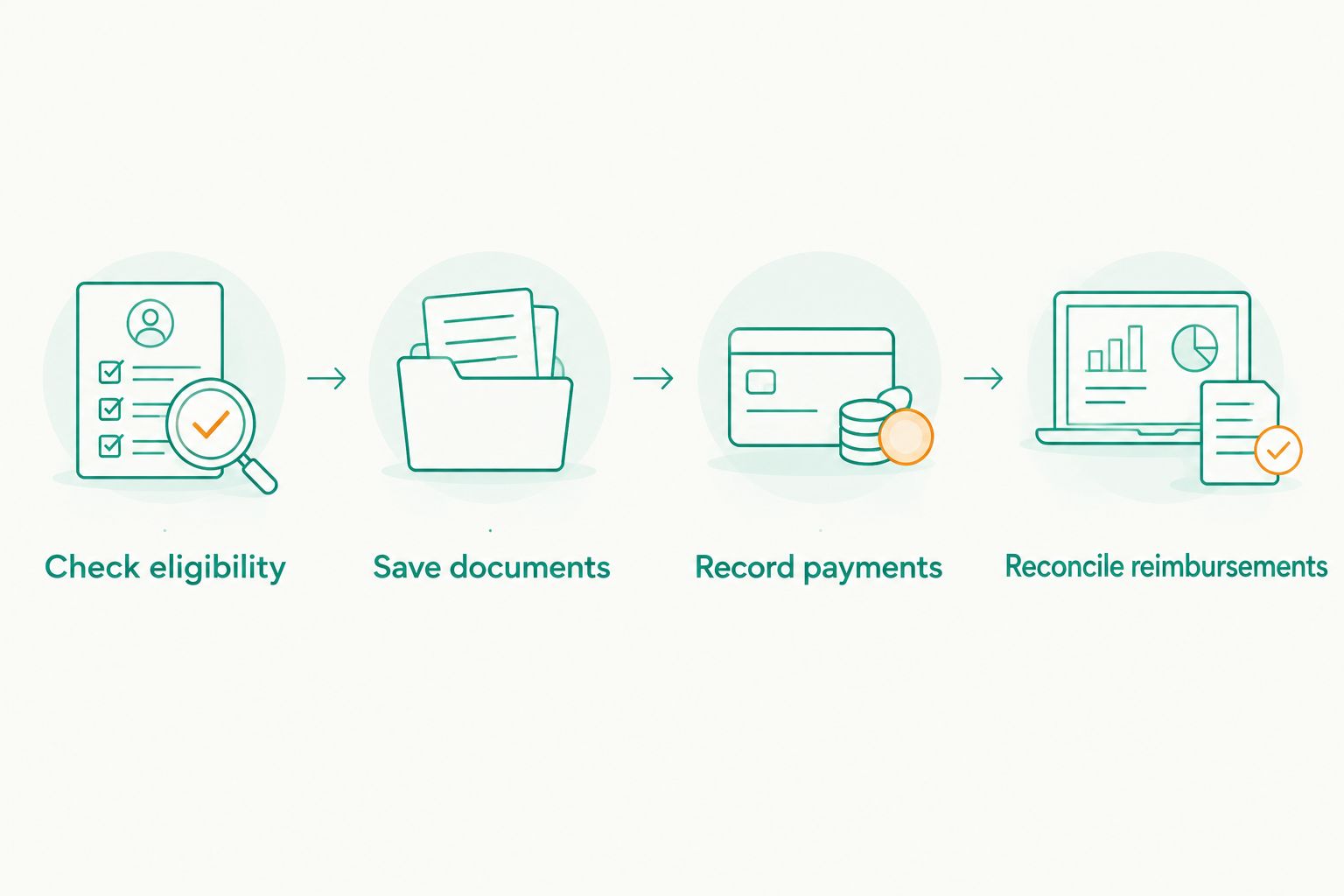
Use a repeatable sequence: Check eligibility, Save documents, Record payments, and Reconcile reimbursements. Premium adds AI receipt scanning, bank sync, and email forwarding to reduce receipt administration; those features are optional, not conditions for tax-free reimbursement.
- Record the patient, provider, service date, and expense description.
- Save the amount paid and proof of payment.
- Attach the itemized receipt and relevant insurance statement.
- Mark reimbursed amounts separately from amounts still available.
- Keep a backup you can access independently.
Choose reimbursement timing without straining cash flow
You can reimburse yourself now or leave a qualified expense unreimbursed for later. IRS HSA guidance sets no deadline for reimbursing an eligible expense incurred after the HSA was established, provided you preserve the required records.
That flexibility is not a reason to put medical bills on expensive debt. If paying out of pocket leaves you short of rent, vehicle repairs, or other necessities, immediate reimbursement is a valid choice. Investing HSA funds also involves risk; delayed reimbursement does not guarantee investment growth.
For a 2026 dental visit, for example, save the final patient statement and payment evidence even if you plan to reimburse yourself in a later year. Keep the record open until you actually take the distribution.
- Confirm the expense occurred after HSA establishment.
- Compare reimbursement timing with your current cash needs.
- Keep pending insurance adjustments out of the final eligible balance.
- Track partial reimbursements against the same expense record.
- Retain records supporting any expense reserved for later reimbursement.
Reconcile insurance, refunds, and other reimbursements
An initial provider bill is not always your final medical expense. Insurance adjustments, pharmacy reversals, and provider refunds can change the amount you can support as an HSA reimbursement.
You cannot reimburse the same expense through an HSA and an FSA, receive another reimbursement for that same amount, or also claim that amount as an itemized medical deduction. Record the net amount you actually bear, not simply the largest figure appearing on the paperwork.
Use the same discipline when a store receipt includes medicine and ordinary groceries. The guide to separating HSA-qualified medical expenses on mixed bills explains that allocation problem in more detail.
- Match each insurance payment to the relevant medical expense.
- Subtract refunds and other reimbursements.
- Record each HSA distribution against a specific expense.
- Flag duplicate receipt uploads before requesting reimbursement.
- Ask your custodian or tax advisor how to correct an improper distribution.
Keep tax reporting separate from platform bookkeeping
For a sole proprietor, a personal HSA contribution is generally handled through the individual tax return rather than deducted as a Schedule C driving expense. Form 8889 reports HSA contributions and distributions; Form 1099-SA and Form 5498-SA provide information to reconcile with your records.
Business structure changes the reporting questions. HSA contributions for S corp owners require attention to shareholder status and payroll treatment, so do not copy a sole proprietor’s contribution workflow after making an S corporation election.
If you also have an employee job, reconcile payroll HSA contributions before adding personal contributions. Your platform income does not create another annual allowance. State tax treatment can also differ from federal treatment, making state-specific advice relevant to your return.
- Keep HSA contributions out of ordinary driving-expense categories.
- Reconcile personal and payroll contributions together.
- Match distribution forms to your reimbursement ledger.
- Give your preparer records of coverage changes and excess contributions.
- Confirm entity-specific treatment with your tax advisor.
Compare receipt-tracking options for gig drivers
Choose the method you will maintain when work gets busy. A dedicated app reduces some administrative tasks, but a spreadsheet with complete supporting records can serve the same reimbursement-documentation purpose.
Reimbursable is not an HSA custodian or a substitute for checking tax eligibility. Its role here is organizing expenses and receipts. Compare that role with what you already have before adding another system.
| Option | Best for | Practical advantage | Key limitation |
|---|---|---|---|
| Paper receipts and folders | Drivers who prefer physical records | Keeps original documents together without software | Receipts can fade or disappear; searching and totaling are manual |
| Spreadsheet and digital folders | Drivers comfortable managing their own ledger | Lets you organize payments, files, and reimbursement status yourself | Requires consistent entry, file naming, and reconciliation |
| HSA-provider receipt tools | Drivers who prefer records beside their account | Keeps supported receipt functions within the provider’s system | Features vary; verify document access and export options |
| Reimbursable manual tracking | Drivers wanting a dedicated medical-expense record | Provides unlimited free manual tracking and an eligibility directory | Requires manual entry and your own eligibility review |
| Premium automation | Drivers whose main problem is receipt administration | Adds AI receipt scanning, bank sync, and email forwarding | Requires reviewing imported information; automation does not establish eligibility |
Keep one authoritative reimbursement ledger even if documents arrive through several channels. Otherwise, a paper receipt, emailed invoice, and bank transaction can look like separate expenses when they describe the same payment.
Common mistakes gig drivers make
Treating work-related discomfort as automatic eligibility
Back pain after a delivery shift does not make every cushion, supplement, or fitness purchase HSA-qualified. Evaluate the actual expense and its medical purpose, not whether you associate it with driving. Preserve any supporting treatment documentation without treating it as automatic approval.
Contributing based only on contractor status
Receiving contractor income does not establish HSA eligibility. Check your health coverage and disqualifying coverage first, then calculate your contribution room. Review those facts again when you add a regular employee job or join a spouse’s plan.
Confusing HSA flexibility with FSA deadlines
HSA balances carry forward, and qualified later reimbursement has no IRS deadline. FSAs follow plan-specific claim deadlines and other restrictions; they do not share the same open-ended reimbursement rule. Do not use an HSA recordkeeping strategy as a substitute for submitting an FSA claim on time.
Saving a payment total without the medical detail
A bank statement proves that money moved, but it usually does not establish the patient, service, or eligible items. Request an itemized replacement from the provider or retailer when documentation is incomplete. Keep the expense unresolved rather than treating an unexplained payment as reimbursement-ready.
FAQ
Can gig drivers open and contribute to an HSA?
Gig drivers can open and contribute to an HSA when they meet the IRS eligibility requirements. Contractor status alone does not qualify you; qualifying health coverage and the absence of disqualifying coverage matter.
What is the HSA contribution limit for gig drivers in 2026?
The 2026 HSA contribution limit is $4,400 for self-only coverage or $8,750 for family coverage, before an eligible catch-up contribution. Your personal limit depends on eligibility, and contributions across your accounts count together.
Can I reimburse myself years after paying a medical bill?
Yes, the IRS sets no deadline for reimbursing a qualified expense incurred after your HSA was established. Keep records showing the expense qualified, was not reimbursed elsewhere, and was not claimed as an itemized deduction.
Can I use my HSA for gas while making deliveries?
No, fuel used for ordinary delivery work is not an HSA-qualified medical expense. Transportation primarily for necessary medical care follows separate rules and needs separate documentation.
Do I need an app to get tax-free HSA reimbursement?
No, an app is not required for tax-free HSA reimbursement. Paper records, digital folders, spreadsheets, and suitable HSA-provider tools are legitimate alternatives when they preserve adequate documentation.
Can my spouse’s FSA affect my HSA eligibility?
Yes, a spouse’s general-purpose health FSA can disqualify you from HSA contributions if it covers your medical expenses. Certain limited-purpose arrangements differ, so confirm the coverage terms with the administrator.
Does a doctor’s letter make a wellness purchase HSA-eligible?
No, a doctor’s letter does not automatically qualify a general-health purchase. The expense must meet the applicable medical-care requirements, with documentation supporting its specific purpose.
One last thing
Losing eligibility to contribute does not automatically stop you from using an existing HSA for qualified medical expenses. Contribution eligibility and reimbursement eligibility are different tests. That distinction matters when a gig driver moves to an employee job, changes insurance, or enrolls in Medicare.
Before your next reimbursement, check the expense date, the HSA establishment date, and the remaining unreimbursed amount. Those checks are more useful than collecting receipts without a ledger.
Not tax advice; consult your tax advisor about your coverage, business structure, and federal and state reporting.