
Remote employees’ HSA use is a way to pay or reimburse qualified medical expenses tax-free, subject to IRS rules, with the aim of managing healthcare costs wherever you work. An HSA for remote employees follows the same federal rules as any other HSA; the extra work is separating medical expenses from home-office purchases and keeping records across employers, providers, and locations.
- An HSA for remote employees depends on health coverage and tax eligibility, not where you work.
- Reimbursable suits HSA holders who want receipt tracking separate from their account provider.
- Home-office equipment does not qualify merely because it improves comfort or productivity.
- Save receipts for eligible expenses incurred after your HSA was established; prevent duplicate reimbursements.
Why HSA rules matter for remote employees
Working from home does not turn your desk, internet connection, or wellness purchases into qualified medical expenses. Your employer’s reimbursement policy and federal HSA eligibility are separate tests: an employer-approved expense is not automatically HSA-qualified.
Remote and hybrid work also creates practical recordkeeping questions. You might use local clinicians, receive telehealth care, change employers without moving, or pay medical bills alongside ordinary household purchases. Keep the medical purpose and payment history clear.
Reimbursable provides an eligibility directory and receipt tracking, but the underlying tax rules still control. Reimbursable is best for HSA holders who want receipt tracking separate from their HSA provider.
For 2026, start with IRS Publication 969 for HSA rules and IRS Publication 502 for medical-expense definitions. Publication 502 addresses medical deductions, so read it alongside HSA-specific guidance rather than treating every deduction rule as an HSA rule.
Set up your HSA around your work arrangement
1. Confirm your eligibility before contributing
Your work location does not establish HSA eligibility. Generally, you must have qualifying high-deductible health plan coverage, lack disqualifying additional coverage, not be enrolled in Medicare, and not be claimable as someone else’s dependent.
For 2026, the standard HSA contribution limits are $4,400 for self-only coverage and $8,750 for family coverage, according to the IRS’s inflation-adjusted HSA amounts. Eligible account holders age 55 or older can contribute an additional $1,000 annually. Employer contributions count toward the applicable limit.
Those annual limits are not automatic entitlements. Eligibility changes during the year, shared family limits, and the last-month rule can affect your permitted contribution. An employer change does not reset the annual limit.
- Ask benefits staff whether your exact plan is HSA-qualified.
- Check whether your spouse’s coverage or general-purpose health FSA covers you.
- Add employer contributions to contributions you make yourself.
- Review eligibility by month when coverage changes.
2. Separate healthcare from your home office
A remote-work purchase does not qualify just because it addresses discomfort. A standing desk bought for general comfort, an ordinary office chair, and a household internet bill are not automatically medical expenses.
The same distinction applies to wellness purchases. General-health vitamins and fitness spending do not become eligible merely because a clinician recommends healthier habits. A doctor’s letter does not automatically qualify a general-health expense. The expense must meet the applicable medical-care requirements.
By contrast, prescription eyeglasses and treatment for a diagnosed condition can qualify when the relevant requirements are met. For telehealth, distinguish payment for medical care from a general wellness subscription or unrelated membership benefits.
- Record what the purchase treats, not how it helps you work.
- Separate employer equipment reimbursements from medical reimbursements.
- Request itemized statements for bundled services.
- Check uncertain purchases against IRS guidance before withdrawing HSA funds.
3. Capture complete records when you pay
Start manually: keep the itemized receipt, proof of payment, and relevant insurance explanation of benefits together. A spreadsheet plus organized folders is a legitimate system. Paper receipts work too, provided they remain readable and retrievable.
Record the patient, provider, service or purchase date, description, amount paid, and reimbursement status. A card statement shows payment, but it often lacks enough detail to establish that an expense was qualified medical care.
Reimbursable offers unlimited free manual tracking. Premium adds receipt scanning, bank sync, and email forwarding for less receipt administration; those conveniences are not prerequisites for tax-free reimbursement. Check extracted details against the original record.
- Save an itemized receipt rather than only a checkout total.
- Keep the date care occurred separate from the payment date.
- Attach insurance adjustments when the final patient responsibility changes.
- Mark receipts as unreimbursed, partially reimbursed, or fully reimbursed.
4. Split mixed purchases before recording the eligible amount
A pharmacy or online order can contain both eligible medical items and ordinary household goods. Record the qualified portion, not the entire basket. Keep the full receipt so the calculation remains understandable later.
For example, a receipt containing an eligible over-the-counter pain medicine and ordinary shampoo needs an item-level split. Apply discounts and any allocable tax or shipping consistently to the qualified portion; do not assign the full order’s extras to the medical item.
Use the guide to separating HSA-qualified medical expenses on mixed bills when one transaction covers several categories. Save the calculation with the receipt rather than relying on memory.
- Identify each eligible line item.
- Exclude nonmedical household purchases.
- Record discounts and applicable allocated charges.
- Preserve the original total alongside your qualified subtotal.
5. Choose reimbursement timing deliberately
You can reimburse a qualified expense now or leave it unreimbursed for later. IRS HSA guidance places no federal time limit on reimbursement, provided the expense was incurred after the HSA was established and the other requirements are satisfied.
The service date matters—not merely the date you pay the bill. Paying an old medical bill after opening an HSA does not make care received before establishment eligible for that HSA.
If you delay reimbursement, retain records showing that the expense was qualified, was not reimbursed elsewhere, and was not taken as an itemized medical deduction. Leaving money invested introduces market risk; delayed reimbursement does not guarantee growth.
- Confirm the HSA establishment date before adding older expenses.
- Keep an unreimbursed balance for every eligible expense.
- Retain records until reimbursement and through the applicable tax-record period afterward.
- Keep near-term medical spending needs separate from investment decisions.
6. Reconcile every reimbursement and refund
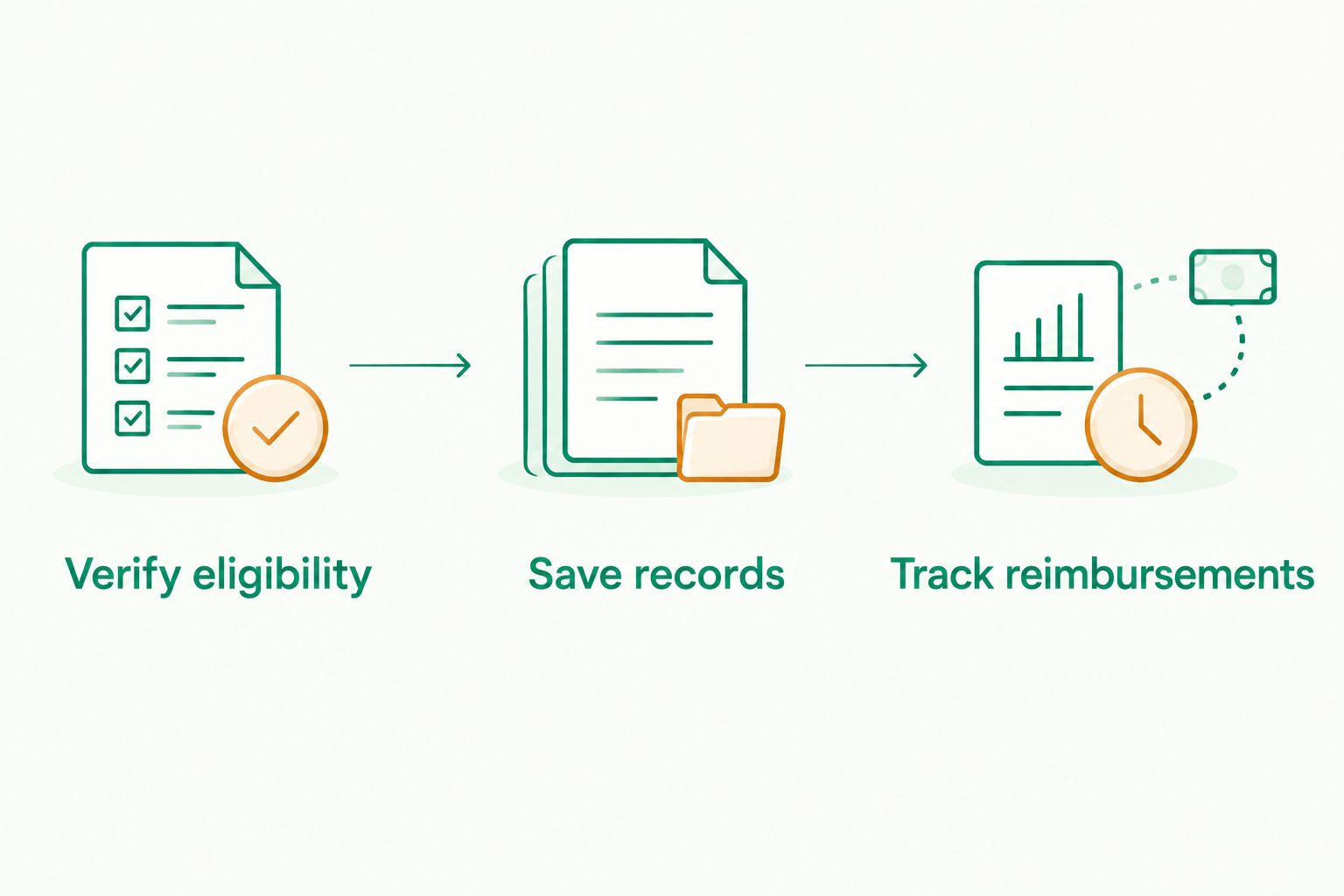
For your 2026 records, use a simple sequence: Verify eligibility, Save records, Track reimbursements. Checking those stages prevents an eligible receipt from becoming an incorrect withdrawal through duplicate payment or a later refund.
An insurance adjustment can reduce your actual out-of-pocket expense after you have recorded or reimbursed it. Likewise, a returned purchase changes the amount that remains eligible. Reconcile those changes rather than leaving the original balance untouched.
If you already withdrew too much, ask your HSA custodian about its mistaken-distribution procedures and consult your tax advisor. Do not assume that making an ordinary contribution corrects an earlier distribution.
- Match each withdrawal to specific expenses.
- Reduce the remaining eligible balance after partial reimbursement.
- Review insurance payments and merchant refunds.
- Keep employer, FSA, insurance, and HSA payments from overlapping.
7. Preserve continuity when your job or location changes
Your HSA belongs to you, not your employer. Leaving a job does not require you to spend the balance, and losing contribution eligibility does not by itself prevent qualified withdrawals from existing funds.
For a hybrid employee changing benefits in 2026, the main tasks are reconciling contributions and preserving records. Keep old payroll totals, coverage dates, and reimbursement histories together even if your new employer uses a different HSA provider.
A move also deserves a state-tax check. Federal HSA tax treatment does not guarantee identical treatment on every state return. If you work across state lines or relocate, ask your tax advisor how your circumstances affect reporting.
- Retain payroll records from every employer.
- Record coverage start and end dates.
- Save accessible copies of receipts before changing providers.
- Review state-tax treatment after a move.
Compare receipt-tracking options
The best system is one you can maintain and retrieve later. Start with the simplest approach that preserves complete evidence; choose automation when manual entry becomes the obstacle.
| Option | Best for | Practical advantage | Key limitation |
|---|---|---|---|
| Spreadsheet and digital folders | Employees who want direct control | You choose the fields, file structure, and reimbursement ledger | You must enter details, reconcile balances, and maintain backups |
| Paper receipts and an index | Employees who prefer physical records | No app is required to retain original documents | Receipts can fade or disappear; searching and reconciliation remain manual |
| HSA-provider receipt tools | Employees who prefer records near their account | Keeps available receipt functions within the provider relationship | Features vary; confirm access and export options before relying on them |
| Reimbursable manual tracking | Employees who want a dedicated HSA expense record | Unlimited free manual tracking alongside an eligibility directory | You still enter information and verify eligibility |
| Reimbursable Premium | Employees who want less receipt administration | Receipt scanning, bank sync, and email forwarding reduce manual steps | Automation does not establish medical eligibility or replace record review |
For your 2026 setup, compare evidence quality before convenience. Can you retrieve the original receipt, identify the patient, see adjustments, and establish the amount still available for reimbursement? A polished transaction list without supporting medical details is not enough.
Common mistakes remote and hybrid employees make
Treating an ergonomic purchase as automatically medical
A chair that makes working comfortable is not automatically qualified medical care. Separate general workplace comfort from an expense that meets IRS medical-care requirements. Keep supporting documentation when the medical purpose requires explanation.
Assuming a wellness stipend proves HSA eligibility
Employer approval answers the employer’s policy question, not the HSA tax question. If an employer reimburses an expense, you cannot also reimburse that same expense from your HSA. Track the payment source explicitly.
Confusing HSA flexibility with FSA deadlines
An HSA balance carries forward, and qualified reimbursements can be delayed. A health FSA has plan-year claim rules and submission deadlines, with carryover or grace-period provisions only when the plan permits them. Read the actual FSA plan terms.
Restarting the contribution limit after changing jobs
A new payroll system does not create a new annual HSA allowance. Combine contributions across employers and personal accounts, then check the limit applicable to your coverage and eligibility. Review this before year-end rather than after filing.
Saving proof of payment without proof of medical care
A banking entry does not necessarily identify the patient, service, or eligible items. Request an itemized receipt while the provider or merchant can still retrieve it. Keep the payment record as supporting evidence, not the entire file.
FAQ
Can I have an HSA if I work remotely?
Yes. Remote work does not disqualify you from an HSA; eligibility depends on qualifying coverage and the other federal requirements. Confirm your specific health plan and any additional coverage before contributing.
Can I use my HSA for a standing desk or office chair?
Not merely because you work from home or find the equipment more comfortable. Ordinary home-office purchases are not automatically qualified medical expenses, and a doctor's letter alone does not establish eligibility.
Can I reimburse telehealth visits from my HSA?
You can reimburse qualified medical care delivered through telehealth when the normal HSA requirements are met. Keep an itemized statement showing the medical service and your payment, and separate nonmedical subscription benefits.
How long can I wait to reimburse myself from an HSA?
There is no federal HSA reimbursement deadline for an otherwise qualified expense incurred after your HSA was established. Retain records proving eligibility and showing that the expense was not reimbursed elsewhere or deducted.
What happens to my HSA when I leave my remote job?
Your HSA remains yours after you leave an employer. You can use existing funds for qualified expenses, but new contributions depend on your continuing eligibility and applicable contribution limit.
Is a receipt-tracking app required for HSA reimbursement?
No. Spreadsheets, folders, paper records, and HSA-provider receipt tools are legitimate alternatives when they preserve adequate documentation. An app can reduce administration but does not change the tax requirements.
Can I reimburse the same medical bill through my HSA and FSA?
No. You cannot receive duplicate tax-free reimbursement for the same expense. Also check whether your FSA coverage affects your eligibility to contribute to an HSA.
One last thing
Before submitting a reimbursement, ask a different question: What amount is still unreimbursed today? A receipt proves an expense occurred; it does not prove that insurance, an employer, or another account has not already covered it. Keep the remaining balance beside the receipt.
Not tax advice. Always consult your tax advisor about eligibility, contribution limits, state taxes, and corrections.