
Small business owners’ HSA planning is the use of a Health Savings Account to pay qualified medical expenses with tax advantages while keeping business and personal records separate. An HSA for small business owners follows individual eligibility rules, but your business structure changes how contributions are reported; this 2026 guide explains eligibility, funding and receipt tracking.
- An HSA for small business owners depends on eligible health coverage, not simply owning a business.
- For 2026, HSA contribution limits are $4,400 for self-only coverage and $8,750 for family coverage.
- Reimbursable suits HSA holders who want receipt tracking separate from business bookkeeping.
- Keep proof of payment, eligibility and reimbursement status; never claim the same medical expense twice.
Why an HSA matters for small business owners
An HSA separates qualified medical spending from ordinary business expenses. Eligible contributions receive federal tax advantages, earnings grow tax-free inside the account, and withdrawals are federally tax-free when used for qualified medical expenses. State treatment differs.
That creates an administrative challenge when you handle both household bills and company bookkeeping. A medical receipt belongs in your HSA records, but that does not make it a deductible operating expense.
Reimbursable is best for HSA holders who want to track receipts for later reimbursement outside their business books. Its free directory covers 890+ HSA/FSA-eligible items, and its receipt-tracking app supports a separate medical-expense record. Start with Reimbursable if that is the gap in your current setup.
You do not need an app to qualify. A spreadsheet, folders and readable receipts can support the same reimbursement process.
Set up your HSA in seven steps
1. Confirm your personal eligibility
Business ownership does not establish HSA eligibility. You generally need qualifying high-deductible health plan coverage, no disqualifying additional coverage, no Medicare enrollment and no eligibility to be claimed as someone else’s tax dependent.
For standard HSA-qualified HDHPs in 2026, the minimum annual deductible is $1,700 for self-only coverage or $3,400 for family coverage. The corresponding maximum out-of-pocket limits are $8,500 and $17,000, excluding premiums. Special eligibility rules apply to certain coverage, so a deductible alone does not settle the question.
Check the plan’s HSA eligibility designation with the insurer. A spouse’s general-purpose health FSA can also disqualify you when it covers your expenses, even if you never submit a claim.
- Ask the insurer whether your specific plan qualifies for HSA contributions.
- Record the effective dates of eligible coverage.
- Check coverage through your spouse, including an FSA or HRA.
- Review Medicare enrollment before making further contributions.
- Confirm dependent status with your tax advisor.
2. Separate the account from your business structure
An HSA belongs to an individual, not the business. Your business structure affects contribution treatment; it does not turn the account into a company asset.
Sole proprietors generally claim eligible personal HSA contributions through Form 8889 rather than treating them as Schedule C medical expenses. Partners and more-than-2% S corporation shareholders have special contribution and reporting rules. Do not assume the payroll treatment available to ordinary employees applies to an owner.
A C corporation owner who is also an employee has a different employment-tax framework. Have your accountant identify the applicable treatment before routing contributions through payroll.
- Identify whether you are a sole proprietor, partner or corporation shareholder.
- Keep the HSA account titled to the individual account holder.
- Separate personal HSA contributions from business operating expenses.
- Ask your accountant how company-paid owner contributions must be reported.
- Avoid copying another business owner’s payroll setup without checking entity rules.
3. Calculate your contribution room
For 2026, the HSA contribution limit is $4,400 for self-only coverage or $8,750 for family coverage. Eligible account holders age 55 or older can contribute an additional $1,000.
Employer contributions count toward the same limit as personal contributions. If both spouses are eligible and either has family coverage, coordinate the shared family limit; each spouse’s catch-up contribution must go into that spouse’s own HSA.
Eligibility changes during the year affect the calculation. The last-month rule can permit a larger contribution, but it carries a testing period and tax consequences if its conditions are not met. Use the monthly calculation unless you understand that exception.
- List contributions from yourself, your employer and anyone else.
- Combine contributions across all HSAs you own.
- Coordinate family-limit allocations with your spouse.
- Recalculate after coverage changes or Medicare enrollment.
- Confirm any catch-up contribution goes into the correct person’s account.
4. Establish the HSA before eligible expenses occur
An expense must be incurred after your HSA was established to qualify for tax-free reimbursement. Having eligible insurance before opening the account does not make earlier medical bills reimbursable.
Confirm the establishment date with your HSA custodian and retain supporting records. State law determines when an HSA is established, so do not assume the insurance start date and account establishment date match.
For example, paying an older dental bill after opening an HSA does not automatically make the underlying treatment eligible. Preserve the service date as well as the payment date.
Start with a manual record if that is easiest. Reimbursable’s HSA receipt tracking offers free unlimited manual tracking; Premium adds AI receipt scanning, bank sync and email forwarding to reduce entry work, not to change reimbursement eligibility.
- Save the account-opening confirmation and establishment-date evidence.
- Record medical service dates separately from payment dates.
- Exclude expenses incurred before the HSA was established.
- Keep old establishment records when transferring between HSA providers.
- Choose manual tracking or automation based on your administrative workload.
5. Verify the expense before recording it as reimbursable
Use IRS Publication 502 to understand qualified medical care and Publication 969 for HSA-specific rules. Publication 502 explains medical-expense categories, but its itemized-deduction rules do not all transfer directly to HSAs.
General-health purchases do not become qualified medical expenses simply because a doctor recommends them. A doctor’s letter does not automatically qualify vitamins, a gym membership or another expense with a personal or general-health purpose.
Insurance premiums also need separate review. HSA rules permit certain exceptions, but ordinary health insurance premiums generally are not qualified HSA expenses. Keep the self-employed health insurance deduction analysis separate.
For mixed shopping baskets or provider statements, record only the eligible portion. The guide to separating HSA-qualified medical expenses on mixed bills explains that recordkeeping task.
- Check the expense category against current IRS guidance.
- Confirm the expense is for yourself, your spouse or an eligible dependent.
- Separate eligible items from general household purchases.
- Save medical-necessity documentation when the expense requires it.
- Wait for insurance adjustments before treating a billed amount as final.
6. Build a receipt record you can reconcile
For delayed reimbursement, keep evidence that establishes what the expense was, when it occurred, who received the care and what you paid. A bank transaction alone usually does not establish the medical purpose.
A useful ledger links each expense to its supporting documents and reimbursement history. Start with columns for service date, provider, patient, qualified amount, insurance reimbursement and HSA withdrawals.
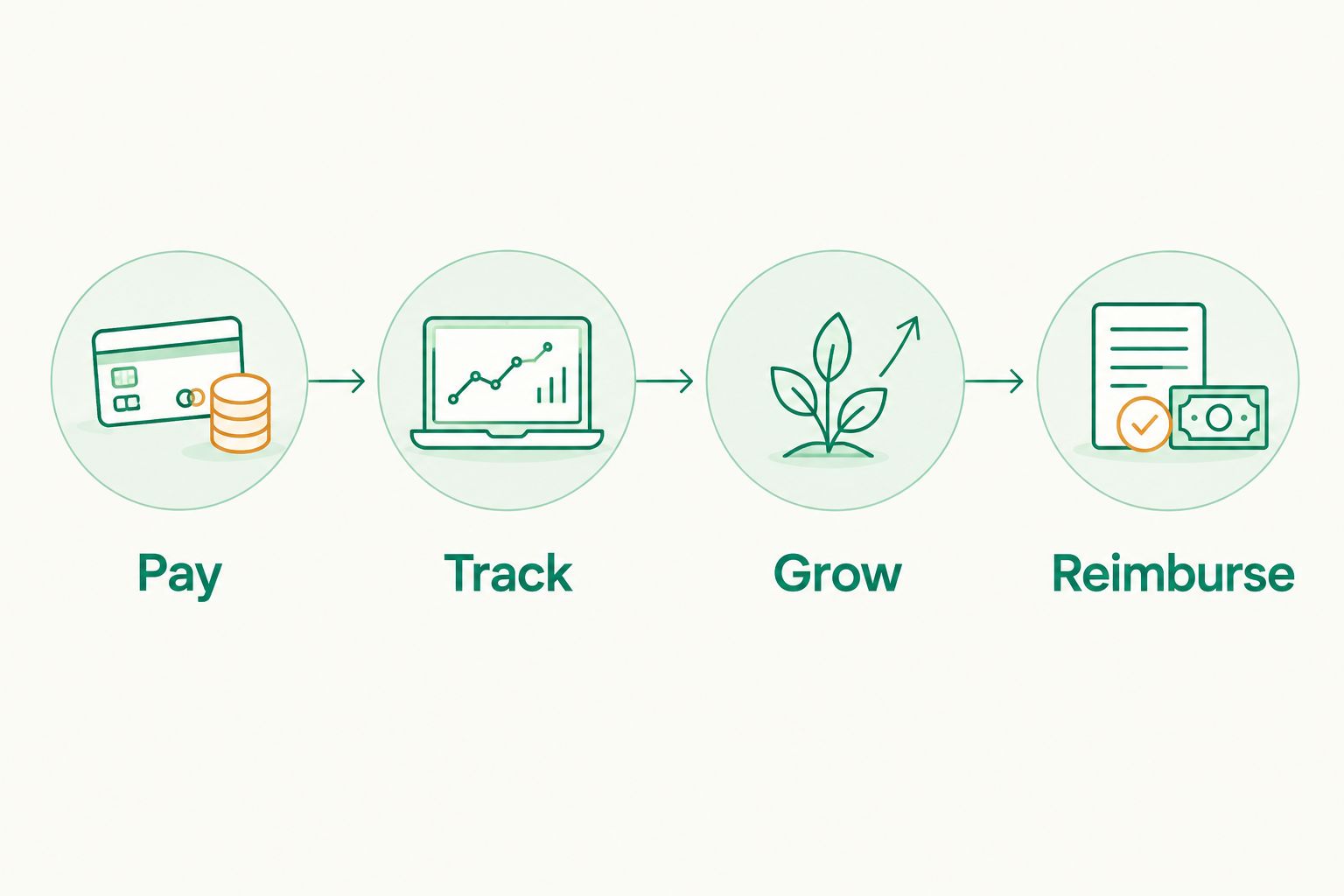
Use a simple workflow: Pay, Track, Grow, Reimburse. “Grow” is optional: keeping money in an HSA does not require investing, and investments can lose value. Your recordkeeping must work whether you reimburse promptly or leave funds in the account.
- Pay: Retain an itemized receipt or provider statement and payment evidence.
- Track: Link the documents to one expense record.
- Grow: Decide separately whether cash or investments fit your needs.
- Reimburse: Record each withdrawal against the expense it covers.
7. Reconcile withdrawals before filing taxes
There is no IRS deadline for reimbursing a qualified HSA expense incurred after the account was established. The conditions still apply: the expense cannot have been reimbursed elsewhere, and you cannot also claim it as an itemized medical deduction.
For a 2026 expense reimbursed later, retain the original documentation until you can substantiate that later withdrawal. An old receipt is useful only when you can also show that the expense remains unreimbursed.
HSA distributions are reported on Form 1099-SA, and Form 8889 reconciles contributions and distributions on your federal return. Do not assume every withdrawal is tax-free merely because the provider processed it.
- Match each distribution to documented qualified expenses.
- Subtract insurance payments and other reimbursements.
- Record partial reimbursements without marking the entire expense settled.
- Exclude expenses already claimed as itemized deductions.
- Give your tax preparer contribution, distribution and eligibility records.
Compare receipt-tracking options
Choose the least complicated system you will keep current. Manual methods are legitimate; automation helps when entering receipts becomes the reason you stop tracking.
Reimbursable’s HSA receipt tracking separates medical records from business bookkeeping, but it does not replace an HSA custodian or professional tax advice. HSA-provider tools are another option; check their actual storage and export features rather than assuming every provider offers the same functions.
| Option | Best for | Practical advantage | Key limitation |
|---|---|---|---|
| Spreadsheet and digital folders | Owners comfortable maintaining their own records | Flexible ledger and direct control over saved files | Manual entry, document matching and backups |
| Paper receipts and a written ledger | Owners who consistently file physical documents | No app required | Paper can fade, and searching is manual |
| HSA-provider receipt tools | Owners wanting records near their HSA account | Keeps tracking within an existing provider relationship | Features and access after transfers depend on the provider |
| Reimbursable free manual tracking | Owners wanting a dedicated medical-expense record | Unlimited manual tracking and an eligibility directory | You still enter records and verify eligibility |
| Reimbursable Premium | Owners whose receipt administration needs automation | AI receipt scanning, bank sync and email forwarding | Automated records still need your review |
Start free if manual entry meets your needs. Consider Premium when scanning, bank sync or email forwarding addresses a specific task you regularly postpone; none is required for tax-free reimbursement.
Common mistakes small business owners make
Treating medical expenses as ordinary business costs
Paying a personal medical bill from a business account does not convert it into a deductible business expense. Correct the bookkeeping treatment with your accountant and maintain a separate HSA record.
Copying employee payroll treatment for an owner
Partners and more-than-2% S corporation shareholders do not receive every employee health-benefit tax treatment. Confirm ownership-specific reporting before excluding contributions from wages or routing them through a cafeteria plan.
Tracking the receipt but not the remaining balance
A receipt does not show whether insurance paid later or whether you already reimbursed part of the bill. Track the remaining qualified, unreimbursed amount—not just the original charge.
Applying FSA deadlines to an HSA
HSA balances carry forward, and qualified delayed reimbursements have no IRS deadline. FSAs follow plan-year, claim-submission and applicable carryover or grace-period rules; do not combine both accounts in one deadline checklist.
Letting a medical letter replace an eligibility check
A letter can support the medical purpose of certain expenses, but it does not override the tax rules. Check the underlying expense and keep the supporting documentation together.
IRS sources for your 2026 decisions
Use IRS Publication 969 for HSA eligibility, contributions and distributions; IRS Publication 502 for medical-expense categories; and Form 8889 instructions for federal reporting. IRS Revenue Procedure 2025-19 establishes the standard 2026 HSA contribution and HDHP limits cited above.
Check current guidance when coverage or ownership changes. Account administration, federal tax treatment and state tax treatment are separate questions.
FAQ
Can I open an HSA if I am self-employed?
Yes, self-employed people can open an HSA if they meet individual eligibility requirements. Business ownership alone is not enough; qualifying coverage and other eligibility conditions still apply.
Does my LLC need to open the HSA?
No, an HSA is an individual account, not an LLC account. Your LLC’s tax classification affects contribution reporting, so confirm the treatment with your accountant.
How much can a small business owner contribute in 2026?
The 2026 limit is $4,400 for self-only coverage or $8,750 for family coverage, plus a $1,000 catch-up contribution for eligible account holders age 55 or older. Employer contributions count toward the same limit, and partial-year eligibility can reduce your contribution room.
Can I reimburse myself years after paying a medical bill?
Yes, there is no IRS deadline for reimbursing a qualified expense incurred after your HSA was established. Keep documentation proving eligibility, payment and that the expense was neither reimbursed elsewhere nor claimed as an itemized deduction.
Can I use my HSA to pay health insurance premiums?
Ordinary health insurance premiums generally are not qualified HSA expenses. Exceptions include certain COBRA coverage, coverage while receiving unemployment compensation and other specifically permitted premiums; check Publication 969 before withdrawing funds.
Do I need an app to claim tax-free HSA reimbursement?
No, an app is not required for tax-free HSA reimbursement. A spreadsheet, folders, paper receipts or HSA-provider tools can work if your records substantiate qualified expenses and prevent duplicate reimbursement.
Can my spouse’s FSA affect my HSA eligibility?
Yes, a spouse’s general-purpose health FSA can disqualify you from HSA contributions if it covers your medical expenses. Limited-purpose or other HSA-compatible arrangements require separate review.
One last thing
Save proof of your HSA establishment date alongside your oldest receipts. A well-organized bill cannot establish that the account existed before the expense occurred. That opening record is easy to overlook when you change providers or move business files.
Not tax advice. Always consult your tax advisor about your eligibility, business structure and federal and state reporting.