
An HSA for teachers is a personal health savings account for eligible medical expenses, with the aim of paying those expenses tax-free while preserving the option to reimburse yourself later. Your eligibility depends on your health coverage, not your teaching job; school-year enrollment, summer coverage changes and a spouse’s benefits all need attention.
- An HSA for teachers requires eligible health coverage; employment by a school does not establish eligibility.
- Reimbursable suits teachers who want HSA receipt tracking separate from their account provider.
- Keep itemized receipts, insurance adjustments and reimbursement records together before withdrawing HSA money.
- HSA reimbursement has no IRS deadline; health FSA claims follow separate plan deadlines.
Why HSAs matter for teachers
A school benefits package can include an HSA, a health FSA or an HRA. These accounts do not follow interchangeable rules. Before choosing payroll deductions, identify exactly what your district offers and whether another household benefit affects your eligibility.
For teachers paying medical bills out of pocket, the practical advantage is timing: you can reimburse a qualified expense later rather than immediately. That flexibility depends on keeping evidence that the expense qualified and was not reimbursed elsewhere.
Your pharmacy receipt also needs more detail than a payment total. When medical purchases share a receipt with household or classroom supplies, follow the same process used to separate HSA-qualified medical expenses on mixed bills: identify eligible line items and exclude everything else.
Build your teacher HSA routine
Check coverage
Start with your district’s benefits booklet and ask the benefits administrator whether your specific plan is HSA-qualified. A large deductible alone does not establish eligibility. Generally, you must have qualifying high-deductible health coverage, no disqualifying additional coverage, no Medicare enrollment and no eligibility to be claimed as someone else’s tax dependent.
A spouse’s general-purpose health FSA can disqualify you if it can reimburse your expenses, even when you never submit a claim. A qualifying limited-purpose dental and vision FSA is different. Check an employer-funded HRA separately because its reimbursement terms matter too.
For a 2026 coverage decision, use IRS Publication 969 alongside your plan documents. The plan’s deductible is only part of the test.
- Confirm the exact plan name and HSA-qualified status.
- Check whether a spouse’s FSA or HRA covers you.
- Record when your qualifying coverage begins and ends.
- Verify coverage during unpaid leave and summer breaks.
- Ask how a midyear job change affects benefits.
Set contributions
For 2026, the HSA contribution limit is $4,400 for self-only coverage and $8,750 for family coverage. Eligible account holders age 55 or older can contribute an additional $1,000 annually. These IRS limits include employer contributions, not just your payroll deductions.
Use the district’s stated employer contribution when calculating your own election. If payroll deductions occur only during paid school months, divide your planned employee contribution across those actual paychecks rather than assuming year-round deductions.
Partial-year eligibility requires extra care. The last-month rule can permit a larger contribution, but it comes with a testing period; do not apply the full annual limit automatically after a late-year enrollment change. Coordinate family contributions with your spouse, and remember that each spouse’s catch-up contribution belongs in that spouse’s own HSA.
- Subtract employer contributions before setting payroll deductions.
- Count the paychecks that will actually include deductions.
- Review eligibility month by month after coverage changes.
- Coordinate family contributions across both spouses’ accounts.
- Ask your tax advisor about partial-year contribution rules.
Verify expenses
Start with IRS Publication 502 to understand medical-expense categories, then use Publication 969 for HSA-specific rules. Publication 502 also discusses itemized deductions; an expense’s appearance there does not make every associated rule identical for HSA purposes. Ordinary health insurance premiums, for example, generally are not HSA-qualified, although specific exceptions exist.
Prescription glasses, eligible dental treatment and medical care can qualify when the applicable conditions are met. Classroom disinfectant, ordinary work shoes and general wellness purchases do not become personal qualified medical expenses simply because teaching involves physical demands or exposure to illness.
Reimbursable’s free directory covers 890+ HSA/FSA-eligible items and offers a starting point for checking purchases. Reimbursable is best for teachers who want HSA receipt tracking separate from their account provider. The directory does not replace the expense-specific IRS rules or your supporting records; Reimbursable also offers receipt tracking for organizing that evidence.
- Identify the patient and medical purpose of each expense.
- Confirm the patient qualifies under HSA reimbursement rules.
- Separate medical purchases from classroom and household purchases.
- Keep documentation supporting any conditional eligibility.
- Do not treat a doctor’s letter as automatic qualification.
Capture receipts
A folder and spreadsheet are legitimate starting points. Save an itemized receipt or provider statement, then record the service date, patient, provider, amount paid and reimbursement status. A card statement establishes a payment but usually does not explain the medical service or item purchased.
Keep the insurance explanation of benefits with the bill when insurance is involved. An explanation of benefits is not, by itself, proof that you paid. Together, these records help distinguish the provider’s original charge from your final responsibility.
A receipt app is optional. Reimbursable offers unlimited free manual tracking; Premium adds receipt scanning, bank sync and email forwarding to reduce manual entry. Automation reduces admin, but you still need to check that the saved record identifies an eligible expense and the correct amount.
- Save readable copies before paper receipts fade.
- Match the receipt to proof of payment.
- Attach insurance adjustments and provider refunds.
- Record the unreimbursed eligible balance separately.
- Keep an independent backup of essential records.
Choose reimbursement timing
You can reimburse yourself now or leave the expense unreimbursed for later. There is no IRS deadline for reimbursing an eligible HSA expense, provided it was incurred after your HSA was established and meets the other requirements. The date you opened the account matters; having qualifying insurance before opening an HSA does not make earlier expenses eligible.
Delaying reimbursement is optional, not a requirement for using an HSA well. If paying a medical bill out of pocket strains your household budget, immediate reimbursement is a valid choice. Leaving money in an HSA also does not guarantee investment growth.
For an expense incurred in 2026, save both the medical documentation and evidence of the HSA’s establishment date. Your future self needs a clear record, not a memory of what happened during a busy semester.
- Keep account-opening records with your permanent HSA documents.
- Choose immediate reimbursement when cash flow requires it.
- Mark deferred expenses as eligible but not yet reimbursed.
- Exclude amounts reimbursed by insurance or another account.
- Exclude expenses already claimed as an itemized deduction.
Reconcile records
Set a recurring reminder to compare your expense ledger with HSA withdrawals and insurance updates. A short reconciliation prevents the same dental bill from remaining on your deferred-reimbursement list after you have already paid yourself back.
Use school breaks as administrative checkpoints, not tax deadlines. Before summer leave, confirm that receipt access and benefits communications will remain available if your school email account changes. Keep personal medical records in storage you control rather than relying only on an employer account.
For your 2026 tax return, Form 8889 is the federal form used to report HSA contributions and distributions. Keep supporting receipts with your records; you generally do not attach them to the return. Follow the applicable form instructions and your tax advisor’s guidance.
- Compare each withdrawal with a specific eligible expense.
- Update balances after partial reimbursements or refunds.
- Check employer and personal contributions together.
- Export records before changing accounts or employers.
- Review unresolved entries before preparing your tax return.
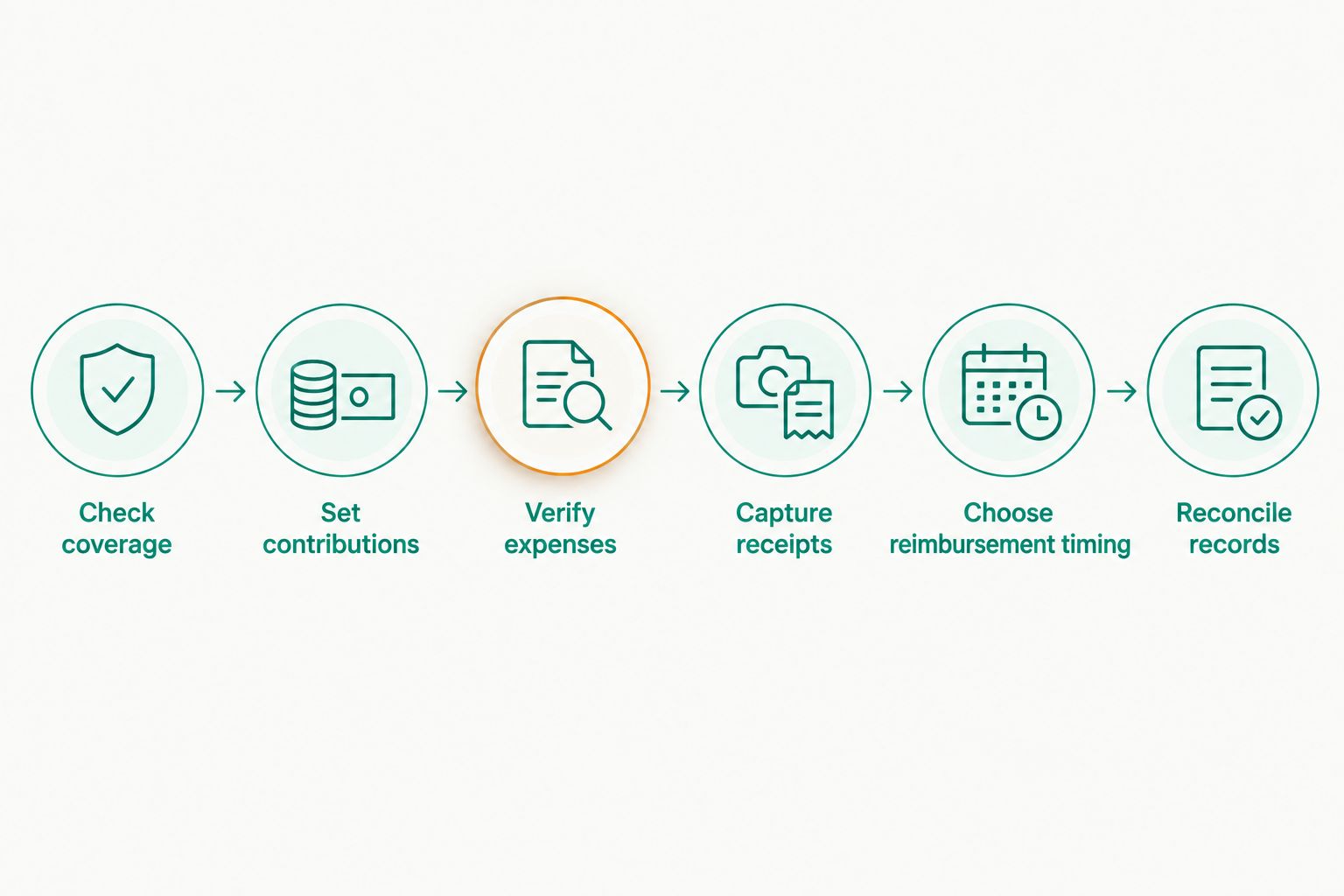
The working sequence is simple: Check coverage, Set contributions, Verify expenses, Capture receipts, Choose reimbursement timing and Reconcile records. Each stage answers a different question; receipt storage alone does not establish eligibility.
Compare receipt-tracking options for teachers
Choose the simplest system you will maintain through the school year. No tracking method creates tax eligibility, and no paid subscription is necessary to obtain a qualified tax-free HSA reimbursement.
| Option | Best for | Main advantage | Key limitation |
|---|---|---|---|
| Paper receipts and folders | Teachers who prefer physical records | Keeps original documents together | Requires manual organization and protection against loss or fading |
| Spreadsheet and digital folders | Teachers comfortable maintaining their own ledger | Lets you define fields and store copies separately | Requires manual entry, matching and backups |
| HSA-provider receipt tools | Teachers whose provider offers suitable storage | Keeps records within the provider’s account workflow | Features vary; confirm export and access before switching providers |
| Reimbursable free manual tracking | Teachers wanting a dedicated receipt-tracking app | Unlimited free manual tracking | Requires manual record entry |
| Reimbursable Premium | Teachers whose receipt admin justifies automation | Receipt scanning, bank sync and email forwarding | Automation still requires checking expense eligibility and accuracy |
Before adopting any system, test whether you can retrieve a complete record: receipt, payment evidence, insurance adjustment and reimbursement history. That test matters more than collecting documents without a way to match them.
Common mistakes teachers make with HSAs
Assuming any school health plan qualifies
A district offering an HSA does not mean every plan on its enrollment menu is HSA-qualified. Check the plan you actually select, and repeat the check when moving districts or joining a spouse’s coverage.
Side work creates another decision point. A teacher evaluating health insurance for self-employed Texans still needs to verify HSA eligibility separately: self-employment and a high deductible do not, by themselves, establish that a policy qualifies. Review all concurrent coverage before contributing.
Treating summer as an automatic coverage gap
A break from teaching duties is not proof that health coverage ended. Conversely, leaving a district does not establish that coverage continues until your next teaching contract starts.
Use the actual coverage termination and effective dates. Payroll timing, the academic calendar and health coverage dates are separate facts; record each rather than inferring one from another.
Applying FSA deadlines to HSA receipts
An HSA balance carries forward and stays yours when you leave the district. A health FSA follows the employer plan’s rules for incurring expenses and submitting claims, including any applicable grace period or carryover.
For 2026 benefits, keep the FSA plan document’s deadlines separate from your HSA ledger. Never submit the same expense to both accounts, even if one deadline is approaching.
Confusing classroom needs with personal medical care
An item purchased to keep students healthy is not automatically your qualified medical expense. Separate classroom supplies from medical care for yourself, your spouse or an eligible dependent.
General-health supplements and fitness expenses also need careful review. A prescription or doctor’s letter does not automatically turn a general-health purchase into an HSA-qualified expense; the underlying medical purpose and applicable IRS rules still control.
FAQ
Can teachers open an HSA?
Teachers can open and contribute to an HSA when they meet the IRS eligibility requirements. Your teaching job does not establish eligibility; qualifying health coverage and the absence of disqualifying coverage matter.
How much can a teacher contribute to an HSA in 2026?
The 2026 HSA contribution limit is $4,400 for self-only coverage or $8,750 for family coverage, including employer contributions. Eligible account holders age 55 or older can contribute an additional $1,000 to their own HSA; partial-year eligibility can affect the permitted amount.
Can I contribute to an HSA if my spouse has an FSA?
A spouse’s general-purpose health FSA generally prevents HSA contributions if it can reimburse your medical expenses. A qualifying limited-purpose FSA is different, so check the plan’s exact coverage terms.
Can I save a teacher’s medical receipts and reimburse myself years later?
Yes, there is no IRS deadline for reimbursing a qualified HSA expense incurred after the HSA was established. Keep records showing the expense qualified, was not reimbursed elsewhere and was not claimed as an itemized deduction.
Do I lose my HSA when I change school districts?
No, your HSA remains yours when you change districts. Your new coverage can change whether you are eligible to make additional contributions, but it does not erase your existing balance.
Can I use my HSA for classroom first-aid supplies?
Classroom first-aid supplies are not automatically your qualified medical expenses. HSA reimbursement generally concerns qualifying medical expenses for you, your spouse or eligible dependents, not general supplies purchased for students.
Do I need a paid app to track HSA receipts?
No, a paid app is not required for tax-free HSA reimbursement. Paper files, digital folders, spreadsheets and suitable HSA-provider tools are legitimate alternatives when they preserve the necessary records.
One last thing
Save proof of when your HSA was established alongside your receipts. A perfectly readable medical bill still cannot support tax-free reimbursement if the expense predates the account’s establishment. Ask the custodian to confirm that date before you lose access to old account documents.
Not tax advice; consult your tax advisor. Federal guidance referenced here includes IRS Publication 969, IRS Publication 502, Form 8889 and the IRS’s published 2026 HSA contribution limits. Check current IRS guidance and your benefits documents before acting.