
Instead of sorting medical receipts while preparing Form 8889, match each HSA withdrawal to documented eligible expenses throughout the year so tax time becomes a reconciliation, not a search. Keep receipts with your records; you generally do not attach them to your federal return.
- For hsa form 8889 receipts, match HSA distributions to qualified expenses and retain supporting records rather than attaching receipts.
- Reimbursable suits HSA holders who want receipt tracking; unlimited manual tracking does not require Premium.
- Expenses must follow HSA establishment and cannot also receive insurance reimbursement, FSA reimbursement, or an itemized deduction.
- Report distributions for the return’s tax year, even when the supporting medical expenses occurred earlier.
Why this matters
A receipt proves an expense; it does not, by itself, prove an HSA withdrawal is tax-free. You also need to establish eligibility, timing, payment, and the absence of another reimbursement or deduction.
Reimbursable offers HSA receipt tracking and an eligibility directory. Use those records to support your return, not as a substitute for applying IRS rules.
For your 2026 review, the federal sources are the IRS Instructions for Form 8889, Publication 969 for HSA distribution rules, and Publication 502 for medical-expense definitions. Publication 502 is a starting point, not a complete HSA checklist: HSA-specific rules differ for some expenses, including certain over-the-counter purchases.
Reimbursable is best for HSA holders who want a dedicated receipt-tracking app. A spreadsheet, organized folders, paper records, or your HSA provider’s receipt tools can also support a valid reimbursement.
Before you start
- Gather itemized receipts, proof of payment, insurance explanations of benefits, your HSA establishment records, and every applicable Form 1099-SA. Have access to your tax software or preparer and HSA transaction history.
- Choose a tracking method you can maintain. Reimbursable provides unlimited free manual tracking; Premium adds AI receipt scanning, bank sync, and email forwarding. Automation reduces entry work but does not determine tax eligibility.
- Separate the withdrawal year from the expense year. A qualifying older expense can support a current HSA reimbursement, but an unreimbursed receipt alone does not create a distribution to report. Do not confuse a return filed during 2026 with a return covering 2026 activity.
These instructions use column names you create yourself, not unverified app buttons. Tax-software screens differ; use the applicable IRS form and instructions to check where the amounts belong.
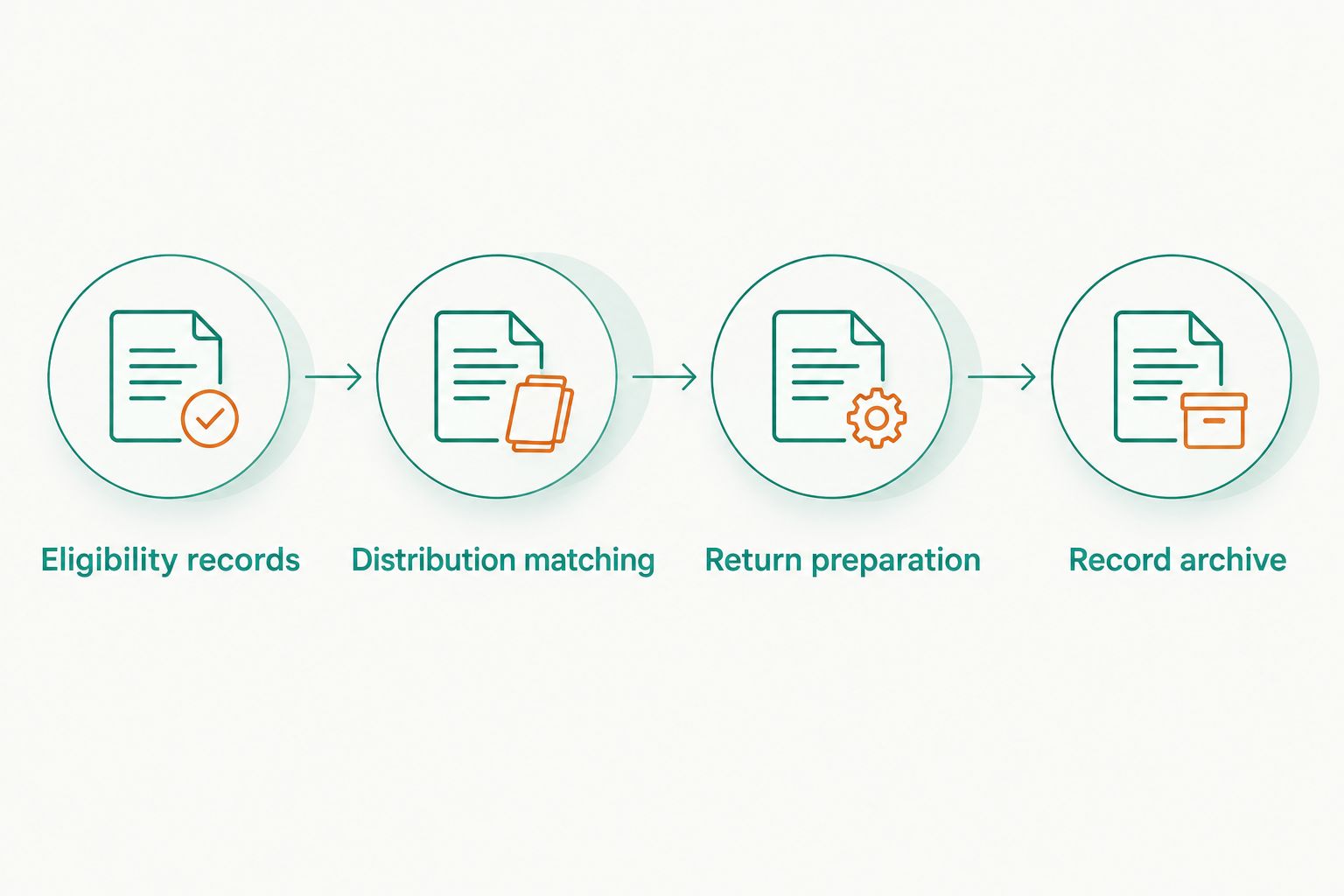
Eligibility records
- Create an expense register. Add columns named Expense ID, Patient, Service date, Payment date, Provider, Description, Amount paid, Insurance reimbursement, Other reimbursement, Prior deduction, and Eligible balance. Store the supporting documents under the same expense identifier.
- Check the expense against HSA rules. Confirm that it is qualified medical care for you, your spouse, or an eligible dependent under the applicable rules. Save an itemized description rather than relying on a merchant name or card statement alone.
- Verify HSA establishment timing. The expense must have been incurred after your HSA was established. Keep evidence of that establishment date; an account’s current balance does not establish when it began.
- Remove amounts paid elsewhere. Exclude insurance payments, FSA reimbursements, other reimbursements, and amounts already used for a medical-expense deduction. Keep unresolved insurance claims separate until you can determine your actual responsibility.
- Review special documentation. A doctor’s letter does not automatically turn a general-health purchase into qualified medical care. Preserve the medical explanation where relevant, then apply the underlying eligibility rule.
Expected result: Each expense has an identifiable document trail and a remaining eligible balance, rather than just a photograph in a folder.
For example, a dental statement and an insurance explanation of benefits serve different purposes. The statement identifies treatment and charges; the insurance record helps establish what insurance covered. Keep proof of your own payment as well.
Distribution matching
- Collect every distribution record. Gather Forms 1099-SA and HSA statements for the tax year being reported. Include direct HSA-card payments as well as transfers reimbursing your personal bank account.
- Create a withdrawal register. Add Distribution date, HSA account, Distribution amount, Matched expense ID, Matched amount, and Unmatched amount. Use separate matching rows when a withdrawal covers several expenses.
- Assign eligible expenses. Match withdrawals to documented eligible balances. An older eligible expense can support a later reimbursement if it meets the HSA requirements and has not already been reimbursed or deducted.
- Reduce the remaining balance. After matching part of an expense, retain the unreimbursed remainder. Never mark an entire receipt reimbursed when only part was covered.
- Investigate differences. Separate direct trustee-to-trustee transfers, rollovers, returned contributions, and ordinary spending before deciding their tax treatment. These transactions do not all follow the same reporting rules.
Expected result: Every distribution has a documented explanation, and no expense balance is used twice.
For a 2026 distribution, the supporting receipt does not have to carry a 2026 date. The controlling questions are whether the expense followed HSA establishment and whether it remains eligible and unreimbursed.
Return preparation
- Select the correct tax year. Open the Form 8889 instructions for the year covered by your return. Use that year’s records and form, not simply the form matching today’s calendar date.
- Enter source information faithfully. Enter each Form 1099-SA as directed by your software or preparer, including its distribution code. Do not change the reported distribution merely because some spending was qualified.
- Reconcile Part II. On Form 8889, line 14a reports total HSA distributions. Line 14b addresses specified exclusions, including qualifying rollovers; follow its instructions before subtracting anything. Line 14c reflects the remaining distributions.
- Determine qualified spending. Line 15 reports qualified medical expenses paid using the relevant HSA distributions. Use your matching register, not the total of every receipt you saved. Line 16 identifies taxable distributions after the applicable subtraction.
- Review the entire form. Form 8889 also addresses contributions and other HSA tax issues. A receipt reconciliation does not establish your contribution eligibility or resolve every reporting requirement.
Expected result: Your reported qualified amount traces back to matched expenses, and your reported distributions trace back to HSA tax documents.
A taxable HSA distribution can also face a 20% additional tax. Exceptions apply, including distributions after age 65, disability, or death; an exception to the additional tax does not automatically eliminate ordinary income tax.
Record archive
- Save the reconciliation. Preserve the expense register, withdrawal register, supporting documents, and final return together in an organized archive. Keep records readable and accessible outside any single device.
- Preserve reimbursement status. Record which expenses supported the filed return and which eligible balances remain available for later reimbursement. Keep a history rather than overwriting the original expense.
- Retain supporting records. IRS Publication 969 requires records supporting qualified distributions, the absence of other reimbursement, and the absence of an itemized deduction. You generally keep these documents rather than submitting them with the return.
- Protect older claims. Keep unreimbursed expense documentation while you intend to use it for a future HSA reimbursement. After reimbursement, retain the supporting tax records for the applicable limitations period; ask your tax advisor about your circumstances.
Expected result: You can move from a reported distribution to its supporting receipts without reconstructing the story from memory.
The 2026 archive should distinguish expenses incurred, expenses reimbursed, and distributions reported. Those categories overlap, but they are not interchangeable.
Second workflow: reimburse older expenses later
Paying an eligible expense out of pocket does not require you to reimburse it immediately. IRS Notice 2004-50, Question 39, explains that there is no time limit for HSA reimbursement when the requirements are met, including incurring the expense after HSA establishment.
- Record the eligible expense when paid, even if you make no withdrawal.
- Mark the expense as unreimbursed and retain its documentation.
- Before a later withdrawal, recheck insurance adjustments, prior reimbursements, and deductions.
- Match the later distribution to the expense and update its remaining balance.
- Report the distribution for the year it occurred, using that year’s applicable form.
An unused receipt is a record, not a tax deduction or a distribution. Delaying reimbursement also does not guarantee investment growth or tax savings.
Do not apply this timing rule to an FSA. FSAs have plan-year coverage rules and claim-submission deadlines, with any grace period or carryover governed by the plan. Check the plan documents rather than assuming HSA flexibility applies.
Troubleshooting
Your receipt total exceeds your distributions
Report qualified expenses paid using the relevant distributions, not your entire receipt archive. Keep unused eligible balances separate for potential later reimbursement; they do not increase the amount distributed.
Your distributions exceed your matched expenses
Look for missing HSA-card purchases, older unreimbursed expenses, or transaction classifications requiring special treatment. Do not create a receipt or assume the difference qualifies. Ask your preparer to address any remaining taxable amount and applicable additional tax.
Insurance reimburses a bill after you matched it
Update the expense and flag the affected HSA distribution immediately. Do not leave both reimbursements assigned to the same medical cost; ask your HSA custodian and tax advisor which correction procedure applies before filing or amending.
You saved a bank transaction but no itemized receipt
Request a duplicate receipt or detailed provider statement, and preserve proof of payment. A bank entry identifies a payment but usually does not establish the medical service or item purchased. An explanation of benefits alone also does not prove you paid.
Your tax document does not match your account records
Compare transaction dates, distribution codes, and all accounts before changing a return entry. Contact the custodian about a potentially incorrect Form 1099-SA; do not silently replace the reported figure with your preferred total.
Customize your workflow
Choose the least burdensome system that preserves the evidence. The table compares tracking approaches, not tax eligibility: every method requires you to review the underlying expenses.
| Method | Best for | Practical advantage | Limitation |
|---|---|---|---|
| Reimbursable manual tracking | HSA holders wanting a dedicated app | Unlimited manual expense tracking | You still enter and review records |
| Reimbursable Premium | HSA holders reducing receipt entry | AI receipt scanning, bank sync, and email forwarding | Imported information still needs verification |
| Spreadsheet and folders | People wanting a custom register | You control columns and document organization | Matching and balance updates require manual work |
| Paper receipts | People maintaining physical records | Preserves original documents | Finding records and protecting against loss require care |
| HSA-provider receipt tools | People keeping records near their account | Can keep supporting records alongside account activity, where offered | Features and access vary by provider |
For 2026, organize around one question: can you trace each reimbursement to an eligible, previously unused expense? The guide to applying HSA reimbursement rules to an expense ledger explains the record structure in more detail.
Start with free manual tracking if it meets your needs. Consider automation only when scanning, bank sync, or email forwarding removes work you actually have.
FAQ
Do I attach HSA receipts to Form 8889?
You generally do not attach HSA receipts to Form 8889 or your federal return. Retain records supporting eligible expenses, payment, and the absence of another reimbursement or deduction.
Do I report every medical receipt I saved?
No. Form 8889 reports HSA activity, including distributions and qualified medical expenses paid using those distributions. An unreimbursed receipt does not create a withdrawal to report.
Can an older receipt support a 2026 HSA withdrawal?
Yes, if the expense was incurred after your HSA was established and otherwise meets the reimbursement rules. It cannot already have been reimbursed elsewhere or used for an itemized deduction.
Does my HSA provider decide whether my withdrawal is qualified?
You are responsible for substantiating that your HSA distribution qualifies for tax-free treatment. A processed withdrawal or accepted receipt upload does not replace your supporting records.
Can I use the same receipt for my HSA and FSA?
You cannot reimburse the same portion of an expense from both an HSA and an FSA. Track which account reimbursed each eligible portion and retain the supporting documents.
Do I need Premium to qualify for tax-free reimbursement?
No. Tax-free treatment depends on the expense and applicable HSA rules, not a paid tracking subscription. Spreadsheets, folders, paper receipts, and suitable provider tools are legitimate alternatives.
Does a doctor's letter make any wellness purchase HSA eligible?
No. A doctor's letter does not automatically qualify a general-health expense. Apply the medical-expense rules and preserve any documentation needed for the specific expense.
One last thing
Use separate fields for the service date and the reimbursement date. An older eligible expense can support a later distribution, so one generic date field can obscure the very distinction your return needs.
Not tax advice. Always consult your tax advisor, especially when correcting a distribution, handling insurance refunds, or reviewing an expense’s eligibility.