
Choose Reimbursable if you want personal HSA receipt tracking for medical expenses you pay out of pocket; choose Forma if your employer uses Forma and you need to manage the benefits provided through that plan. This 2026 comparison separates personal recordkeeping from employer benefit administration so you can choose the right workflow—not replace an account administrator with a receipt app.
- Reimbursable vs Forma is a personal HSA receipt-tracking versus employer-benefits decision, not a like-for-like account comparison.
- Reimbursable is best for HSA holders building a personal record of unreimbursed medical expenses.
- Forma is best for employees managing benefits their employer provides through Forma.
- HSA reimbursement timing differs from FSA claim deadlines; a receipt app does not change either rule.
Why this matters
A medical receipt can serve different purposes: supporting an employer-plan claim, documenting an HSA withdrawal, or preserving evidence for a reimbursement years later. Choosing software before identifying that purpose creates unnecessary work.
Your receipt tracker and your benefits administrator do not have to be the same service. For a 2026 decision, start with the account involved, who controls its administration, and whether you need to submit a claim now or preserve records for later.
Neither a directory entry nor an app-generated expense record establishes tax eligibility by itself. You still need a qualified expense, supporting documentation, and a record showing that another source has not already reimbursed it.
At a glance
| Dimension | Reimbursable | Forma |
|---|---|---|
| Best for | Individuals saving HSA receipts for later reimbursement | Employees managing employer-provided benefits through Forma |
| Standout purpose | Personal receipt tracking alongside an eligibility directory | Employer-sponsored benefits administration |
| Workflow ownership | You maintain your personal expense record | Your employer's benefit arrangement determines the relevant workflow |
| Eligibility decisions | Directory supports research; tax rules still apply | Plan requirements and applicable tax rules still apply |
| Reimbursement timing | Tracking does not change HSA or FSA rules | Administration does not change HSA or FSA rules |
| Pricing model | Free manual tracking; optional Premium subscription | Employer-arranged benefit terms rather than a directly equivalent personal tracker subscription |
| Main limitation | Receipt tracking does not replace your benefits administrator | An employer benefit workflow is not automatically your complete personal HSA archive |
The table compares purposes, not an exhaustive inventory of software features. Do not treat an unlisted feature as absent, or assume that every employer's Forma arrangement includes the same benefits.
Personal HSA receipt tracking wins for your long-term archive
Reimbursable is best for HSA holders building a personal record of unreimbursed medical expenses. Its free manual tracking is unlimited, and Premium adds receipt scanning, bank sync, and email forwarding to reduce receipt administration.
That distinction matters when you pay a qualified medical bill yourself and leave money in your HSA. You need a durable connection between the expense, its supporting documents, and any later reimbursement—not simply a record that you visited a doctor.
A useful personal entry includes the patient, provider, service date, eligible amount, payment evidence, and reimbursement status. Keep insurance adjustments with the same expense so the record reflects your final responsibility rather than the provider's original charge.
The limitation is clear: a personal tracker does not approve an employer-plan claim or replace the institution holding your HSA. You must still follow the appropriate process when you actually request money.
Forma wins when the task is using an employer-provided benefit
Forma is the better fit when your employer provides a benefit through Forma and you need to use that benefit's administration process. The relevant instructions come from your employer's plan, not from a separate receipt directory.
For example, if your employer directs you to Forma for a benefit claim, adding the receipt to a personal archive does not submit that claim. Complete the required employer-plan process, then update your personal records to show what was reimbursed.
This is Forma's practical advantage in this comparison: it belongs to the employer-benefit workflow you have been assigned. A standalone tracker cannot substitute for that relationship.
The tradeoff is scope. Do not assume an employer-benefit record contains every medical expense you paid yourself, every historical receipt, or every remaining amount eligible for a future HSA reimbursement. Maintain your own record where those responsibilities extend beyond the employer workflow.
A personal ledger wins when expenses span several workflows
Your medical records can include pharmacy receipts, dental bills, insurance explanations of benefits, and expenses submitted through an employer plan. A personal ledger gives those records a common place without pretending they all follow the same reimbursement rules.
The important field is the remaining unreimbursed eligible amount. An expense marked merely as paid does not tell you whether insurance, an FSA, an HSA, or another source has already covered it.
Use separate statuses for expenses awaiting insurance processing, expenses ready for reimbursement, partially reimbursed expenses, and fully reimbursed expenses. A folder can hold the evidence; a ledger should explain what the evidence means.
Spreadsheets, organized folders, paper receipts, and HSA-provider receipt tools are legitimate alternatives. The advantage of a dedicated tracker is less manual organization when its features match your habits—not a different entitlement to tax-free reimbursement.
Forma wins for following employer-plan instructions
An employer benefit has its own administrative requirements. When Forma is the designated administrator for the relevant benefit, its plan-specific instructions are the right starting point for submissions, documentation requests, and claim status.
Keep the distinction between a tax question and an administrative question clear. Whether an expense meets a tax definition is different from where your employer requires you to submit it or which supporting documents the plan requests.
For a 2026 claim, read the current plan materials rather than relying on a comparison article to describe your employer's arrangement. Confirm the benefit type before using any deadline or eligibility guidance.
After a claim is paid, preserve the outcome alongside the receipt. That record prevents an employer-plan reimbursement from later appearing in your personal ledger as an expense still available for HSA reimbursement.
Neither service overrides medical-expense eligibility
Eligibility is a tie: software helps organize the decision, but the applicable rules determine the answer. IRS Publication 502 explains medical-expense categories; IRS Publication 969 addresses HSAs and other tax-favored health plans.
The eligibility directory covers 890+ HSA/FSA-eligible items and supports research. It does not make every purchase within a broad product category qualified, and it does not replace the documentation needed for your particular expense.
A doctor's letter does not automatically turn a general-health expense into a qualified medical expense. The underlying purpose and applicable requirements still matter. Be especially careful when a purchase serves both ordinary wellness and treatment purposes.
Mixed receipts need the same discipline. Separate qualified items from unrelated purchases before recording the eligible total; the guide to separating HSA-qualified expenses on mixed bills explains that recordkeeping problem in more detail.
Neither service changes HSA or FSA reimbursement timing
Timing is another tie: your account rules—not your choice of app—control reimbursement. There is no IRS deadline for reimbursing yourself from an HSA for a qualified expense incurred after the HSA was established, provided you retain the required records.
The expense cannot also have been reimbursed elsewhere or claimed as an itemized medical deduction. Delaying the withdrawal does not relax those conditions.
An FSA is different. Eligible expense periods and claim-submission deadlines depend on the plan's rules, including any applicable grace period or carryover provisions. Do not apply the HSA's delayed-reimbursement approach to an FSA claim.
If you pay an eligible bill in 2026 and plan to reimburse yourself later, preserve the service date and evidence that your HSA already existed. A recent payment date does not rescue an expense incurred before the account was established.
Pricing: choose automation only when it reduces work
Reimbursable offers unlimited free manual tracking and an optional Premium subscription. Premium's role is less receipt administration through receipt scanning, bank sync, and email forwarding—not permission to obtain tax-free reimbursement.
Review the current pricing before deciding whether automation solves a recurring problem. If you already keep complete records with a spreadsheet and folders, a subscription is not required to make that method legitimate.
Forma's relevant terms come through the employer benefit arrangement. That is not the same purchasing decision as choosing an optional personal receipt-tracking subscription; start with your employer's benefit documents to understand the arrangement that applies to you.
Compare effort as well as payment models. Manual tracking gives you direct control but requires consistent filing. Automation can reduce entry work, but you still need to review the expense, eligibility, and reimbursement status.
Use this receipt workflow with either option
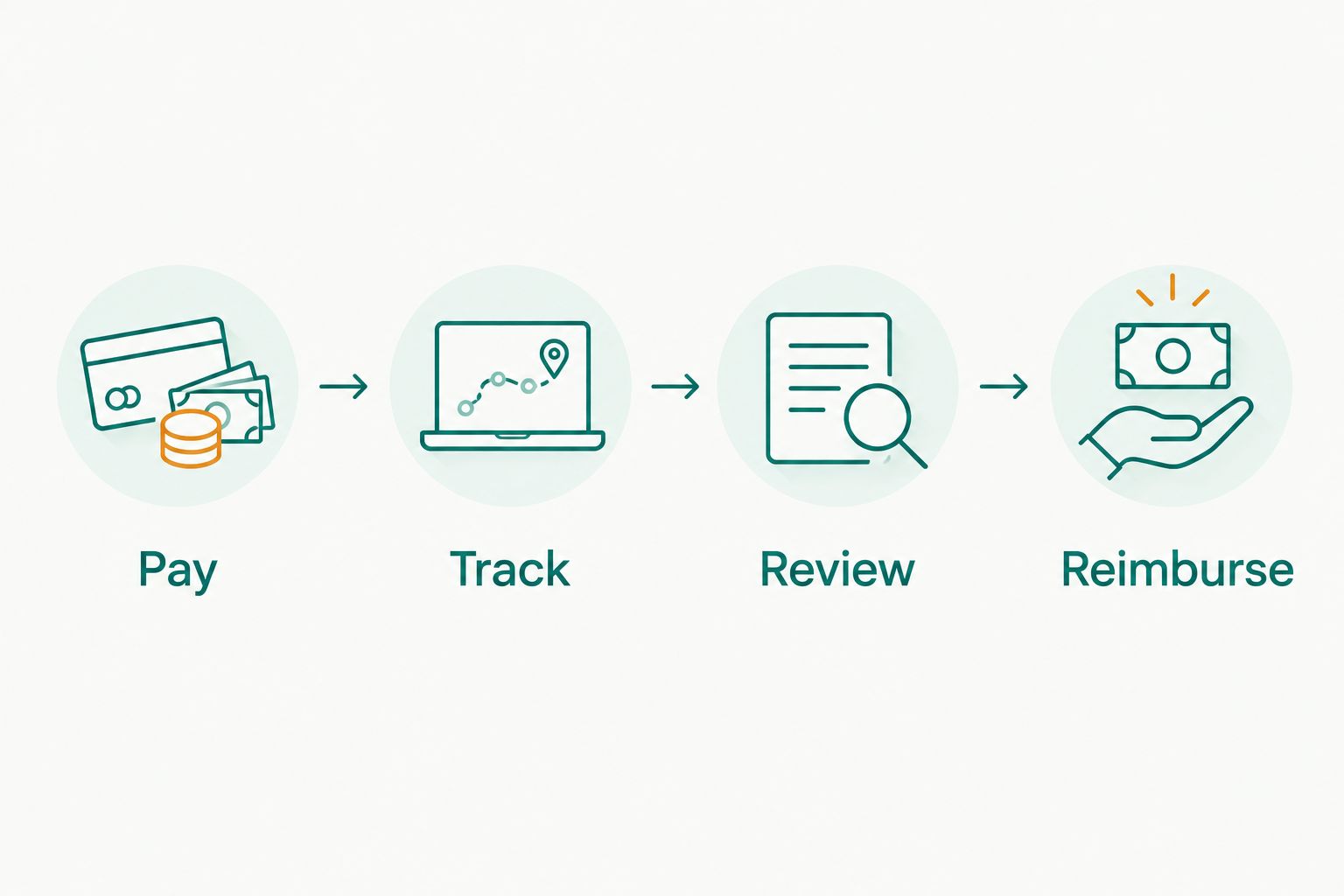
Build your 2026 process around 4 steps: Pay, Track, Review, Reimburse. The sequence works whether you use a dedicated app, an HSA-provider tool, or a spreadsheet with supporting files.
Pay
Keep the itemized bill or receipt and evidence of payment. Where insurance applies, retain the explanation of benefits and reconcile it with the provider's final bill.
A payment transaction alone does not explain which medical service you received. Keep enough detail to connect the payment to the qualified expense.
Track
Record the patient, service date, provider, eligible amount, and account involved. Note whether the expense is awaiting insurance processing or has already been submitted to another reimbursement source.
Keep 3 record types together: the expense detail, payment evidence, and reimbursement history. They answer different questions and should be easy to match.
Review
Confirm that the expense occurred after your HSA was established. Check that you have not already received reimbursement elsewhere or claimed the expense as an itemized deduction.
Review scanned entries rather than treating extracted text as a tax decision. Correct dates, totals, and duplicate records before relying on the ledger.
Reimburse
Use the process required by the account or benefit involved. Record the withdrawal or claim payment against the original expense and update any remaining eligible balance.
Do not delete the supporting documents after reimbursement. They substantiate why the distribution received its tax treatment.
The most useful workflow is the one you keep current. Schedule a regular review of unresolved insurance adjustments and expenses that still lack supporting documents.
Final verdict: choose by responsibility, not feature count
Choose Reimbursable if you own the long-term receipt record
Best for: an HSA holder paying medical expenses out of pocket and preserving receipts for later reimbursement. Start with free manual tracking; consider Premium when scanning, bank sync, or email forwarding removes work you otherwise postpone.
Choose Forma if you need your employer's benefit workflow
Best for: an employee whose employer provides the relevant benefit through Forma. Follow that plan's submission requirements, then keep the outcome in your personal records where needed.
You can have both responsibilities. Using an employer platform and maintaining a separate personal archive is not a contradiction, provided you keep reimbursement status consistent.
| Dimension | Winner |
|---|---|
| Personal HSA receipt archive | Personal receipt tracking |
| Employer-provided benefit access | Forma, when designated by your employer |
| Consolidating your own expense ledger | Personal receipt tracking |
| Employer-plan submission instructions | Forma, for the benefit it administers |
| Medical-expense eligibility | Tie: applicable rules control |
| HSA versus FSA timing | Tie: account and plan rules control |
| Pricing decision | Different purchasing models; no universal winner |
FAQ
Is Reimbursable better than Forma for HSA receipt tracking?
Reimbursable is the better fit for an individual building a personal HSA receipt archive. Forma is the relevant choice when your employer provides the benefit through Forma and requires its administration process.
Can I use a personal receipt tracker alongside Forma?
Yes, personal recordkeeping can sit alongside an employer-benefit workflow. Keep both records consistent so an expense reimbursed through one source is not claimed again through another.
Do I need Premium to get tax-free HSA reimbursement?
No, a paid receipt-tracking subscription is not required for tax-free HSA reimbursement. Eligibility and adequate supporting records matter; spreadsheets, folders, paper receipts, and HSA-provider tools are legitimate alternatives.
Can I reimburse myself years after paying a medical bill?
Yes, there is no IRS deadline for HSA reimbursement of a qualified expense incurred after the HSA was established. Keep documentation and ensure the expense was not reimbursed elsewhere or claimed as an itemized medical deduction.
Do FSA claims have the same unlimited timing as HSA reimbursements?
No, FSA claims follow the plan's eligible expense periods and submission deadlines. Check your plan materials for any applicable grace period or carryover provisions.
Does a doctor's letter make a wellness purchase HSA eligible?
No, a doctor's letter does not automatically qualify a general-health purchase. The expense must satisfy the applicable medical-expense requirements, and supporting documentation must match your circumstances.
Which IRS sources explain these reimbursement rules?
IRS Publication 969 explains HSAs and other tax-favored health plans, while Publication 502 explains medical-expense categories. For a 2026 decision, consult the current IRS guidance and your plan documents rather than treating a directory entry as a tax ruling.
One last thing
The most important receipt field is often what remains unreimbursed. A perfectly readable receipt can still lead to a duplicate claim if your records omit an insurance payment, employer-plan reimbursement, or earlier HSA withdrawal.
Keep the receipt and its reimbursement history together. Not tax advice; always consult your tax advisor.