
If insurance refunds a medical bill after you reimbursed yourself from your HSA, the refunded portion no longer supports a tax-free reimbursement for that expense. Reconcile the final amount you actually owed, then contact your HSA custodian about its mistaken-distribution process. If that correction is unavailable, ask your tax advisor how to substantiate or report the distribution; do not treat an ordinary HSA deposit as an automatic fix.
- HSA reimbursement rules after insurance refund require matching your withdrawal to your final, unreimbursed qualified medical expense.
- IRS Publication 969 explains that insurance-reimbursed expenses cannot also support tax-free HSA distributions.
- Ask your HSA custodian about mistaken-distribution treatment before depositing the refund into your HSA.
- Keep the original receipt, revised insurance explanation, refund confirmation, and any correction records together.
What happens if insurance refunds an HSA-reimbursed bill?
You cannot keep two tax-free reimbursements for the same medical expense. Insurance reimbursement reduces the expense available to support your HSA withdrawal, whether the insurer pays you directly or a provider returns an overpayment after insurance settles.
Start with this calculation:
Final qualified expense = eligible amount you paid minus insurance payments, provider refunds, and other reimbursements covering that amount.
Compare that result with the HSA money you already withdrew for the bill. For a repeatable recordkeeping method, use an HSA expense ledger that distinguishes the original payment from later adjustments.
| What happened | What it means | Next move |
|---|---|---|
| Insurance reimbursed the entire expense | That expense no longer supports the HSA withdrawal | Ask the custodian about correcting a mistaken distribution |
| Insurance reimbursed part of the expense | Only the final unreimbursed qualified portion remains available | Identify the portion of the withdrawal no longer supported |
| Insurance paid the provider, but you received no refund | An insurance payment alone does not establish how much you overpaid | Obtain the revised patient balance and resolve any overpayment |
| Insurance only issued a revised explanation of benefits | The explanation is not itself proof of a refund | Match it with the provider's account and actual payments |
For a refund discovered in 2026, use IRS Publication 969 for HSA distribution rules and Publication 502 for medical-expense eligibility. Publication 502 alone does not explain every HSA correction or reporting rule.
Why this matters
An original receipt proves that you paid a bill. It does not prove that the expense remained unreimbursed after insurance finished processing it.
Your records must tell the complete story: payment, HSA withdrawal, insurance adjustment, and final patient responsibility. Otherwise, the same receipt can appear to support more tax-free reimbursement than the expense allows.
Correct the record when the refund arrives, not when you next need money from your HSA. Waiting makes it harder to identify the affected distribution and can jeopardize a correction deadline.
What should you do after the refund arrives?
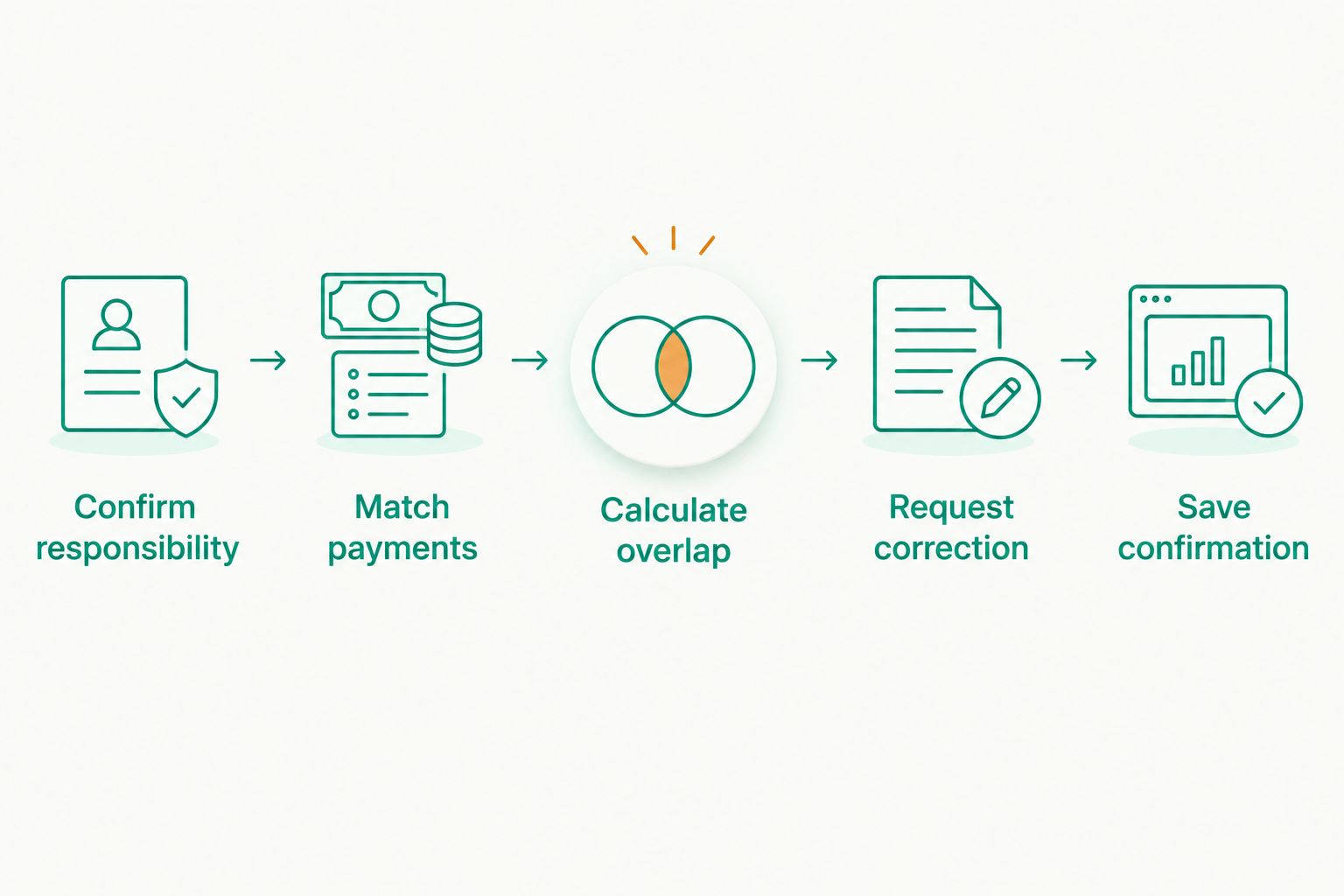
1. Confirm responsibility
Request the provider's final account statement and compare it with the insurer's latest explanation of benefits. An explanation of benefits describes claim processing; it is not a receipt showing what you paid or what the provider returned.
Identify who received the insurance payment. If the insurer paid the provider, establish whether the provider owes you a refund or applied a credit elsewhere. Do not assume that every insurance adjustment equals cash returned to you.
2. Match payments
Find the original payment and the HSA distribution used to reimburse it. Record whether you paid directly with an HSA card or paid out of pocket and later transferred money from the HSA to yourself.
Both routes require qualified, unreimbursed expenses. Paying first with a personal credit card does not preserve eligibility after insurance reimburses the same expense.
3. Calculate overlap
Separate the amount you ultimately owed from the amount someone else covered. If the bill contained eligible and ineligible charges, resolve those separately rather than treating the entire statement as one qualified expense.
The guide to separating HSA-qualified expenses on mixed bills explains that distinction. A refund allocated to a particular charge belongs against that charge, not an unrelated expense on the statement.
4. Request correction
Contact the HSA custodian and describe the sequence accurately: you paid a medical expense, took an HSA distribution, and subsequently received an insurance-related refund. Ask whether the custodian accepts a return of a mistaken distribution for those facts.
Request its required paperwork, deadline, payment instructions, and reporting treatment. Do not label the transfer a regular contribution unless that is actually what you intend and your advisor confirms the consequences.
5. Save confirmation
Keep the custodian's written response and any completed correction documents with the medical records. Update the expense's status so it cannot accidentally support another reimbursement later.
If the custodian declines the correction, retain that response too. Your tax advisor needs the facts, amounts, dates, and available records to determine the appropriate reporting.
Can you return the refund as a mistaken distribution?
IRS guidance permits certain mistaken HSA distributions to be returned when the mistake resulted from reasonable cause. An insurance refund does not automatically guarantee that your custodian will accept a mistaken-distribution return. The circumstances and the custodian's procedures matter.
The IRS deadline for returning a qualifying mistaken distribution is April 15 following the first year you knew, or should have known, the distribution was a mistake. A custodian is not required to accept these returns.
For example, if 2026 is the first year you knew or should have known about the mistake, the relevant deadline is the following April 15. Do not assume that extending your income-tax filing deadline extends this correction window.
A properly handled return of a mistaken distribution is different from a normal contribution. Ask the custodian how it will classify the return and handle any affected tax documents; an unexplained transfer into the account does not establish that a correction occurred.
What happens if the distribution cannot be corrected?
A distribution that is not supported by qualified medical expenses is generally included in taxable income. An additional 20% tax generally applies to the nonqualified amount, subject to exceptions including distributions after age 65, disability, or death.
Those exceptions remove the additional tax where applicable; they do not make a nonmedical distribution tax-free. A refund affecting only part of an expense does not automatically make the entire original withdrawal nonqualified.
Before filing, ask your advisor whether other properly documented, unreimbursed qualified expenses can substantiate the distribution. Do not simply swap in a different receipt without checking its timing, eligibility, and reimbursement history.
For your 2026 tax review, consult IRS Publication 969 and the applicable Instructions for Form 8889. If the original distribution appeared on an earlier return, your advisor should determine whether that return needs correction rather than assuming everything belongs on the refund year's return.
Why the correction path varies
The next step depends on the actual payment history, not just the word refund on a bank statement:
- Final patient responsibility: A partial refund leaves a different qualified amount than a full refund.
- Payment destination: Insurance money paid to you and insurance money paid to the provider require different reconciliation records.
- Discovery date: The mistaken-distribution deadline depends on when you knew or should have known about the mistake.
- Reason for the mistake: Reasonable-cause requirements matter; acceptance is not automatic.
- Custodian procedures: The custodian decides whether it accepts mistaken-distribution returns and what documentation it requires.
- Tax-reporting history: A previously filed return requires a different review from a distribution that has not yet been reported.
When you contact the custodian in 2026, provide the timeline rather than only the refund notice. That gives the custodian the information needed to explain its available process.
What records should you keep together?
Create one file for the expense, with the original documents and every later adjustment. Preserve the original entries rather than deleting the receipt once a refund arrives.
Include:
- The itemized bill identifying the patient, provider, service date, and services.
- Proof of your original payment.
- The HSA distribution date and amount.
- The original and revised explanations of benefits.
- The provider's final statement and refund confirmation.
- A calculation of the remaining unreimbursed qualified expense.
- Custodian correspondence and correction confirmations.
- Notes identifying any related tax-return correction.
Also verify that the expense occurred after your HSA was established. It cannot have been reimbursed elsewhere or also claimed as an itemized medical deduction.
Eligibility and documentation are separate tests. A doctor's letter does not automatically turn a general-health expense into a qualified medical expense, and an excellent receipt cannot fix an ineligible purchase.
For a 2026 reconciliation, keep the payment date, service date, refund date, and HSA distribution date in separate fields. Each answers a different question; replacing them all with a single transaction date hides useful evidence.
Which tracking method fits this problem?
Reimbursable suits HSA holders who want receipt tracking alongside an eligibility directory. Its free manual tracking is unlimited, but recording a receipt does not determine whether a later refund requires a tax correction.
Choose a method you can keep current. A spreadsheet, organized folders, paper files, and an HSA provider's receipt tool are legitimate alternatives; none eliminates your responsibility to reconcile insurance refunds.
| Method | Best for | Useful capability | Limitation |
|---|---|---|---|
| Reimbursable | HSA holders wanting receipt tracking and eligibility lookup | Combines a receipt-tracking app with an eligibility directory | Does not replace custodian correction procedures or tax advice |
| Spreadsheet and folders | People comfortable maintaining their own ledger | Lets you record payments, refunds, and reimbursement status in separate fields | Requires manual updates and consistent filing |
| Paper records | People who prefer physical documentation | Keeps bills and insurance correspondence together without an app | Requires careful storage and a separate way to track changes |
| HSA-provider receipt tool | People wanting records near their HSA account | Provides a provider-based place to keep supporting records where offered | Features and correction procedures depend on the provider |
If you use Reimbursable, keep the revised insurance and refund records alongside your expense documentation. If you use another method, apply the same rule: the final unreimbursed amount must remain clear.
Can you leave the refund in your checking account?
Leaving the refund in checking does not resolve the HSA distribution's tax treatment. First determine whether a mistaken-distribution return is available or whether the withdrawal needs another substantiation or reporting treatment.
The bank account holding the refund is not the central issue. The issue is whether the HSA distribution remains supported by qualified, unreimbursed medical expenses.
Does the same rule apply to an FSA refund?
An FSA also cannot reimburse an expense already covered by insurance, but its correction procedures and deadlines differ from HSA rules. Contact the FSA administrator rather than applying the HSA mistaken-distribution process yourself.
HSAs have no IRS deadline for reimbursing otherwise eligible expenses incurred after the account was established, provided you retain the required records. FSA claim deadlines and any plan-specific grace period or carryover are separate rules.
FAQ
What are the HSA reimbursement rules after an insurance refund?
An insurance refund reduces the qualified expense available to support your HSA withdrawal. Reconcile your final out-of-pocket amount and ask your HSA custodian whether it accepts a return of a mistaken distribution for your circumstances.
Can I just put the insurance refund back into my HSA?
Do not assume an ordinary HSA deposit corrects the distribution. Ask the custodian for its mistaken-distribution process so the money is classified and reported appropriately.
What is the deadline for returning a mistaken HSA distribution?
April 15 following the first year you knew, or should have known, about the mistake is the IRS deadline for returning a qualifying mistaken distribution. Reasonable-cause requirements apply, and the custodian is not required to accept the return.
Will I owe a penalty if insurance refunds an HSA-reimbursed expense?
An additional 20% tax generally applies to nonqualified HSA distributions unless an exception applies. The nonqualified amount is also generally taxable income; first determine whether an accepted correction or other valid substantiation applies.
Does turning 65 make the refunded HSA withdrawal tax-free?
Age 65 removes the additional 20% tax on nonqualified HSA distributions, but it does not remove ordinary income tax on those distributions. A qualified medical expense is still required for tax-free treatment.
Do I need to amend my tax return after an insurance refund?
Whether you need an amended return depends on the distribution, available correction, and prior reporting. Give your tax advisor the original payment, HSA withdrawal, refund, and custodian records before deciding how to report it.
Can Reimbursable replace my HSA custodian's correction process?
Reimbursable provides eligibility lookup and receipt tracking, not a substitute for your HSA custodian's correction process. Keep the supporting records and request correction instructions directly from the custodian.
One last thing
The document to watch is the revised patient balance, not just the refund deposit. An insurer can adjust a claim before the provider returns your overpayment, so an unresolved account credit deserves follow-up even when no money has reached your bank.
Add a final review step to your 2026 receipt routine: confirm that insurance has settled and your ledger reflects what you ultimately paid. That small administrative check keeps an old receipt from supporting a reimbursement it no longer justifies.
Not tax advice. Always consult your tax advisor.