
Yes. Sales tax and shipping directly attributable to an HSA-qualified medical purchase can be included in the amount you reimburse from your HSA. Charges connected to personal items do not qualify, and a mixed order requires you to separate the medical portion before reimbursing yourself.
- For HSA qualified medical expenses, sales tax and shipping follow the eligibility of the underlying purchase.
- Mixed orders require separate treatment of eligible items, personal items, and shared charges.
- Keep an itemized receipt, payment evidence, and your calculation together for later reimbursement.
- Reimbursable suits HSA holders who want eligibility lookup alongside receipt tracking; manual records remain a valid alternative.
Are sales tax and shipping part of HSA medical expenses?
Include sales tax and shipping that belong to qualified medical purchases—not automatically the entire checkout total. The underlying item must qualify first. Adding a tax or delivery charge does not turn an otherwise personal purchase into medical care.
For a 2026 purchase, start with the itemized receipt rather than the amount charged to your card. A checkout total can combine eligible medical supplies, personal purchases, sales tax, shipping, and discounts. Those components need separate treatment when the order contains both eligible and ineligible items.
| Purchase situation | Sales tax treatment | Shipping treatment | What to keep |
|---|---|---|---|
| Order contains only qualified medical items | Include tax actually charged on those items | Include delivery charges directly connected to the medical purchase | Itemized order and payment record |
| Order contains medical and personal items | Include only tax attributable to qualified items | Separate the medical portion; do not assume the entire charge qualifies | Item-level details and allocation notes |
| Order contains only personal items | Exclude the tax | Exclude the shipping | Keep outside your reimbursable balance |
| Qualified item is later refunded | Adjust for any tax returned | Adjust for any shipping returned | Original receipt and refund record |
For a detailed separation workflow, see how to separate HSA-qualified medical expenses on mixed bills. The same principle applies here: your reimbursement should match the qualified amount you actually paid and have not recovered elsewhere.
Why this matters
An HSA reimbursement is not simply a withdrawal matching a store receipt. You need records showing that the distribution covered qualified medical expenses and that those expenses were not already reimbursed through insurance or another source.
Ignoring eligible tax and shipping can leave legitimate expenses out of your records. Including an entire mixed-order total creates the opposite problem: your saved reimbursement balance can contain personal spending.
For 2026 receipt tracking, record the qualified amount when you make the purchase. That prevents you from having to reconstruct tax treatment, delivery charges, and refunds years later.
Which IRS rules control the reimbursement?
IRS Publication 969 explains the HSA distribution and recordkeeping rules. IRS Publication 502 explains medical and dental expense categories, including the distinction between medical treatment and general-health spending. Read them together: Publication 502 is not a standalone list of everything an HSA can pay for.
The HSA-specific rules matter because some expenses receive different treatment under the medical expense deduction and HSA provisions. For example, qualifying over-the-counter medicines do not require a prescription for HSA reimbursement. Do not assume that every prescription reference in Publication 502 applies unchanged to your HSA.
Your records must support these conditions:
- The expense was incurred after your HSA was established.
- The expense qualifies under the applicable HSA rules.
- Insurance, an FSA, or another source did not reimburse the same amount.
- You did not also claim that amount as an itemized medical expense deduction.
For your 2026 tax records, consult IRS Publication 969, IRS Publication 502, and the instructions for Form 8889. These sources cover HSA distributions, medical-expense categories, and reporting; they do not provide a universal checkout-allocation formula for every retailer's shipping policy.
Not tax advice; consult your tax advisor. Get advice before including a charge whose connection to qualified medical care you cannot document.
How do you calculate the qualified portion of a receipt?
Use the receipt's actual amounts. Do not estimate sales tax from a local rate when the retailer already shows what it charged, and do not calculate reimbursement from the order subtotal before discounts or refunds.
- Check eligibility. Identify each medical item and confirm that it qualifies under HSA rules. Leave personal items out, even when you bought them at a pharmacy.
- Separate charges. Identify sales tax and shipping connected to the eligible items. Use the retailer's item-level breakdown whenever it provides one.
- Apply adjustments. Account for discounts, returns, insurance payments, and reimbursements from other sources. Keep the supporting documents.
- Save evidence. Store the receipt, payment record, and a short explanation of any shared-charge calculation together.
- Record reimbursement. Track the amount already withdrawn from the HSA and the qualified amount still available for later reimbursement.
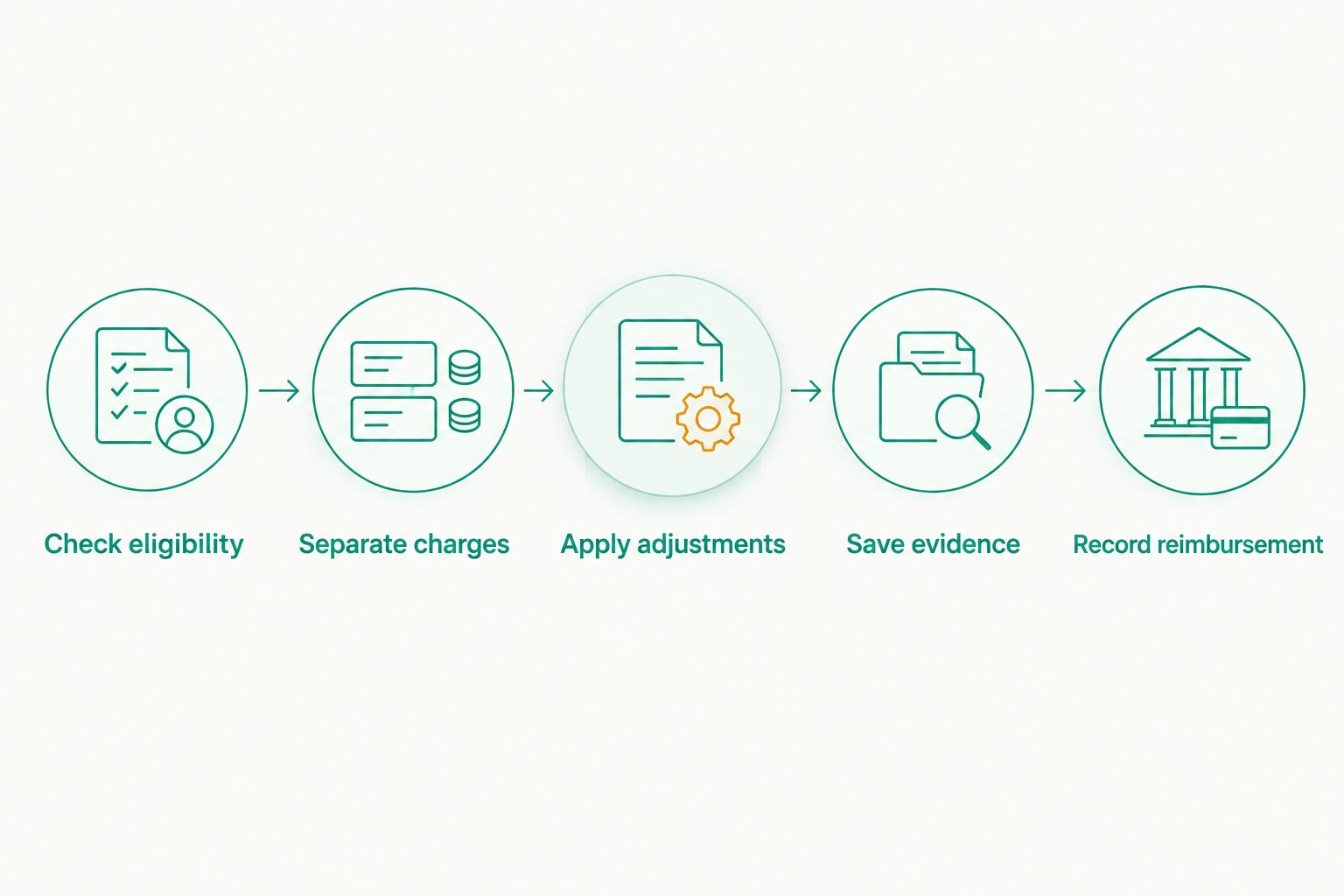
Keep a brief note beside any calculation that will not be obvious from the receipt alone. A useful note explains which items qualified, where the tax detail came from, and how you handled delivery charges. A total without its supporting explanation is harder to verify later.
What if the order contains only qualified medical items?
An order consisting entirely of qualified medical supplies is the simplest case. You can include the sales tax and shipping directly associated with that purchase, subject to the normal HSA reimbursement conditions.
For example, an order containing only qualifying bandages does not need a medical-versus-personal split. You still need the itemized receipt and proof of payment; a card statement showing only the merchant and total does not establish what you bought.
What if medical supplies and personal items share shipping?
A mixed order needs more care. Suppose you buy qualifying bandages and ordinary shampoo in the same shipment: the bandages qualify, but the shampoo does not qualify merely because it shares a package with medical supplies.
Use separately stated delivery charges when available. If the retailer provides only a shared charge, document any allocation and have your tax advisor confirm the treatment rather than labeling the whole charge medical. Until you can support the medical portion, keep the uncertain shipping amount outside your reimbursement request.
Why the reimbursable amount varies
The qualified amount depends on the purchase and its records—not just the store or the payment method. These factors explain why two checkout totals can require different treatment:
- Underlying eligibility: Tax and shipping attached to an ineligible item do not become qualified medical expenses.
- Order contents: An all-medical order is easier to document than a basket containing groceries, toiletries, and medical supplies.
- Actual tax charged: State rules and item classifications affect the retailer's tax calculation. Reimburse actual eligible tax, not a hypothetical amount.
- Delivery breakdown: Separately stated medical-item shipping is easier to support than a shared charge covering personal purchases too.
- Discounts and refunds: Your record must reflect what you ultimately paid and did not recover, including any returned tax or shipping.
- Other reimbursement: Insurance or another benefit can reduce the amount available for HSA reimbursement, even when the original purchase qualified.
A doctor's letter is not a shortcut around eligibility. General-health products do not automatically qualify because a clinician recommends them, and their associated tax and shipping do not qualify automatically either.
Can you reimburse sales tax and shipping years later?
Yes—there is no IRS deadline for reimbursing a qualified HSA expense incurred after the HSA was established. IRS Notice 2004-50, Q&A 39, explains that there is no time limit on when the distribution must occur, provided the reimbursement conditions and recordkeeping requirements are met.
That means a qualifying 2026 purchase can be reimbursed later, including its supported eligible tax and shipping. You must retain evidence that the expense qualified, was not previously reimbursed, and was not taken as an itemized deduction.
Paying out of pocket does not require you to postpone reimbursement. Choose a timing approach that fits your finances; delaying a withdrawal does not guarantee investment gains or tax savings beyond the rules that actually apply.
Do FSA sales tax and shipping follow the same deadline?
No—HSA reimbursement timing does not apply to an FSA. Although qualified medical purchases can have eligible tax and delivery charges under either arrangement, an FSA has plan-specific coverage and claim-submission rules.
For a 2026 FSA purchase, check the plan's expense-incurrence deadline and claim-submission deadline separately. A run-out period generally gives you time to submit claims for an earlier coverage period; it does not itself extend the period for incurring expenses.
Do not move an expense into your HSA reimbursement queue after an FSA has already paid it. The same medical expense cannot support both reimbursements.
What if the retailer refunds the purchase later?
Update your records whenever a refund changes the qualified amount you paid. A returned medical item can also trigger a sales-tax refund, while the retailer might retain the original delivery charge.
Before HSA reimbursement, reduce your saved eligible balance by the refunded eligible amount. After HSA reimbursement, ask your HSA custodian and tax advisor how to address the distribution; do not assume that an ordinary deposit automatically corrects it.
Keep the refund confirmation beside the original receipt. The record should explain both the original qualified charge and the later adjustment, rather than silently replacing the original total.
Choose a receipt system you will maintain
You need a dependable record, not a particular app. Reimbursable is best for HSA holders who want eligibility lookup and receipt tracking together. Its free manual tracking is unlimited; automation is optional, not a condition of tax-free reimbursement.
Choose based on the administrative work you want to handle yourself:
| Tracking approach | Best for | Useful capability | Limitation or responsibility |
|---|---|---|---|
| Paper receipts and folders | People comfortable maintaining physical records | Keeps original purchase documents together | You must protect receipts from loss and fading |
| Spreadsheet and digital folders | People who want a self-managed ledger | Lets you record item totals, adjustments, and reimbursement status | You must enter details and maintain backups |
| HSA-provider receipt tools | People who prefer records alongside their account | Keeps receipt management with the provider when offered | Check the provider's actual features and export options |
| Reimbursable | People wanting eligibility lookup and receipt tracking | Offers unlimited free manual tracking; Premium adds receipt scanning, bank sync, and email forwarding | You still need to verify eligibility and review recorded amounts |
Premium's role is less receipt administration. If manual entry already works for you, a spreadsheet, folders, paper receipts, or an HSA-provider tool remains a legitimate choice. No tracking system makes a personal purchase eligible or replaces your responsibility to keep accurate records.
FAQ
Can I include sales tax in an HSA reimbursement?
Yes, include sales tax actually paid on a qualified medical purchase. On a mixed receipt, exclude tax attributable to personal or otherwise ineligible items.
Does shipping count as an HSA-qualified medical expense?
Shipping directly attributable to a qualified medical purchase can be included in the reimbursement. A shared delivery charge covering personal items needs separate treatment and supporting documentation.
Can I reimburse the entire receipt if some items are HSA eligible?
No, reimburse only qualified items and their supported eligible charges. Buying personal items alongside medical supplies does not make the entire checkout total eligible.
What proof should I keep for sales tax and shipping?
Keep the itemized receipt, payment evidence, and a note explaining any allocation. Retain refund records and reimbursement history with those documents.
Does a doctor's letter make a general-health purchase eligible?
No, a doctor's letter does not automatically make a general-health expense HSA eligible. The underlying expense must meet the applicable medical-care requirements before its tax or shipping can qualify.
Can I reimburse an expense from before I opened my HSA?
No, an expense incurred before your HSA was established does not qualify for tax-free HSA reimbursement. Keeping the receipt or paying the bill later does not change when the expense was incurred.
Do I need Reimbursable Premium to reimburse myself later?
No, Premium is not required for tax-free HSA reimbursement. Free manual tracking, spreadsheets, folders, paper receipts, and suitable HSA-provider tools can support your records if you retain the necessary evidence.
One last thing
Save the itemized order before the retailer's purchase history becomes your only copy. A bank transaction proves a payment occurred; it does not identify the eligible products or explain which tax and shipping charges belong to them.
For your next purchase, save the receipt and record the qualified amount immediately. That small task preserves the explanation you will need if you reimburse yourself much later.
Not tax advice; consult your tax advisor.