
Instead of manually copying every medical card charge into a spreadsheet, use bank sync to collect transactions, attach itemized receipts, and review eligibility before recording an HSA reimbursement. Bank sync finds payments; it does not prove that an expense qualifies for tax-free reimbursement.
- Reimbursable HSA bank sync receipt tracking suits holders who want less payment-entry work while keeping medical receipts organized.
- Match each transaction to an itemized receipt; a merchant name alone does not establish HSA eligibility.
- Only reimburse eligible expenses incurred after your HSA was established, without duplicate reimbursement or a medical-expense deduction.
- Keep FSA claim deadlines separate from your HSA reimbursement records.
Why this matters
A pharmacy transaction can include medicine and household goods. A hospital payment can later change after insurance processing. Importing either charge without checking the supporting documents creates an unreliable reimbursement balance.
Reimbursable HSA receipt tracking is best for HSA holders who want bank sync alongside saved medical receipts. Its free manual tracking is unlimited; Premium adds bank sync, AI receipt scanning, and email forwarding to reduce receipt administration. Automation is optional, not a condition for tax-free reimbursement.
Start with Reimbursable if you want those records in an HSA-focused app. The workflow below also works with a spreadsheet and document folders.
For your 2026 records, use IRS Publication 969 for HSA distribution and recordkeeping rules and Publication 502 for medical-expense guidance. Publication 502 is not a substitute for HSA-specific rules; for example, HSA distributions have their own restrictions on insurance premiums.
Before you start
- Gather access: Have your tracking account, access to the bank or credit-card account you use for out-of-pocket medical spending, and itemized receipts. Use your institution's authorization process rather than sharing credentials by email.
- Gather evidence: Keep the HSA establishment date, service dates, patient names, payment records, and relevant insurance explanations of benefits. An explanation of benefits is not proof that you paid.
- Check the trap: A posted card transaction proves a payment, not medical eligibility. Separate personal out-of-pocket charges from HSA-card payments, pending charges, refunds, and credit-card bill payments before calculating what remains reimbursable.
Choose your tracking method
For a 2026 setup, choose the least complicated method you will maintain. These are recordkeeping choices, not different tax treatments.
| Method | Best for | Useful feature | Limitation |
|---|---|---|---|
| Reimbursable free manual tracking | Holders who prefer entering expenses themselves | Unlimited manual tracking | You enter and review records yourself |
| Reimbursable Premium | Holders who want less receipt administration | Bank sync, AI receipt scanning, and email forwarding | Imported or scanned information still needs review |
| Spreadsheet with digital folders or paper receipts | Holders who want direct control over their records | You choose the columns and filing system | You manage matching, backups, and duplicate checks |
| HSA-provider receipt tools | Holders who prefer keeping records with their account provider | A legitimate alternative when the provider offers receipt storage | Check the provider's actual storage and export functions |
A paid plan does not make an otherwise ineligible expense eligible. Choose automation when collecting transactions and receipts is the part you struggle to maintain.
Payment source configuration
The labels below are suggested ledger fields, not instructions to find identically named buttons in an app. Use equivalent fields or notes in your chosen tracker.
- Identify the payment source. Choose the personal checking account or credit card used for out-of-pocket medical expenses. Do not treat an HSA debit-card payment as a new expense awaiting reimbursement.
- Authorize the connection. Follow the tracking service's bank-connection process, review the requested access, and complete your financial institution's authentication prompts. Confirm that the selected account is the one you intended to connect.
- Set your review boundary. Choose a starting period you can reconcile against statements. For a fresh 2026 workflow, keep older expenses in a separately reviewed backlog instead of mixing them into an unchecked opening balance.
- Separate payment types. Distinguish purchases from transfers, refunds, and payments toward a credit-card balance. The card purchase and the later checking-account payment are not separate medical expenses.
- Check an imported purchase. Compare its merchant, amount, and posting date with your statement. Record the service or purchase date separately when it differs from the bank posting date.
Expected result: Your tracker contains identifiable payment records, with transfers and already-HSA-paid purchases kept out of the unreimbursed-expense total.
Do not assume a bank connection imported every historical charge. Reconcile the period you intend to track against the underlying statement before relying on the balance.
Receipt and eligibility records
- Create an expense record. Record the patient, provider or merchant, service or purchase date, payment date, total paid, and payment source. Assign a reference you can also put on the receipt filename.
- Attach itemized evidence. Save the receipt or provider statement showing what was purchased or provided. Add payment confirmation when the itemized document does not establish payment.
- Match the payment. Compare the receipt with the imported transaction. Keep separate fields for Total paid and Qualified amount so a mixed purchase does not inflate your reimbursement balance.
- Review eligibility. Check Publication 502 and the applicable HSA rules in Publication 969. Record why an unusual expense qualifies and retain supporting medical documentation when relevant.
- Apply the timing and duplication checks. Confirm the expense was incurred after your HSA was established and was not reimbursed by insurance, an FSA, an HRA, or another source. Do not also claim a medical-expense deduction for the same amount.
Expected result: Each reviewed expense connects an identifiable payment to an itemized document and a supported qualified amount.
Treat the import, receipt, and eligibility review as different parts of the record. A doctor's letter does not automatically turn a general-health purchase into a qualified medical expense. The expense must satisfy the applicable tax rules.
For split purchases, retain the full receipt and your allocation calculation. Saving only a cropped eligible line can remove the context needed to reconcile the document with the bank charge.
Keep the evidence chain intact
Use this sequence for each expense: Payment, Receipt, Eligibility review, Reimbursement record. The final record should let you trace a withdrawal back to the underlying medical expense without relying on memory.
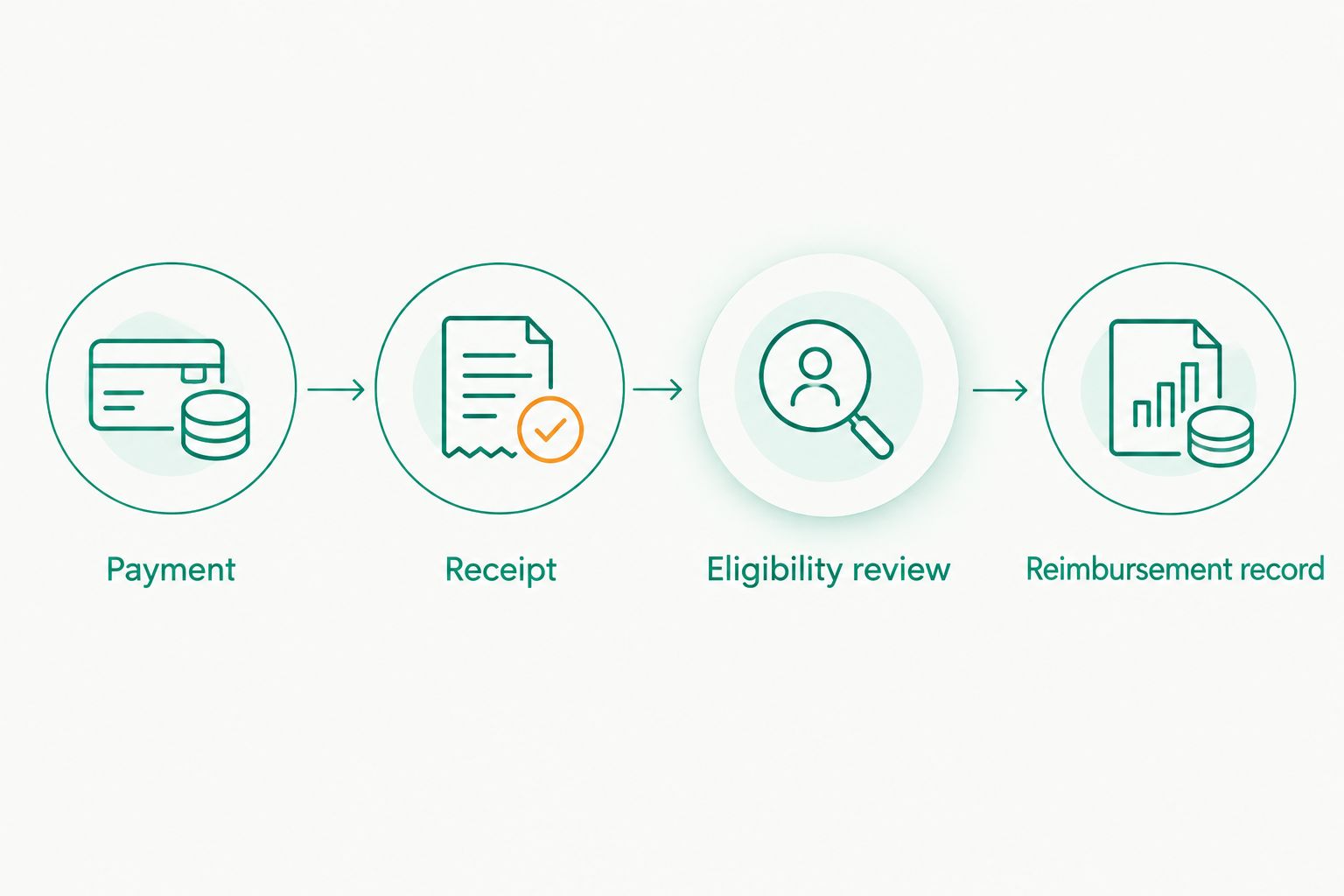
Keep a separate note for unresolved questions. An expense awaiting an insurance decision belongs in review, not in the balance you use to request reimbursement.
Reimbursement ledger configuration
- Define record states. Use clear labels such as Needs receipt, Needs review, Ready, Partially reimbursed, and Reimbursed. These are suggested categories you can maintain in fields, notes, or a spreadsheet.
- Calculate the remaining amount. Start with the supported qualified amount. Subtract insurance payments, other reimbursements, applicable refunds, and prior HSA reimbursements without subtracting the same adjustment twice.
- Keep partial reimbursements visible. Record each HSA distribution date and the amount applied to the expense. Leave the remaining supported balance open rather than marking the entire expense reimbursed.
- Reconcile the withdrawal. Match your reimbursement record to the HSA distribution shown by your account provider. Tracking an expense and actually withdrawing HSA money are different actions.
- Preserve the completed record. Keep the receipt, supporting documents, eligibility notes, and reimbursement history together. Maintain a readable backup outside a single account or device.
Expected result: You can distinguish paid medical expenses from amounts still eligible for reimbursement, including partially reimbursed expenses.
For example, 1 medical expense can produce 2 payment transactions under a payment arrangement. Conversely, 1 card transaction can cover several receipt lines. Match the documents to the underlying expenses rather than assuming every imported row equals a separate reimbursement opportunity.
In 2026, there is no IRS deadline requiring you to reimburse an eligible HSA expense in the year you incur it. Keep evidence that it occurred after the HSA was established and has not already received another tax benefit.
Refund and correction configuration
- Review credits alongside charges. Check the connected account for merchant refunds and compare insurance updates with the original medical bill.
- Link the adjustment. Associate a refund or corrected patient balance with the original expense record. Preserve the original document and the revised evidence.
- Update the open balance. Reduce the unreimbursed amount when a refund or insurance payment changes what you ultimately paid for qualifying care.
- Resolve completed reimbursements separately. If an HSA distribution already covered an amount later refunded or reimbursed elsewhere, flag it for tax review. Ask your HSA custodian and tax advisor about the appropriate correction rather than deleting the transaction.
Expected result: Your ledger reflects what you actually paid and prevents a refund from leaving an overstated reimbursement balance.
A bank feed cannot explain every credit. A merchant refund, insurance reimbursement, and unrelated transfer can require different treatment even when their amounts look similar.
Receipt-first variant: match the payment later
Use a receipt-first workflow when you receive an emailed provider bill before the payment posts or when a family member gives you a paper receipt. The same evidence checks still apply.
- Save the itemized receipt and create a provisional expense record.
- Record the service date and patient, but leave the payment unconfirmed until you have proof.
- When the bank transaction posts, match it to the existing record instead of creating another expense.
- Review eligibility and insurance adjustments before moving the record to Ready.
Expected result: You retain the receipt promptly without counting an unpaid bill or creating a duplicate when the bank feed catches up.
This variant trades earlier document capture for a later matching task. It is useful when receipts are easy to lose, but an invoice alone should not enter your paid-expense total.
Troubleshooting
The same expense appears twice
Compare merchant, amount, receipt reference, and payment status. A pending transaction, posted charge, and scanned receipt can describe the same purchase; retain the supporting evidence but count the expense only once.
The bank amount does not match the qualified amount
Review the itemized receipt for nonmedical items, split payments, or adjustments. Keep the full payment amount for reconciliation and a separate qualified amount for reimbursement calculations.
A medical provider charge has no itemized receipt
Request an itemized statement and retain payment evidence. Do not treat the provider's name on a bank statement as a description of the care received.
A connected account stops updating
Check the connection status and complete any authentication requested by your financial institution. Compare the last imported transaction with your statement, and reconcile any gap before adding manual records that might later duplicate imports.
An insurance adjustment arrives after reimbursement
Preserve both the original expense and the adjustment. Stop counting the affected amount as unreimbursed, and obtain tax guidance on any HSA distribution that no longer has supporting qualified expenses.
Customize your workflow
Use a regular review session to match new payments, chase missing documents, and resolve insurance changes. Keep reimbursement as a separate decision; importing a transaction should never be your signal to withdraw HSA funds automatically.
For 2026 household records, patient names help distinguish family expenses, while a separate Reimbursed elsewhere field helps prevent duplicate claims. Do not copy FSA submission deadlines into your HSA ledger: FSA plan-year and claim rules are different.
Use the guide to applying HSA reimbursement rules to an expense ledger to develop the record structure. Consider Reimbursable Premium when bank sync, receipt scanning, or email forwarding solves a recurring admin problem; otherwise, free manual tracking remains a valid choice.
FAQ
Does HSA bank sync receipt tracking prove an expense is eligible?
No. Bank sync records a payment, while eligibility depends on the underlying expense and applicable HSA rules. Keep itemized evidence, payment records, and any supporting documentation needed for the expense.
Can I connect the credit card I use for medical bills?
Use your personal credit card as the payment source when your chosen tracking service supports that institution and account. Match purchases to receipts, and do not count the later credit-card bill payment as another medical expense.
Do I need Premium to get tax-free HSA reimbursement?
No. Reimbursable Premium reduces receipt administration through bank sync, AI receipt scanning, and email forwarding; it does not determine tax eligibility. Unlimited free manual tracking, spreadsheets, folders, paper receipts, and HSA-provider receipt tools are legitimate alternatives.
Can I reimburse an expense from before I opened my HSA?
No. A qualified expense must be incurred after your HSA was established. A later payment date does not by itself make earlier medical care eligible.
Is there a deadline to reimburse an HSA expense in 2026?
There is no IRS time limit requiring reimbursement in the year you incur an eligible HSA expense. Retain records showing eligibility, the establishment-date requirement, and that the expense was not reimbursed elsewhere or deducted.
Can I reimburse a medical bill that insurance already paid?
No. You cannot use tax-free HSA reimbursement for an amount insurance already reimbursed. Track your supported out-of-pocket portion and update it when insurance adjustments arrive.
Does a doctor's letter make a general-health purchase HSA eligible?
No. A doctor's letter does not automatically qualify a general-health expense. The expense must meet the applicable medical-expense rules, and supporting documentation does not replace that test.
One last thing
Test your system backward before adding more automation. Pick a reimbursement and confirm you can reach its itemized receipt, payment evidence, eligibility review, and remaining balance without guessing. A smaller, reconciled ledger is more useful than a large list of unchecked imports.
Not tax advice; consult your tax advisor.