
Best overall for ongoing talk treatment: psychotherapy. Best for medication evaluation: psychiatric care. Best for diagnostic clarification: psychological assessment. The best HSA eligible mental health services in 2026 are medical services that fit your treatment needs—not wellness purchases with an eligibility badge.
- Psychotherapy leads this best HSA eligible mental health services guide for ongoing talk treatment, not general wellness coaching.
- Psychiatric care suits medication evaluation; psychological assessment addresses diagnostic questions.
- HSA expenses must follow account establishment and cannot also be reimbursed elsewhere or deducted.
- Reimbursable helps organize mental health receipts for later HSA reimbursement; tracking does not establish eligibility.
Why this matters
A therapist's medical treatment and a wellness coach's general encouragement are not interchangeable for HSA purposes. The service's medical purpose matters more than its label, payment method, or location.
For 2026 reimbursement decisions, IRS Publication 502 explains medical-expense categories, while IRS Publication 969 explains HSA distribution and recordkeeping rules. Use them together: Publication 502 also discusses deductions, whose rules do not all carry over to HSAs.
Reimbursable offers an eligibility directory and receipt tracking. Reimbursable is a receipt-tracking option for HSA holders saving mental health bills for later reimbursement. It does not replace the eligibility rules or your tax records.
Not tax advice; consult your tax advisor. Choose treatment with a qualified clinician, not by its tax treatment alone.
What makes the best HSA eligible mental health services?
Use these criteria before choosing a service or setting money aside for reimbursement:
- Medical purpose: The service diagnoses, treats, mitigates, or prevents disease rather than supporting general well-being alone.
- Clinical fit: The provider and treatment match the reason you are seeking care.
- Clear billing: The bill identifies the patient, provider, service date, service, and amount.
- Expense timing: The care occurs after your HSA was established.
- Reimbursement status: Insurance, an FSA, another account, or another payer has not already covered the amount you claim.
- Record access: You can retain receipts, payment evidence, and relevant insurance statements independently of the provider's portal.
Mental health services at a glance
These 5 service categories address different treatment needs. The ranking is a decision guide, not a claim that one treatment works best for every patient.
| Service | Best for | Standout purpose | Key limitation |
|---|---|---|---|
| Psychotherapy | Ongoing talk treatment | Structured mental health treatment | General life coaching is not equivalent |
| Psychiatric care | Medication evaluation and management | Medical assessment and prescription management when appropriate | Not every visit includes talk therapy |
| Psychological assessment | Diagnostic clarification | Evaluation of a specific clinical question | General educational testing is not automatically eligible |
| Substance use treatment | Treatment of substance use disorders | Care directed at a medical condition | Nonmedical program extras require separate review |
| Clinician-led group therapy | Treatment in a group setting | Therapeutic work with clinician involvement | Peer support alone does not establish eligibility |
1. Psychotherapy: best for ongoing talk treatment
Psychotherapy treats mental health conditions through structured work with a qualified mental health professional. Treatment can take place in person or remotely; the communication format does not turn medical treatment into general wellness.
Psychotherapy pros:
- Provides a treatment setting for mental health symptoms and conditions.
- Supports an ongoing course of care rather than an isolated wellness purchase.
- Can produce service-specific bills that help document the expense.
Psychotherapy cons:
- A counseling label alone does not prove a service is medical care.
- Combined coaching, relationship advice, and treatment packages need careful review.
Best for: Someone seeking ongoing clinical talk treatment.
Before paying, ask what service will appear on the receipt. Marriage counseling is not automatically a qualified medical expense simply because a therapist provides it; distinguish it from treatment of a mental health condition.
Verdict: Choose psychotherapy for clinical talk treatment; skip the assumption that all counseling qualifies.
2. Psychiatric care: best for medication evaluation and management
Psychiatric care includes medical evaluation and management of mental health conditions. A psychiatrist can assess whether medication belongs in your treatment plan and monitor treatment when prescribed.
Psychiatric care pros:
- Addresses medical questions about psychiatric treatment.
- Provides a setting for reviewing medication effects and concerns.
- Separates a clinical visit from general wellness advice.
Psychiatric care cons:
- A medication-management appointment is not necessarily a psychotherapy session.
- A visit receipt does not document a separate pharmacy purchase.
Best for: Someone whose treatment needs include psychiatric evaluation or medication management.
Keep the clinician's bill and pharmacy receipts as separate expense records. For 2026 tracking, record what you actually paid for each, then account for insurance payments or later adjustments before claiming reimbursement.
Verdict: Choose psychiatric care for medical evaluation; do not assume every appointment includes talk therapy.
3. Psychological assessment: best for diagnostic clarification
A psychological assessment investigates a clinical question through professional evaluation and, when appropriate, testing. Its purpose matters: testing connected to diagnosing a condition differs from testing purchased solely for general educational or career guidance.
Psychological assessment pros:
- Addresses a defined diagnostic question.
- Produces clinical findings that can inform a treatment discussion.
- Gives you a distinct service to document rather than an undefined wellness package.
Psychological assessment cons:
- Not every educational, personality, or occupational assessment is medical care.
- A bundled evaluation can include components requiring separate eligibility review.
Best for: Someone seeking clarification of a suspected condition with a qualified professional.
Ask the provider to identify the assessment's clinical purpose and itemize distinct services. Keep sensitive clinical reports securely; your expense ledger can reference their location without repeating private details throughout the record.
Verdict: Choose assessment for a clinical diagnostic question; hold general-purpose testing for separate review.
4. Substance use treatment: best for substance use disorders
Treatment for alcohol or drug addiction falls within medical care described in IRS Publication 502. The relevant question is which charges belong to treatment, not whether a program uses the word recovery.
Substance use treatment pros:
- Addresses a recognized medical treatment need.
- Can include coordinated professional services.
- Allows treatment charges to be evaluated against established IRS medical-expense guidance.
Substance use treatment cons:
- Personal amenities and nonmedical extras are not automatically qualified expenses.
- A package total can obscure what each charge covers.
Best for: Someone seeking professional treatment for a substance use disorder.
Request an itemized statement before treating an entire package as reimbursable. IRS guidance includes specific treatment-related rules, but a retreat, sober-living arrangement, or wellness program should not inherit eligibility from its marketing language.
Verdict: Choose treatment based on clinical needs; review bundled charges individually.
5. Clinician-led group therapy: best for a group treatment setting
Group therapy can be medical treatment when a qualified clinician provides it to address a mental health condition. A social group, meditation gathering, or peer-support membership does not become medical care merely because participants find it helpful.
Clinician-led group therapy pros:
- Offers a group format for clinical treatment.
- Includes professional involvement in the therapeutic service.
- Can be documented through a provider's treatment bill.
Clinician-led group therapy cons:
- Group participation alone does not establish a medical purpose.
- Memberships combining therapy and community benefits need itemization.
Best for: Someone whose clinician recommends treatment in a group setting.
Ask who provides the service and how it is billed. Do not assume that a subscription's discussion boards, educational library, and clinical sessions all receive the same tax treatment.
Verdict: Choose clinician-led group treatment when it fits your care plan; hold general memberships for review.
How these services are ranked
Psychotherapy is the default for ongoing talk treatment because that is its service purpose—not because it outranks other care clinically. Psychiatric care, assessment, substance use treatment, and group therapy each serve a different need.
This 2026 guide ranks service categories by clinical purpose, documentation clarity, and the distinction between medical care and general wellness. It does not rank individual providers or report treatment outcomes.
What about meditation, coaching, yoga, and wellness subscriptions?
Feeling better is not, by itself, the HSA eligibility test. General-health expenses do not qualify simply because they reduce stress or support healthy habits.
A doctor's letter does not automatically make a general-health expense eligible. The underlying expense must meet the applicable medical-care rules; documentation supports an eligible expense rather than changing the rules.
For a subscription that combines clinical sessions with general wellness content, ask for separate charges. The guide to separating qualified medical expenses on mixed bills explains how to keep the eligible portion distinct.
Save the evidence before reimbursing yourself
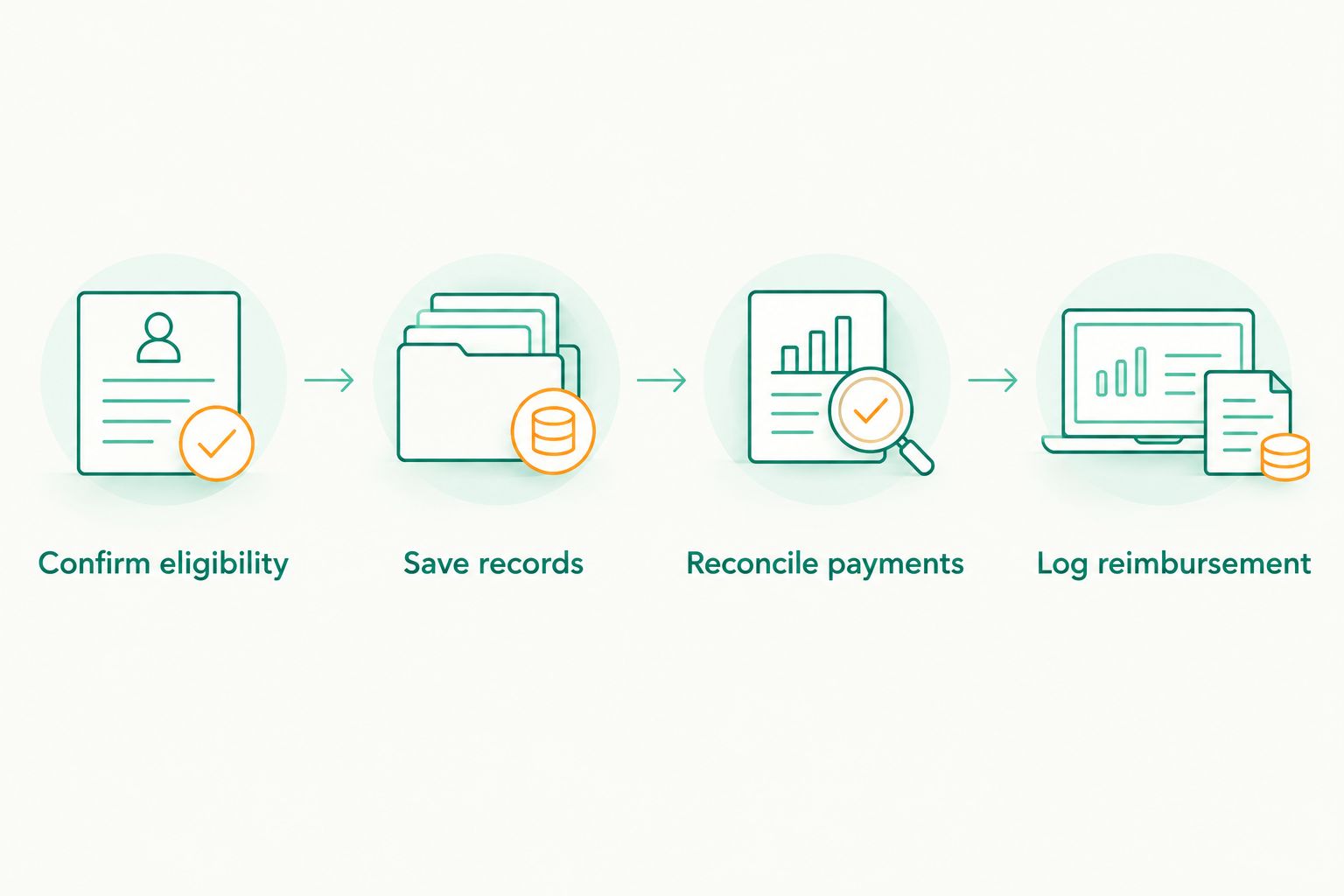
For a 2026 mental health expense, use these 4 recordkeeping steps. They work whether you reimburse yourself promptly or keep the expense for later.
Confirm eligibility
Check the service's medical purpose and confirm that the expense occurred after your HSA was established. The date you pay a bill does not make care received before establishment eligible.
Save records
Keep an itemized bill or receipt, evidence of payment, and any relevant explanation of benefits. Capture the patient, provider, service date, service description, and amount you paid.
Reconcile payments
Separate your responsibility from insurance payments, refunds, and reimbursements elsewhere. Do not claim an amount that another source reimbursed or that you deducted on your tax return.
Log reimbursement
Record the amount and date of each HSA reimbursement and the remaining unreimbursed balance. Partial reimbursement needs a running balance so the same expense is not claimed twice.
There is no IRS deadline for reimbursing a qualified HSA expense incurred after account establishment, provided you retain the required records and meet the other rules. Delaying reimbursement does not remove the obligation to prove what the expense was and that it remained unreimbursed.
Choose a tracking method you will maintain
Reimbursable offers unlimited manual tracking at no charge. Premium adds AI receipt scanning, bank sync, and email forwarding to reduce receipt administration; automation is not a requirement for tax-free reimbursement.
| Tracking method | Best for | Advantage | Limitation |
|---|---|---|---|
| Reimbursable manual tracking | A dedicated expense log | Unlimited manual entries | You enter records yourself |
| Reimbursable Premium | Reducing receipt administration | Scanning, bank sync, email forwarding | Automation does not verify tax eligibility |
| Spreadsheet and folders | A self-managed digital archive | You choose the organization | You maintain links and balances |
| Paper receipts and ledger | A physical filing routine | No app required | Loss and fading threaten records |
| HSA-provider receipt tools | Keeping records with an account | Connects recordkeeping to your provider | Features and export options vary |
Keep backups whichever method you choose. Before changing tools, confirm that you can retrieve both the expense history and its supporting documents.
Which mental health service should you choose?
Start with psychotherapy when your need is ongoing clinical talk treatment. Choose psychiatric evaluation for medication-related questions, assessment for diagnostic clarification, and specialized treatment when your condition calls for it.
In 2026, the practical HSA decision stays separate: confirm eligibility, pay, preserve evidence, and reconcile reimbursement. A suitable treatment is not automatically a qualified expense in every billing arrangement.
FAQ
What's the best HSA eligible mental health service for talk treatment?
Psychotherapy is the relevant service category for ongoing clinical talk treatment. Choose a qualified provider whose care fits your needs, and distinguish medical treatment from general coaching or relationship advice.
Can I use my HSA for online therapy?
Online therapy can qualify when the underlying service is eligible medical care. Video delivery does not make general coaching eligible or disqualify an otherwise qualified treatment expense.
Does a doctor's letter make a meditation app HSA eligible?
A doctor's letter does not automatically make a meditation app HSA eligible. General-health expenses remain subject to the medical-care rules, so review the actual expense with your tax advisor.
Can I reimburse myself years after paying a therapist?
Yes, there is no IRS deadline for reimbursing an otherwise qualified HSA expense incurred after your HSA was established. Keep records showing eligibility, payment, and that the expense was not reimbursed elsewhere or deducted.
Are HSA and FSA reimbursement deadlines the same?
No, HSA reimbursement timing differs from FSA claim deadlines. FSAs have plan-specific coverage and claim-submission rules; do not apply the HSA's lack of a reimbursement deadline to an FSA.
Can I claim the full therapy bill if insurance pays part?
No, claim only the otherwise qualified portion that remains your responsibility. Reconcile insurance payments and refunds before reimbursing yourself, and correct your records if an insurer pays later.
Do I need a paid receipt app for HSA reimbursement?
No, a paid receipt app is not required for tax-free HSA reimbursement. Spreadsheets, folders, paper records, and HSA-provider tools are legitimate alternatives when they preserve sufficient evidence and reimbursement history.
One last thing
An eligibility check and a card approval answer different questions. A successful HSA-card payment does not establish that a wellness service qualifies, and paying with a personal card does not prevent later reimbursement of a qualified expense.
Save the itemized record when you receive care, not when you eventually need the money. Not tax advice; consult your tax advisor.