You generally cannot use an HSA for dental insurance premiums tax-free in 2026, even when the policy covers eligible dental treatment. Exceptions can apply to COBRA coverage, coverage while you receive federal or state unemployment compensation, and certain coverage once you are age 65 or older. A dental insurance premium and a dentist’s treatment bill follow different HSA rules, so classify the payment before reimbursing yourself.
- Can you use HSA for dental insurance premiums? Usually no; specific insurance exceptions determine eligibility.
- COBRA dental premiums and coverage during qualifying unemployment compensation can qualify for tax-free HSA reimbursement.
- At age 65 or older, additional insurance premiums can qualify; Medigap premiums remain excluded.
- Reimbursable supports HSA receipt tracking; keep premium eligibility evidence alongside proof of payment.
Can you use HSA for dental insurance premiums?
Ordinary dental insurance premiums generally are not qualified HSA expenses. IRS Publication 969 excludes insurance premiums from HSA-qualified medical expenses unless a listed exception applies. Buying a policy yourself does not create an exception, and neither does paying the premium with an HSA debit card.
Use this comparison to separate the common situations. Each exception still requires an eligible expense, appropriate timing and no duplicate tax benefit.
| Payment or coverage | Tax-free HSA treatment | Best next step | Main limitation |
|---|---|---|---|
| Ordinary standalone dental insurance premium | Generally not eligible | Keep outside your HSA reimbursement total | Covered treatment being eligible does not qualify the premium |
| Dental coverage under COBRA | Can qualify | Save the COBRA election and premium records | Verify that the charge actually covers continuation coverage |
| Dental insurance while receiving federal or state unemployment compensation | Can qualify | Match coverage records to unemployment compensation records | Being unemployed alone does not satisfy the exception |
| Dental insurance when the HSA beneficiary is age 65 or older | Can qualify under the older-beneficiary insurance exception | Check the policy and beneficiary’s age | Medigap premiums remain excluded |
| Unreimbursed qualifying dental treatment | Generally eligible | Save the itemized treatment bill and payment record | Cosmetic-only treatment generally does not qualify |
Why this matters
A recurring premium buys coverage; a treatment bill pays for care. Confusing them can put a nonqualified distribution into your tax records even when the dentist’s actual work qualifies.
Reimbursable provides an eligibility directory and receipt-tracking app, but a saved receipt does not make an expense eligible. Your records must establish both what you paid and why the payment meets the applicable HSA rule.
Ordinary dental premiums: generally not eligible
A standalone dental policy you buy directly generally falls outside tax-free HSA reimbursement unless an insurance exception applies. The same restriction applies even if you need the coverage for medically necessary dental work.
Do not treat an insurer’s description of covered benefits as an HSA eligibility determination. Coverage for fillings, examinations or other eligible care does not change the tax treatment of the premium itself.
Payroll deductions need a separate check. A premium already paid with pre-tax payroll dollars cannot receive another tax-free reimbursement from your HSA. Look at how the deduction was treated rather than assuming every amount on a pay statement represents an unreimbursed expense.
For the underlying care, use the separate guide to HSA dental expenses and what to save. That distinction keeps a rejected premium from causing you to overlook a qualifying treatment bill.
COBRA dental premiums: an insurance exception
Premiums for qualifying continuation coverage under COBRA can be paid or reimbursed tax-free from an HSA. That exception can include dental continuation coverage; it is not limited to a bill labeled medical insurance.
The advantage is straightforward: an otherwise excluded insurance premium can qualify because of the coverage arrangement. The limitation is equally important: replacing an employer policy with an ordinary individual dental policy does not automatically make the replacement policy COBRA coverage.
Keep the continuation-coverage notice, election confirmation, premium statement and payment evidence together. If an administrator bills several benefits together, retain enough detail to identify the dental coverage and any other amounts included.
For a 2026 COBRA payment, record the coverage period as well as the payment date. Those details help explain the expense later, when a bank transaction alone will not identify the policy or the reason it qualified.
Unemployment compensation: another premium exception
Health coverage premiums can qualify while you receive unemployment compensation under federal or state law. Dental coverage can fall within this exception.
Losing your job is not, by itself, the test. Keep evidence that you received qualifying unemployment compensation, together with the policy statement and proof of the premium payment. Do not assume a gap between jobs makes every insurance payment eligible.
This exception is useful when you are paying for coverage without an employer paycheck. Its recordkeeping burden is higher than that of an ordinary dental bill: you need to support the qualifying circumstance as well as the payment.
If benefits begin or end during the coverage period, have your tax advisor review the timing before reimbursing the premium. A payment date, a coverage month and an unemployment-benefit period are different facts; preserve all of them rather than choosing whichever date appears most favorable.
Age 65 or older: broader insurance eligibility
Once the HSA beneficiary is age 65 or older, the HSA insurance exception extends to Medicare and other health care coverage, excluding Medicare supplemental coverage such as Medigap. Dental insurance premiums can qualify under that broader exception.
Turning 65 is not permission to reimburse every earlier premium. Keep records showing that the payment fits the exception when applicable, and check whose coverage the policy provides. Spouse coverage can introduce additional age-related questions.
Medicare enrollment also raises a separate contribution issue: enrollment generally ends eligibility to contribute to an HSA. Contribution eligibility and spending eligibility are different rules. You can still use existing HSA funds for qualified expenses even when you can no longer contribute.
The age-65 exception helps with qualifying insurance payments, but it does not erase the other requirements. An expense already reimbursed elsewhere or paid with pre-tax dollars cannot receive a second tax benefit.
Why dental premium eligibility varies
The policy’s name is not enough to determine the answer. For your 2026 records, check these factors:
- Coverage arrangement: COBRA continuation coverage has a specific exception; an ordinary standalone policy generally does not.
- Unemployment compensation: The exception depends on receiving qualifying federal or state compensation, not simply being out of work.
- Beneficiary age: Age 65 or older changes the insurance-premium rules; retirement alone does not.
- Expense timing: Eligible expenses must occur after the HSA was established. Keep the establishment date available.
- Previous tax treatment: Insurance payments, pre-tax payroll deductions, other reimbursements and medical-expense deductions can prevent another tax-free reimbursement.
A doctor’s letter does not override the insurance-premium exclusion. More broadly, a letter does not automatically turn a general-health expense into qualified medical care. Identify the actual rule before collecting supporting documents.
How to document a dental premium before reimbursement
Use this process before moving money out of your HSA. It separates the eligibility decision from the administrative task of saving a receipt.
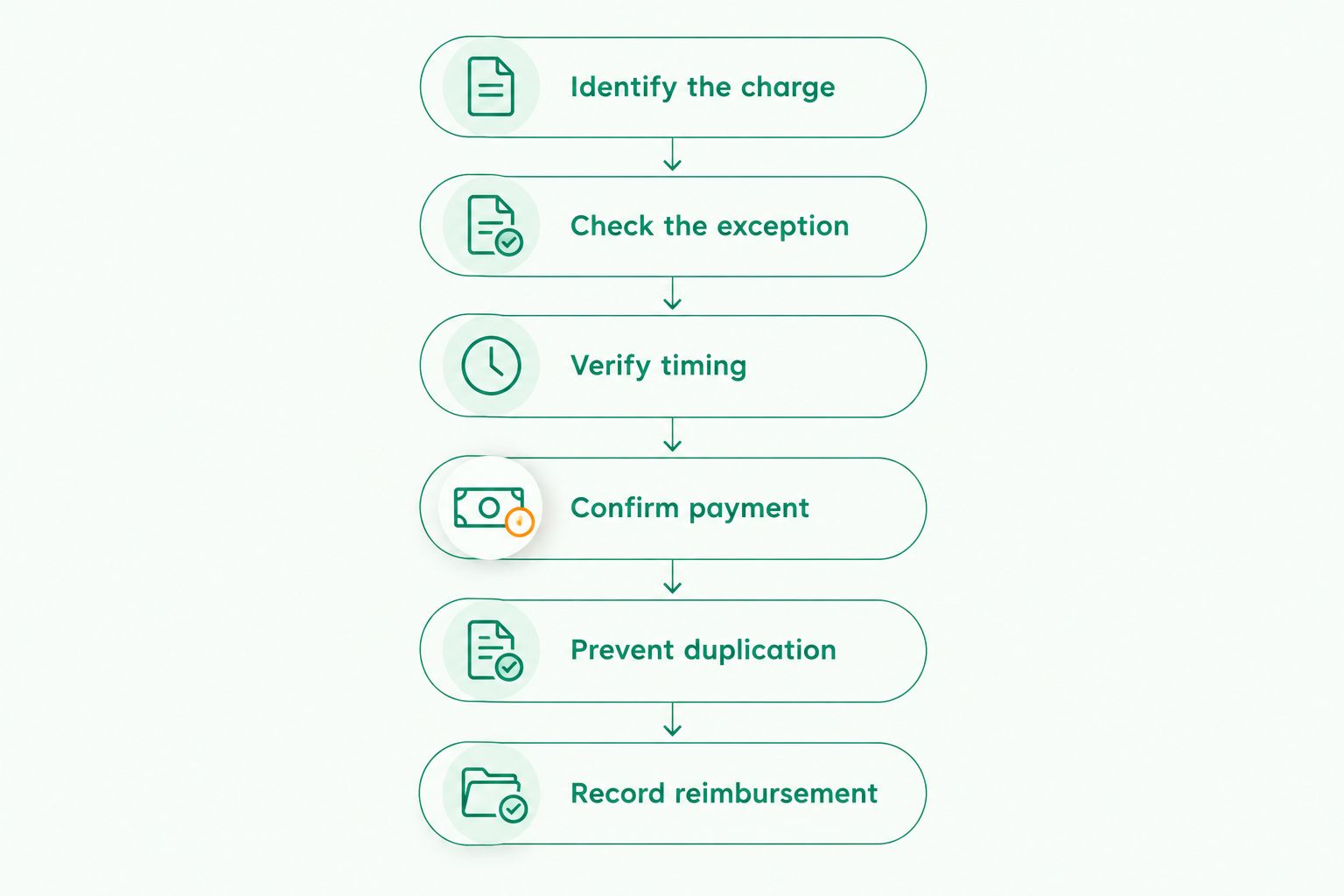
- Identify the charge. Determine whether the document shows an insurance premium, dental treatment, a plan fee or several charges together. Do not classify the entire payment from the merchant’s name alone.
- Check the exception. For a premium, identify the applicable insurance exception. If none applies, leave the payment out of the qualified HSA reimbursement total.
- Verify timing. Confirm that the expense occurred after your HSA was established. For an exception tied to unemployment compensation or age, preserve the dates supporting that exception.
- Confirm payment. Save the premium statement and proof that you paid it. A coverage notice establishes insurance information but does not necessarily establish payment.
- Prevent duplication. Check for employer contributions, pre-tax payroll treatment, insurance payments and earlier reimbursements. Do not also deduct an expense reimbursed tax-free from the HSA.
- Record reimbursement. Mark the reimbursed amount and date in your ledger. Keep the underlying documents attached or clearly referenced so the payment is not reimbursed again.
These steps work whether you reimburse yourself promptly or leave the money in your HSA. The essential record is the connection between the payment, its qualifying basis and the eventual distribution.
If a document combines different charges, separate them before totaling eligible expenses. The guide to separating HSA-qualified expenses on mixed bills explains that recordkeeping approach.
Choose a tracking method you will maintain
Reimbursable is best suited to HSA holders who want a dedicated receipt-tracking app. Its free manual tracking is unlimited; Premium adds receipt scanning, bank sync and email forwarding to reduce receipt administration. Automation is optional, not a requirement for tax-free reimbursement.
Compare the administrative trade-offs rather than assuming an app changes eligibility.
| Method | Best for | Benefit | Limitation |
|---|---|---|---|
| Reimbursable | HSA holders wanting dedicated receipt tracking | Unlimited free manual tracking; optional Premium automation | Premium features do not replace eligibility checks |
| Spreadsheet and digital folders | People comfortable maintaining their own ledger | You control the fields and file organization | You must keep entries and documents connected |
| Paper receipts and a ledger | People who prefer physical records | No receipt-tracking software required | Physical records need protection and an organization system |
| HSA-provider receipt tools | People wanting records alongside their account | Uses the provider’s existing account tools where offered | Features and record-export options depend on the provider |
Whatever method you choose, use 2 separate records when necessary: the payment document and the evidence supporting the insurance exception. Store them together or give them the same reference in your ledger.
Can you reimburse a qualifying dental premium years later?
There is no IRS deadline for reimbursing a qualified HSA expense. The expense must have occurred after the HSA was established, and you must retain records showing that it was eligible, not reimbursed elsewhere and not deducted.
Waiting does not fix an ineligible premium. An ordinary dental premium that failed the rules when incurred does not become qualified just because you reimburse it after turning 65.
What if you already used your HSA for an ineligible premium?
A nonqualified HSA distribution is generally included in taxable income. Before age 65, it generally also carries a 20% additional tax, subject to exceptions such as disability.
At age 65 or older, the additional tax generally no longer applies, but a nonqualified withdrawal remains taxable. Contact your HSA custodian and tax advisor about an incorrect distribution rather than recording it as a qualified expense to make the ledger balance.
Which IRS guidance should you use in 2026?
Use IRS Publication 969, Health Savings Accounts and Other Tax-Favored Health Plans, for the insurance-premium exceptions, HSA recordkeeping requirements and distribution rules. Use IRS Publication 502, Medical and Dental Expenses, for the underlying medical-expense categories, including dental treatment.
Publication 502 also discusses itemized medical deductions, which are not identical to HSA rules. A premium’s possible treatment as an itemized deduction does not establish HSA eligibility. Consult the latest available IRS guidance when preparing your 2026 return.
FAQ
Can I use my HSA for a standalone dental insurance premium?
An ordinary standalone dental insurance premium generally is not eligible for tax-free HSA payment. An exception can apply for qualifying COBRA coverage, coverage while receiving federal or state unemployment compensation, or certain coverage when the HSA beneficiary is age 65 or older.
Can I pay COBRA dental premiums with my HSA?
Qualifying COBRA dental premiums can be paid or reimbursed tax-free from an HSA. Keep the continuation-coverage records, premium statement and proof of payment, and avoid reimbursing an amount already paid elsewhere.
Does being unemployed make my dental premiums HSA eligible?
Being unemployed alone does not make dental premiums HSA eligible. The insurance exception applies while you receive unemployment compensation under federal or state law, so retain evidence of those benefits.
Can I use my HSA for dental insurance after age 65?
At age 65 or older, dental insurance premiums can qualify under the broader health-coverage exception for HSA beneficiaries. Medigap premiums remain excluded, and previously reimbursed or pre-tax payments cannot receive another tax-free reimbursement.
Are dentist bills treated the same as dental insurance premiums?
Dentist bills and dental insurance premiums follow different HSA rules. Qualifying dental treatment can be eligible even when the insurance premium is not; cosmetic-only treatment generally is not eligible.
Is there a deadline to reimburse myself for an eligible dental premium?
There is no IRS deadline for reimbursing a qualified HSA expense. The expense must occur after the HSA was established, and your records must show eligibility, payment and no duplicate reimbursement or deduction; FSA deadlines are different.
Does a doctor’s letter make a dental insurance premium eligible?
A doctor’s letter does not override the HSA insurance-premium exclusion. It also does not automatically qualify a general-health expense; the payment must independently meet the applicable tax rules.
Do I need a paid receipt app to get tax-free HSA reimbursement?
A paid receipt app is not required for tax-free HSA reimbursement. Spreadsheets, folders, paper records and HSA-provider tools are legitimate alternatives when they preserve adequate supporting documentation.
One last thing
Save the reason a premium qualified, not just the receipt. Years later, an insurer’s name and a bank debit will not explain whether the payment involved COBRA, qualifying unemployment compensation or the age-65 exception.
Reimbursable can help organize the receipt, but the supporting eligibility evidence belongs in the same recordkeeping system. Before your next reimbursement, check that someone reading the file could understand both the payment and the exception without relying on your memory.
Not tax advice; consult your tax advisor.