
Ordinary purchase-based credit card rewards do not, by themselves, make an otherwise qualified medical expense ineligible for HSA reimbursement. Your reimbursement still depends on the medical expense, when your HSA was established, and whether insurance or another source covered the expense—not simply whether your card earned points. Separate general card rewards from a refund or credit tied directly to the medical charge, which requires a closer review of your actual expense.
- HSA reimbursement rules credit card rewards questions turn on qualified expenses, not simply earning points or cash back.
- Keep medical receipts and payment records; a credit card statement alone does not establish medical eligibility.
- Separate ordinary card rewards from medical refunds, insurance payments, and charge-specific credits.
- Reimbursable suits HSA holders who want receipt tracking; spreadsheets and folders remain legitimate alternatives.
Do credit card rewards affect HSA reimbursement?
Earning ordinary credit card rewards does not automatically disqualify your HSA reimbursement. Paying with a personal credit card is different from having the medical expense reimbursed by insurance, an FSA, or another payer.
For your 2026 records, distinguish the payment method from the expense itself. IRS Publication 969 establishes the qualified-expense and recordkeeping rules; it does not provide a blanket answer for every credit card reward arrangement.
| Transaction | What it means for your HSA records | What to check |
|---|---|---|
| Ordinary points earned on purchases | Earning points does not itself establish another medical reimbursement | Keep the underlying medical receipt and payment evidence |
| General purchase-based cash back | Do not automatically treat it as insurance reimbursement | Identify whether it is a general reward or a charge-specific adjustment |
| Provider refund or reversed medical charge | The original bill no longer represents your full unreimbursed expense | Update the expense before taking another distribution |
| Insurance payment after you paid | The insurer-covered portion is not also available for tax-free HSA reimbursement | Reconcile the payment with the final patient responsibility |
| Promotional credit tied to the medical purchase | Its treatment depends on the arrangement | Have your tax advisor review the terms before setting the reimbursable amount |
The table separates common situations; it does not establish a universal tax rule for rewards. A card reward and a medical refund are not interchangeable entries in your ledger.
Why this matters
A credit card statement proves a charge occurred, but it usually does not prove what treatment or item you purchased. You need medical documentation even when your HSA provider lets you request a reimbursement without uploading a receipt.
Reimbursable is best for HSA holders who want a dedicated receipt-tracking app. The value is less recordkeeping work, not a different set of tax rules or an exemption from keeping supporting documents.
In 2026, the practical question is not whether you earned something from the card. It is whether you can substantiate a qualified, paid, unreimbursed medical expense when you take money out of your HSA.
How to document a medical expense paid by credit card
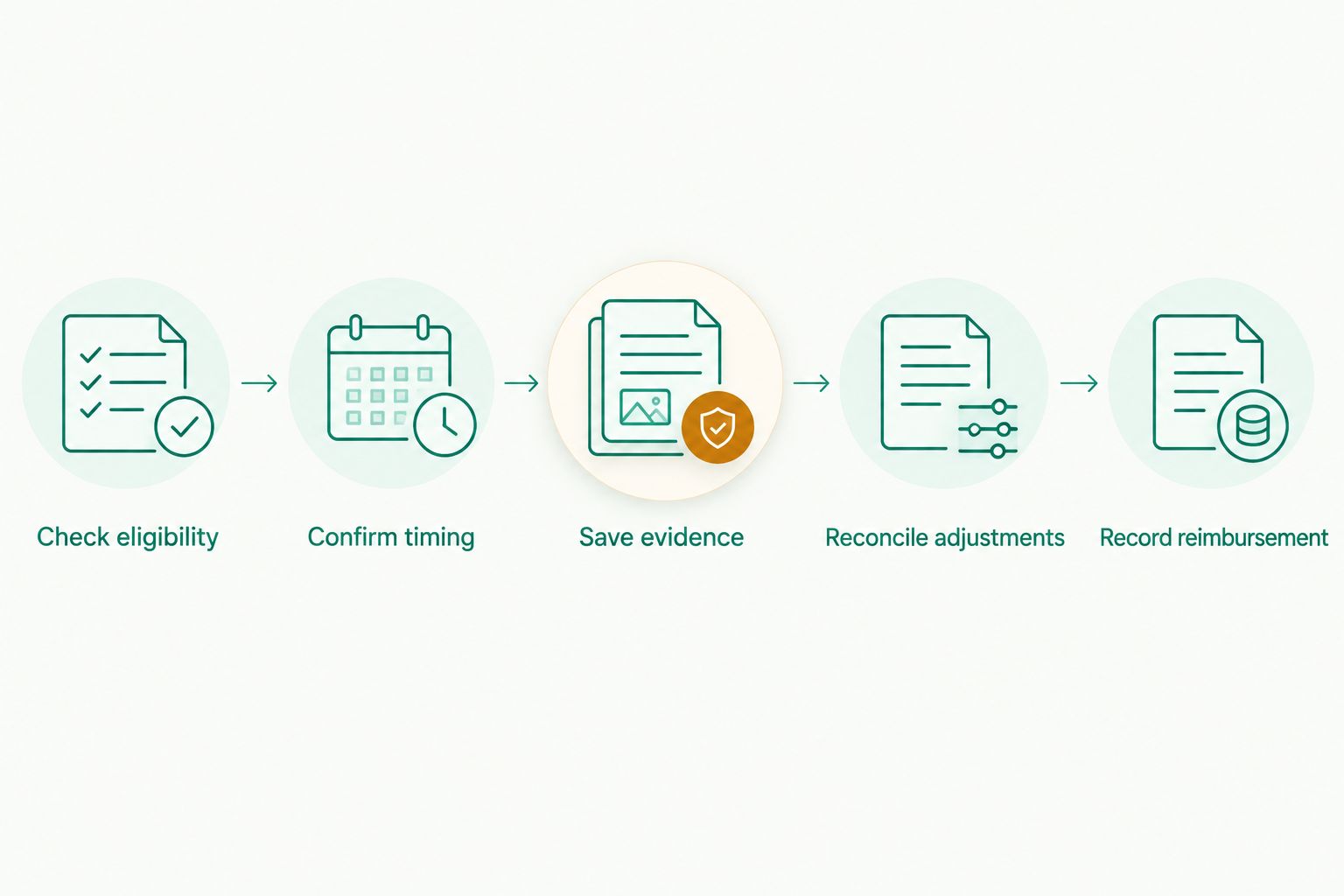
Use the same process whether you reimburse yourself promptly or save the receipt for later. Keep the medical expense and the card reward in separate records so you can explain each transaction without reconstructing an old statement.
1. Check eligibility
Confirm that the purchase meets the applicable medical-expense rules. IRS Publication 502 explains medical expenses, while Publication 969 explains how qualified medical expenses work for HSAs; the rules are related but not identical in every category.
A prescription or doctor's letter does not automatically qualify a general-health expense. An eligible treatment does not become ineligible merely because you paid with a rewards card, either.
2. Confirm timing
The expense must have been incurred after your HSA was established. Paying an older medical bill with a new credit card does not change when the medical expense occurred.
Keep the service or purchase date separate from the date you paid the card issuer. A statement closing date is not evidence that the underlying care occurred after your HSA establishment date.
3. Save evidence
Save the itemized receipt or provider statement, plus evidence of payment. Include an explanation of benefits when insurance affects your final responsibility; an explanation of benefits is not itself proof that you paid.
For a mixed purchase, separate qualified medical items from unrelated items. Use the guidance on separating HSA-qualified medical expenses on mixed bills rather than treating the entire card charge as eligible.
4. Reconcile adjustments
Record insurance payments, merchant refunds, reversals, and other reimbursements against the expense. Keep ordinary rewards in a separate category, with enough information to distinguish them from a credit that directly adjusts the medical purchase.
If the promotion's terms make that distinction unclear, ask your tax advisor before reimbursing the disputed portion. Do not classify every statement credit as ordinary cash back just because it appears on the same statement.
5. Record reimbursement
Record each HSA distribution against the expense it reimburses. If you reimburse only part of the expense, preserve the remaining unreimbursed balance and the supporting documents.
A later card payment does not create another medical expense. Neither does moving the card balance to a different account.
Why the reimbursement treatment varies
The purchase and any later adjustments determine the result. These factors matter more than whether your card advertises points, miles, or cash back:
- Medical eligibility: The underlying item or treatment must qualify under HSA rules; the card's merchant category does not decide eligibility.
- HSA establishment date: The medical expense must occur after the account was established, regardless of when you repay the credit card.
- Other coverage: Insurance, FSA payments, and other reimbursements reduce the expense available for HSA reimbursement.
- Type of credit: A general purchase reward is different from a provider refund, reversed charge, or transaction-specific adjustment.
- Prior tax treatment: You cannot also claim an itemized medical deduction for an expense reimbursed tax-free from your HSA.
- Documentation: Your records must establish the qualified expense, payment, and absence of duplicate reimbursement.
For a 2026 reimbursement, review those factors against the specific expense. A card's rewards summary cannot replace that review.
Can I pay with a credit card and reimburse myself later?
Yes. There is no IRS time limit for reimbursing a qualified expense incurred after your HSA was established. You must retain records showing that the expense qualifies, was not reimbursed elsewhere, and was not taken as an itemized deduction.
For example, you can pay a qualified dental bill with a personal card, keep the paid itemized statement, and request an HSA reimbursement later. If insurance subsequently pays part of that bill, update the unreimbursed amount rather than relying on the original charge.
Waiting is optional. It does not guarantee investment growth, and keeping money in an HSA does not remove the risk of losing receipts or accidentally claiming the same expense twice.
An FSA is different. An FSA has plan-specific claim and spending deadlines; do not apply the HSA's reimbursement timing rule to an FSA expense.
Do I subtract cash back from every medical receipt?
Do not automatically subtract general card cash back as though it were an insurance payment. First identify what generated the credit and whether it changes the amount of the specific medical purchase.
A provider refund clearly changes the bill you ultimately paid. A general reward earned across purchases is a different arrangement; IRS HSA guidance does not supply a dedicated calculation for every reward structure.
For a credit expressly tied to a medical transaction, keep the offer terms with the receipt and get advice on the reimbursable amount. The label on the statement is not enough to settle the treatment.
Can I reimburse credit card interest or late fees?
Credit card interest and late fees are not qualified medical expenses merely because the balance includes medical charges. Keep those financing costs separate from the underlying eligible purchase.
Reimbursing yourself from the HSA does not pay off the card automatically. You remain responsible for the card balance and its payment terms, so do not let the rewards question distract you from repayment.
Choose a receipt system you will actually maintain
Reimbursable offers unlimited free manual tracking and a directory of 890+ HSA/FSA-eligible items. Premium adds AI receipt scanning, bank sync, and email forwarding for less receipt administration; automation is not required to obtain tax-free reimbursement.
Use the method that leaves you with readable evidence and a reliable reimbursement history. These are all legitimate options, with different amounts of manual work.
| Method | Best for | Useful feature | Trade-off |
|---|---|---|---|
| Reimbursable receipt tracking | HSA holders wanting dedicated tracking | Unlimited free manual tracking; optional receipt automation | You still verify eligibility and review records |
| Spreadsheet and digital folders | People comfortable maintaining their own system | Flexible fields and document organization | You enter and reconcile information yourself |
| Paper receipts and a written ledger | People who prefer physical records | No app is required | You must protect receipts from loss and fading |
| HSA-provider receipt tools | People wanting records near their account | Receipt tools where the provider offers them | Features vary; check retrieval and export options |
Whichever method you choose in 2026, record the provider, patient, service date, qualified amount, payment evidence, adjustments, and reimbursement history. Link each ledger entry to its supporting receipt rather than keeping an unexplained total.
What IRS guidance should you use in 2026?
Use IRS Publication 969 for HSA qualified-expense, distribution, and recordkeeping rules. Use IRS Publication 502 to understand medical-expense categories, while checking the HSA-specific distinctions in Publication 969.
IRS Notice 2004-50, Question 39, addresses delayed HSA reimbursement and the records needed to substantiate it. Form 8889 and its instructions cover reporting HSA distributions and qualified medical expenses; a credit card rewards statement does not replace those reporting requirements.
Nonqualified HSA distributions generally enter taxable income and can also face a 20% additional tax. That additional tax generally does not apply after you reach 65 years of age, or in certain other exceptions, but nonqualified withdrawals can still be taxable.
Those consequences apply to nonqualified distributions—not automatically to every rewards-related question. Keep the analysis focused on the documented expense rather than assuming that earning points creates a penalty.
FAQ
Can I earn credit card points and still reimburse a medical expense from my HSA?
Yes, earning ordinary purchase-based points does not by itself make a qualified medical expense ineligible. Keep evidence of the expense and payment, and exclude amounts reimbursed elsewhere.
Does cash back count as a second HSA reimbursement?
General purchase-based cash back is not automatically the same as another payer reimbursing your medical bill. Review transaction-specific credits separately because the underlying arrangement determines whether your medical expense changed.
Is a credit card statement enough for HSA reimbursement?
A credit card statement alone generally does not establish medical eligibility. Keep an itemized receipt or provider statement and payment evidence, with insurance documentation when relevant.
Do I have to reimburse my HSA expense in the same year?
No, there is no IRS time limit for reimbursing a qualified expense incurred after your HSA was established. Preserve records showing it was not reimbursed elsewhere or claimed as an itemized deduction.
Can I reimburse the whole credit card balance if it includes medical bills?
No, only the qualified medical portion is eligible for tax-free HSA reimbursement. Separate unrelated purchases, interest, fees, refunds, and amounts covered by another payer.
Can I claim an FSA reimbursement and an HSA reimbursement for the same expense?
No, you cannot receive tax-free reimbursement twice for the same expense. Track which account paid each portion, and follow the FSA plan's separate deadlines.
Do I need a paid receipt app to get tax-free HSA reimbursement?
No, a paid app is not required for tax-free HSA reimbursement. Reimbursable offers unlimited free manual tracking; spreadsheets, folders, paper records, and HSA-provider receipt tools are also legitimate alternatives.
One last thing
Track the medical purchase, not the credit card balance. Paying the issuer, transferring a balance, or redeeming points does not create a new medical expense available for another reimbursement.
Before requesting a distribution, check the expense's remaining unreimbursed amount against its receipt and adjustments. That final check protects the record you will need long after the card statement stops being memorable.
Not tax advice. Always consult your tax advisor, especially when a promotional credit directly relates to the medical purchase.