
A humidifier used to treat a medical condition needs documentation of that medical purpose, and an FSA administrator can require a letter of medical necessity before approving reimbursement. For an HSA, there is no universal IRS rule requiring a document with that exact title for every humidifier purchase, but you must substantiate that the expense qualifies. A doctor's letter does not turn a humidifier bought for ordinary comfort or general health into an eligible medical expense.
- A letter of medical necessity for humidifier reimbursement supports medical purpose; it does not guarantee HSA or FSA eligibility.
- Ask your FSA administrator what documentation it requires before submitting a humidifier claim.
- HSA expenses must occur after account establishment and cannot also be reimbursed elsewhere or deducted.
- Reimbursable offers receipt tracking; keep the medical explanation alongside your purchase records.
Why this matters
A humidifier can serve different purposes: treating a medical condition or making a dry room more comfortable. The product name alone does not establish which purpose applies to your purchase.
For a 2026 purchase, separate the eligibility decision from the paperwork. First establish whether the expense qualifies; then preserve the evidence. The same distinction appears in this guide to general health versus medical treatment, although the product-specific rules differ.
Does a humidifier need a letter of medical necessity?
Get a written medical explanation when you intend to treat a condition, and check your account's documentation requirements before claiming reimbursement. An FSA administrator's substantiation requirements and your responsibility to support an HSA distribution are different processes.
| Situation | What the documentation must establish | What a letter cannot do |
|---|---|---|
| Humidifier used to treat a medical condition | The connection between the purchase and medical care | Guarantee that every related purchase qualifies |
| Humidifier bought for ordinary room comfort | A genuine medical-care purpose would still be necessary | Convert personal comfort into medical treatment |
| FSA reimbursement request | Eligibility plus the administrator's required claim evidence | Replace the receipt or override plan deadlines |
| HSA reimbursement taken later | Qualified expense, purchase evidence, and no duplicate reimbursement | Make an expense from before HSA establishment eligible |
IRS Publication 502 explains the distinction between medical care and expenses that are merely beneficial to general health. IRS Publication 969 explains the qualified-medical-expense and recordkeeping rules for HSAs and health FSAs. Neither a retailer's eligibility badge nor a successful debit-card transaction replaces those rules.
What should a humidifier medical-necessity letter include?
Ask the treating clinician to explain the actual medical reason for the humidifier. Do not ask for a generic approval statement detached from your care.
A useful letter identifies:
- The patient: Whose condition the humidifier is intended to treat.
- The condition: The medical condition relevant to the recommendation.
- The treatment connection: Why the clinician recommends humidification for that condition rather than general comfort.
- The recommended use: Any treatment period or instructions the clinician considers appropriate.
- The clinician: Name, credentials, signature, and date, using the administrator's form when required.
These are practical documentation elements, not a claim that the IRS requires a universal humidifier form. Your FSA administrator can specify additional information or its own submission format.
For a 2026 claim, ask whether the letter must address the purchase date or treatment period. Do not assume that a later letter automatically supports an earlier purchase. It must truthfully describe the medical circumstances, and an FSA administrator must accept the documentation under the plan's rules.
How do you document the purchase before reimbursement?
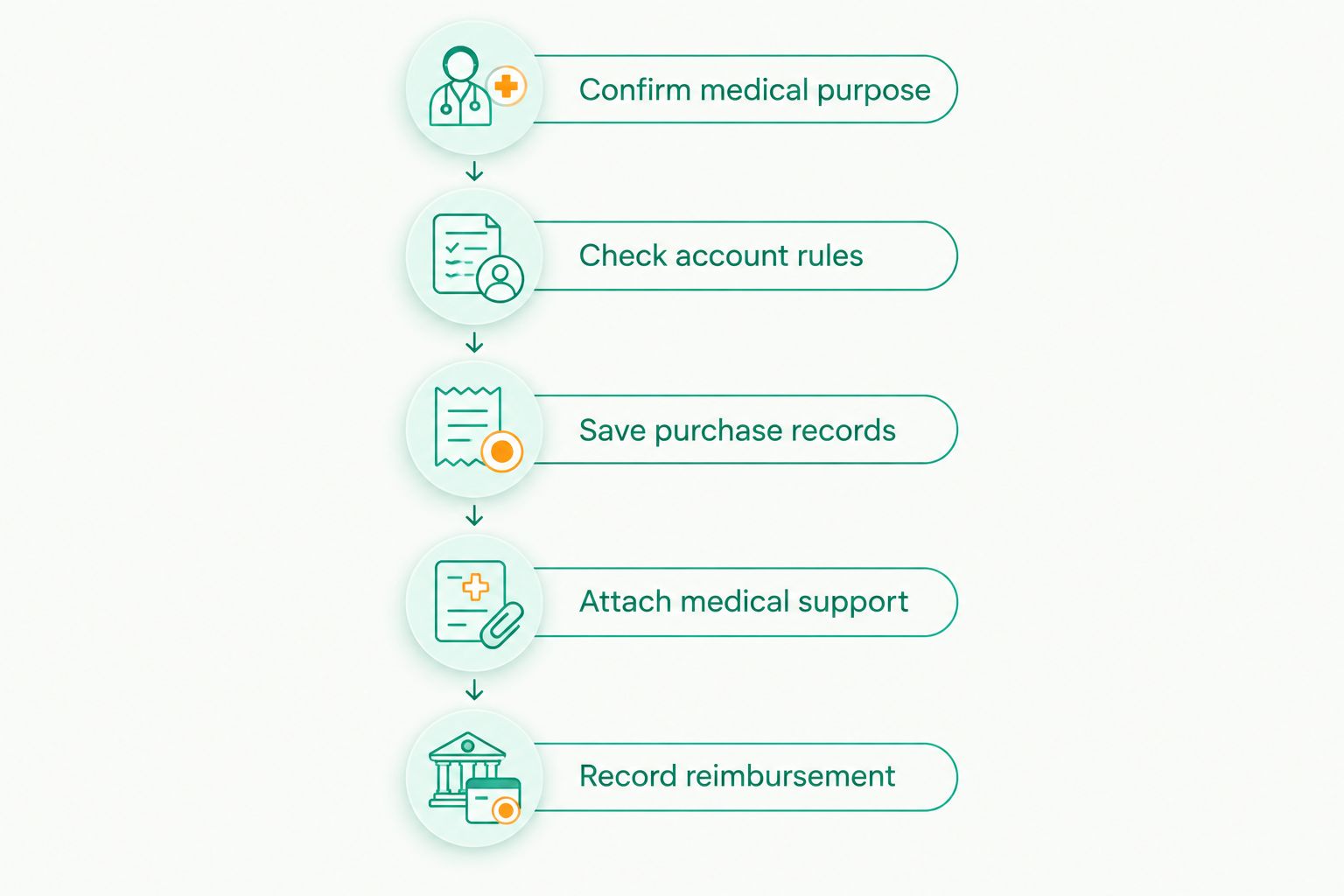
Use this sequence to keep the medical decision, purchase evidence, and reimbursement record connected. Paying out of pocket gives you time to organize the records, but payment method does not determine eligibility.
- Confirm medical purpose. Ask your clinician whether the humidifier is part of treatment for a condition, rather than a recommendation for general comfort.
- Check account rules. For an FSA, ask the administrator about its letter requirements, covered period, and claim deadline. For an HSA, confirm that the expense occurred after the account was established.
- Save purchase records. Keep the itemized receipt and evidence of payment. A card statement alone generally does not explain what you bought.
- Attach medical support. Store the clinician's letter or relevant treatment documentation with the receipt, not in a disconnected inbox.
- Record reimbursement. Note whether the expense remains unreimbursed, was paid directly from the account, or was reimbursed later. Account for refunds and payments from other sources.
Keep the original receipt even if you create a tracking entry. A summary helps you find the evidence; it does not replace the underlying documents.
Why humidifier documentation requirements vary
The question is not simply whether humidifiers appear on an eligible-items list. These factors change what you need to establish:
- Purpose of use: Treatment of a medical condition differs from everyday comfort or general wellness.
- Account type: An FSA administrator reviews claims; an HSA holder remains responsible for supporting tax-free distributions.
- Plan procedures: An FSA can require a particular form, supporting details, or further substantiation.
- Timing: HSA establishment dates and FSA coverage and filing periods are separate requirements.
- Purchase contents: A receipt containing unrelated household items requires you to identify the qualifying expense rather than claim the entire total.
- Other payments: Insurance reimbursement, another account's payment, or a merchant refund changes the amount left for reimbursement.
A medical letter addresses the treatment purpose. It does not resolve every other factor on this list.
Is a prescription enough for HSA reimbursement?
A prescription alone does not automatically make a humidifier HSA-eligible. The underlying purchase must meet the medical-expense rules, and your records must support that conclusion.
A brief instruction to use a humidifier can be less informative than a medical explanation connecting it to treatment. Ask the clinician for accurate supporting details, not stronger wording designed only to secure reimbursement.
The reverse matters too: the absence of a document titled “letter of medical necessity” does not itself prove that an HSA expense is ineligible. The issue is whether the expense qualifies and whether you can substantiate it.
Can I reimburse myself years after buying the humidifier?
There is no IRS deadline for reimbursing yourself from an HSA for a qualifying expense incurred after the HSA was established. You must retain records showing that the expense qualified, was not reimbursed elsewhere, and was not taken as an itemized deduction.
For example, a qualifying humidifier expense incurred in 2026 after your HSA was established can remain unreimbursed until a later year. Keep the medical support and receipt together throughout that delay; waiting does not remove the documentation requirement.
Do not apply that rule to an FSA. Health FSAs have plan-specific coverage and claim-submission rules, including any applicable grace period or carryover provisions. Check your plan documents rather than assuming you can submit an old purchase whenever you choose.
Does paying with an HSA or FSA card prove eligibility?
A successful HSA or FSA card payment does not prove that a humidifier qualifies. Transaction approval and tax eligibility are separate questions.
For an HSA purchase, keep supporting records even when the account paid the merchant directly. For an FSA purchase, respond to requests for substantiation and follow the administrator's instructions if a transaction is not approved as eligible.
Do not reimburse yourself again for a purchase already paid from the account. Your tracking record should distinguish direct account payments from expenses you paid personally and still intend to reimburse.
Keep the letter, receipt, and reimbursement status together
The useful record is a connected file: what you bought, why it qualified, what you paid, and what remains unreimbursed. A medical letter without purchase evidence leaves a gap; a receipt without medical context leaves a different gap.
Reimbursable is best for HSA holders who want unlimited free manual receipt tracking rather than a separate spreadsheet. That is an organizational choice, not a requirement for tax-free reimbursement.
| Recordkeeping option | Best for | Benefit | Limitation |
|---|---|---|---|
| Reimbursable manual tracking | HSA holders wanting an expense-tracking app | Unlimited free manual tracking | You still enter records and assess eligibility |
| Spreadsheet and digital folders | People comfortable maintaining their own system | You choose the fields and folder structure | You maintain links between entries and documents |
| Paper receipts and folders | People who prefer physical records | No app is necessary | You must preserve legible copies and organize retrieval |
| HSA-provider receipt tools | People wanting records near their account | Uses the provider's available recordkeeping tools | Features vary; check document support and export options |
None of these methods makes a questionable purchase eligible. Choose the system you will maintain, including after changing providers or waiting to reimburse yourself.
If automation solves a recurring administrative problem, consider Reimbursable's tracking plans. Premium offers receipt scanning, bank sync, and email forwarding to reduce receipt administration; those features are optional, not conditions for tax-free reimbursement.
Which IRS guidance should you check?
For a 2026 reimbursement decision, use the IRS guidance for the relevant tax year and your FSA plan documents where applicable. Read each source for its specific purpose:
- IRS Publication 502, Medical and Dental Expenses: The medical-care definition and the distinction between treatment and general-health expenses.
- IRS Publication 969, Health Savings Accounts and Other Tax-Favored Health Plans: HSA qualified expenses, recordkeeping, and health FSA rules.
- Instructions for Form 8889: Reporting HSA distributions and qualified medical expenses on your tax return.
Publication 502 discusses itemized medical deductions as well as qualifying medical care. Do not apply the deduction's income threshold as an HSA reimbursement threshold. Also, do not claim an itemized deduction for the same expense you reimburse tax-free from an HSA.
Not tax advice; consult your tax advisor about your circumstances. Ask your FSA administrator about its claim requirements before relying on a letter format or submission deadline.
FAQ
Do I need a letter of medical necessity for humidifier reimbursement in 2026?
You need evidence that the humidifier qualifies as medical care, and your FSA administrator can require a letter of medical necessity. For an HSA, there is no universal requirement for a document bearing that exact title, but you must retain adequate supporting records.
Can I use my HSA for a humidifier bought just because my bedroom is dry?
Ordinary room comfort does not establish an HSA-qualified medical expense. A clinician's letter does not automatically convert a general-health purchase into medical treatment.
Can my doctor write the letter after I buy the humidifier?
Do not assume a letter written after purchase will satisfy the documentation requirements. Ask your administrator what it accepts, and make sure any medical statement accurately describes the circumstances of the purchase.
Do I send my humidifier receipt to the IRS with my tax return?
You generally retain HSA receipts with your tax records rather than attach them to your return. Keep the purchase evidence and medical support available to substantiate the distribution if requested.
Does my humidifier letter expire after a year?
There is no universal HSA rule making every humidifier letter expire after a year. An FSA administrator can require documentation covering the relevant treatment period, so check the plan's requirements rather than assuming a permanent approval.
Can I claim the same humidifier through both my HSA and FSA?
You cannot receive tax-free reimbursement twice for the same expense. Track payments from each source and claim only an otherwise eligible amount that remains unreimbursed.
Do I need a receipt-tracking subscription to reimburse myself later?
No subscription is required for tax-free HSA reimbursement. Reimbursable offers unlimited free manual tracking, and spreadsheets, folders, paper records, and HSA-provider tools are legitimate alternatives.
One last thing
Your HSA opening date belongs in your receipt system, not just your account paperwork. A medically justified humidifier bought before the HSA was established does not become eligible because you reimburse yourself later.
Before marking a 2026 purchase ready for reimbursement, check that date alongside the receipt, medical support, and prior-payment record. Those checks matter more than whether the merchant accepted your account card.