
Massage therapy does not have a blanket IRS requirement for a letter of medical necessity, but an FSA administrator can require one, and an HSA holder needs records supporting the treatment's medical purpose. A letter of medical necessity for massage therapy helps document treatment of a condition; it does not turn a relaxation massage into a qualified expense. Before using tax-free funds in 2026, confirm the medical purpose, ask about documentation requirements, and keep the treatment records with your receipt.
- A letter of medical necessity for massage therapy supports medical treatment; it does not automatically establish HSA or FSA eligibility.
- IRS Publication 502 distinguishes medical care from expenses that merely benefit general health.
- HSA reimbursement requires an eligible expense incurred after your HSA was established, without duplicate reimbursement or deduction.
- Reimbursable supports HSA receipt tracking; storing a letter does not establish tax eligibility.
Does massage therapy need a letter of medical necessity?
Ask your FSA administrator whether a letter is required; for an HSA, keep evidence explaining why the massage qualifies as medical care. IRS Publication 502 describes medical expenses as costs of diagnosing, curing, mitigating, treating, or preventing disease. Expenses that merely benefit general health do not meet that standard.
The treatment's purpose matters more than the business name, booking category, or payment method. A massage offered in a spa is not automatically excluded, and a service labeled therapeutic is not automatically eligible.
| Situation | What determines eligibility | What to keep |
|---|---|---|
| Massage used to treat a medical condition | Whether the service meets the medical-care standard | Medical recommendation, treatment details, itemized receipt, and proof of payment |
| Massage for relaxation or general wellness | General-health benefits alone do not qualify | Keep it separate from expenses claimed for tax-free reimbursement |
| Medical treatment bundled with unrelated services | Only the qualifying portion belongs in your reimbursement claim | An itemized bill separating treatment from nonmedical services |
If your appointment includes separate charges, use the guidance on separating qualified medical expenses on mixed bills. Do not treat the entire visit as eligible because one service qualifies.
Why this matters
A receipt proves that you bought a service. It does not necessarily prove that the service was medical care, which is the central issue with massage.
For a 2026 HSA withdrawal, you remain responsible for supporting tax-free treatment. With an FSA, the administrator reviews documentation under the plan's claims process. Neither a successful card transaction nor a provider's eligibility claim replaces that evidence.
Paying out of pocket gives you time to assemble the records before requesting HSA reimbursement. It does not fix an ineligible expense, and it does not extend an FSA deadline.
How do I document massage therapy before reimbursement?
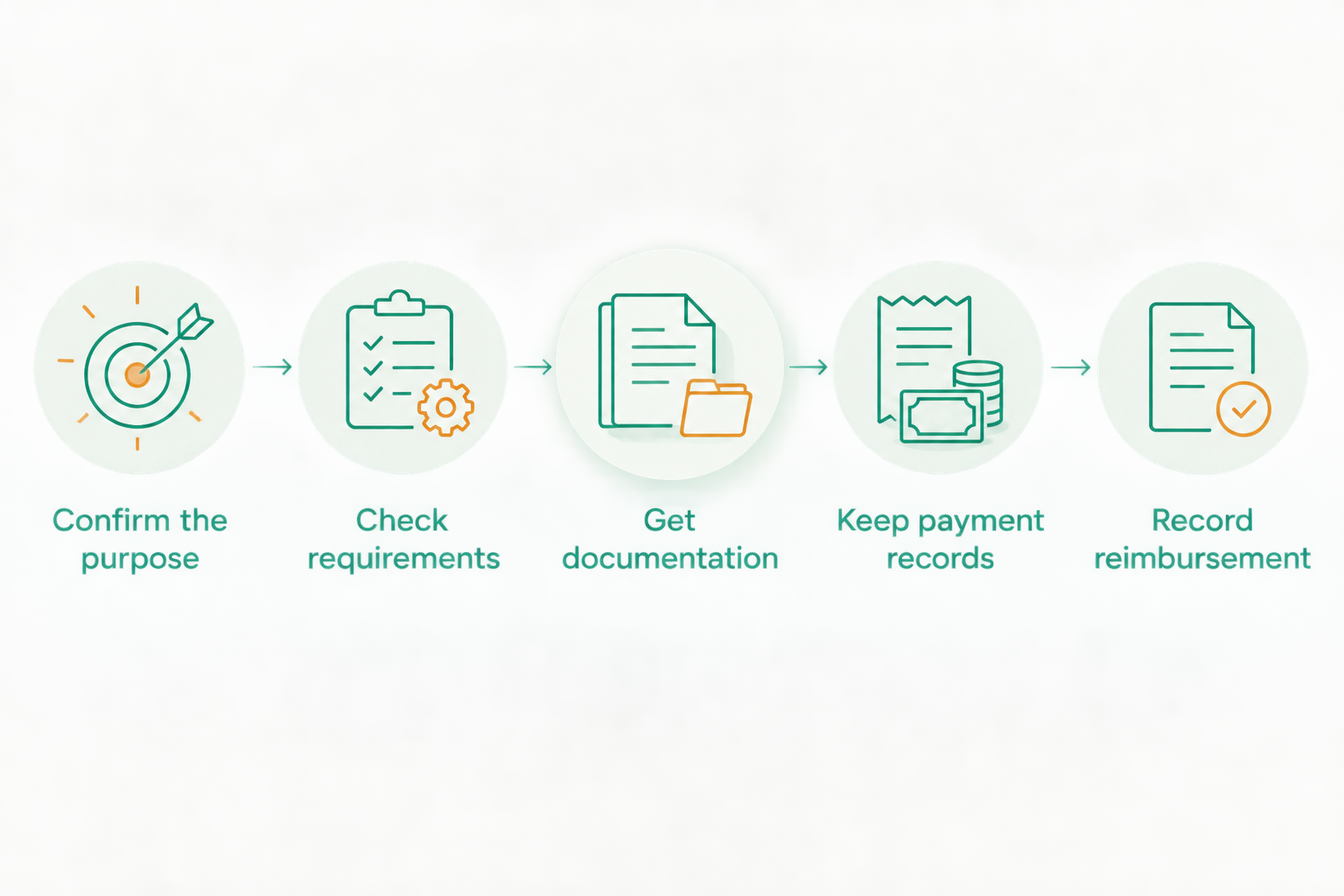
Use these 5 steps to build a record that explains the service, its medical purpose, and the amount you actually paid. Complete the eligibility review before withdrawing HSA money or submitting an FSA claim.
1. Confirm the purpose
Ask the clinician managing your condition whether massage is part of your medical treatment. Explain the symptoms or condition being addressed rather than asking only whether massage is HSA eligible.
For example, massage recommended as part of treatment for a documented injury presents a different eligibility question from an appointment booked simply to unwind. Neither the word recovery nor a general reference to stress settles the question.
2. Check requirements
For an FSA claim, ask the administrator whether it requires a particular letter, form, or supporting treatment record. Also ask which expenses the account covers and when documentation must be submitted.
For an HSA, ask your provider about its reimbursement process, but distinguish its procedures from your tax responsibilities. A provider allowing a withdrawal is not an IRS determination that the expense qualifies.
3. Get documentation
Ask your treating clinician to explain the medical reason for massage and how the recommended treatment relates to your condition. If your administrator supplies a form, give that form to the clinician rather than substituting a generic online template.
A useful record identifies the patient, the condition being treated, the recommended service, and the clinician making the recommendation. Follow any additional administrator requirements about treatment frequency, duration, signatures, or renewal.
4. Keep payment records
Request an itemized receipt showing the patient, provider, service date, service description, and amount paid. Keep proof of payment and any insurance explanation of benefits with it.
If the receipt says only spa package, ask for a more specific breakdown. A card statement supports payment, but it usually does not explain the treatment or separate medical services from unrelated purchases.
5. Record reimbursement
Record whether insurance, an FSA, an HSA, or another source has reimbursed any part of the bill. If you reimburse yourself later, enter the withdrawal date and amount against the original expense.
The same expense cannot support both tax-free HSA reimbursement and a medical-expense deduction. It also cannot be reimbursed twice through different accounts or insurance.
What should a massage therapy letter explain?
A useful letter explains the connection between the service and your medical treatment. It is supporting evidence, not an eligibility certificate.
Ask your clinician to address these points where applicable:
- Patient identification: Who receives the treatment.
- Medical condition: What condition or symptoms the treatment addresses.
- Treatment connection: Why massage is recommended for that condition.
- Treatment plan: The recommended course, if the clinician specifies one.
- Clinician identification: The recommending professional's name, credentials, signature, and date.
Do not add a diagnosis, treatment schedule, or clinical explanation yourself. The clinician must supply the medical judgment, and the FSA administrator can specify what its claim review requires.
For 2026 appointments, ask about documentation before booking a course of treatment. That lets you identify missing information before paying for sessions you intend to reimburse.
Why massage therapy documentation requirements vary
There is no single letter format that resolves every massage claim. These 5 factors affect what you need to establish or submit:
- Medical purpose: Treatment of a condition requires a different explanation from general relaxation or wellness.
- Account type: An HSA relies on your supporting tax records; an FSA uses an administrator's claim-substantiation process.
- Plan requirements: An FSA administrator can require its own form or additional information.
- Receipt detail: A clear treatment description is more useful than an unexplained package name.
- Other reimbursement: Insurance payments or other reimbursements change the amount remaining for an eligible claim.
A clinician's recommendation addresses the medical-purpose question. It does not prove when the expense occurred, how much you paid, or whether someone else reimbursed it.
Can I get a letter after the massage appointment?
A letter obtained after treatment does not automatically qualify an earlier massage appointment. Ask the clinician whether the medical record supports the treatment's purpose at the time, and ask your FSA administrator about its documentation rules.
For an HSA, a later letter cannot change an appointment's actual purpose or make an expense incurred before the HSA was established eligible. Do not assume that obtaining paperwork later fixes either problem.
For an FSA, a pending letter also does not suspend the plan's submission deadline. Contact the administrator while you still have time to resolve a documentation request.
Does my letter of medical necessity expire?
There is no universal IRS expiration period for every massage therapy letter. Your FSA administrator can specify a validity period or require updated documentation under its claims process.
Ask whether the letter covers a particular treatment course and what happens if the condition or recommendation changes. Do not assume a letter written for an earlier course supports every future appointment.
For 2026 treatment, review whether your records still describe the care you are receiving. Keep updated recommendations alongside the corresponding receipts rather than replacing the earlier records.
Can I save the receipt and reimburse myself years later?
There is no IRS deadline for HSA reimbursement of a qualified expense incurred after the HSA was established. You must keep records showing that the expense qualified, was not reimbursed elsewhere, and was not taken as an itemized medical deduction.
This rule does not apply to an FSA. FSA expenses must fit the applicable coverage period, and claims must meet the plan's submission deadline; any grace period or carryover depends on the plan.
Before delaying HSA reimbursement, check 3 things: the service occurred after your HSA was established, the medical-purpose documentation is complete, and the unreimbursed amount is accurate. Waiting does not make weak documentation stronger.
How should I store the letter and massage receipts?
Keep the letter, itemized receipts, payment evidence, and reimbursement history together. Give each appointment its own entry so you can distinguish an unpaid claim from an expense already reimbursed.
Reimbursable is a fit for HSA holders who want manual expense tracking without a paid plan. Its free manual tracking is unlimited; Premium adds AI receipt scanning, bank sync, and email forwarding to reduce receipt administration, not to create eligibility.
| Tracking option | Best for | Useful feature | Limitation |
|---|---|---|---|
| Spreadsheet and digital folders | People comfortable maintaining their own records | You control the expense ledger and file organization | You must connect receipts, letters, and reimbursement entries yourself |
| Paper receipt folder | People who prefer physical records | Keeps original documents together without an app | You must protect, organize, and retrieve the paperwork yourself |
| HSA-provider receipt tools | People whose provider offers suitable tools | Can keep supporting records near account activity | Features and record-access arrangements depend on the provider |
| Reimbursable HSA receipt tracking | People who want an expense-tracking app | Unlimited free manual tracking, with optional Premium automation | You still determine eligibility and check the supporting records |
These are all legitimate ways to keep records. Choose based on the administrative work you will actually maintain, not on the idea that an app is required for tax-free reimbursement.
For a practical filing routine, follow the phone-photo-to-reimbursement receipt workflow. Add the medical letter to the same expense record rather than leaving it in a separate email thread.
Which IRS sources should I use in 2026?
Use the current IRS Publication 502 for the federal definition of medical care and the distinction between treatment and general-health spending. Its medical-deduction discussion does not make every rule in that publication an HSA reimbursement requirement.
Use the current IRS Publication 969 for HSA and health FSA rules, including qualified distributions and recordkeeping. The income threshold for an itemized medical deduction is not an HSA reimbursement threshold.
Read those sources alongside your FSA plan documents when submitting an FSA claim. Not tax advice; consult your tax advisor about whether your particular treatment and documentation support reimbursement.
FAQ
Do I always need a letter of medical necessity for massage therapy?
No blanket IRS rule requires a letter for every massage expense, but an FSA administrator can require one. For an HSA, keep documentation showing that the massage was medical care rather than general relaxation.
Does a doctor's note make a relaxation massage HSA eligible?
No, a doctor's note does not automatically make a relaxation massage HSA eligible. The expense must meet the medical-care standard; general-health benefits alone do not qualify.
Can I use my HSA card for massage without a letter?
A successful HSA card payment does not establish that massage qualifies. You remain responsible for supporting the medical purpose and retaining the expense records.
Can I reimburse massage therapy from both my HSA and FSA?
You cannot reimburse the same portion of a massage expense from both an HSA and an FSA. Track any insurance or account reimbursement before claiming the remaining eligible amount.
Can I reimburse a massage from before I opened my HSA?
No, an expense incurred before your HSA was established does not qualify for tax-free HSA reimbursement. A later medical letter does not change that timing rule.
Does massage therapy need a new medical letter every year?
There is no universal IRS annual-renewal rule for every massage letter. Ask your FSA administrator about its requirements and obtain updated medical documentation when needed to support the treatment.
Do I need a paid receipt app to claim massage therapy?
No, a paid receipt app is not required for tax-free reimbursement. Reimbursable offers unlimited free manual tracking, while spreadsheets, folders, paper records, and suitable HSA-provider tools are legitimate alternatives.
One last thing
Ask for the itemized receipt before leaving the appointment. A medical letter explains why you received treatment; the receipt explains what you actually purchased, and you need records that connect those two facts.
Save that connection now, even if HSA reimbursement is years away. Consult your tax advisor before claiming an expense whose medical purpose remains unclear.