
FSA Store is useful when you want to shop for products presented as FSA eligible. A shopping lookup stops short of explaining every medical-use condition or organizing receipts for an HSA reimbursement years later. The best FSA Store alternative in 2026 is Reimbursable for eligibility lookups plus receipt tracking; IRS guidance is best for checking the underlying tax rules.
- For fsa store alternatives, choose Reimbursable for eligibility lookups and HSA receipt tracking, not a replacement checkout.
- Use IRS Publications 502 and 969 to check medical-expense rules and account-specific restrictions.
- Ask your FSA administrator about claim documentation and deadlines; HSA reimbursement timing follows different rules.
- Spreadsheets, folders and paper receipts remain legitimate alternatives when you maintain complete records.
Why this matters
An eligibility lookup answers a different question from a reimbursement record. You need to know both whether an expense qualifies and whether you can substantiate the amount you withdraw.
For an HSA, the expense must occur after the account was established. It cannot also be reimbursed by insurance, an FSA or another source, and you cannot claim an itemized medical deduction for the same expense.
For a health FSA, your plan's coverage period and claim-submission rules matter. An HSA's delayed-reimbursement approach does not let you ignore an FSA deadline.
The useful comparison in 2026 is therefore not simply which website lists more products. It is which resource answers your immediate question: what qualifies, what documentation is needed, or what remains available for reimbursement.
FSA Store alternatives at a glance
These options serve different jobs. A directory helps you research, an administrator handles plan claims, and a tracking system preserves your evidence.
| Option | Best for | Standout function | How it differs from FSA Store |
|---|---|---|---|
| FSA Store | Shopping for products presented as FSA eligible | Retail product discovery | The shopping benchmark, rather than a tax-rule source |
| Reimbursable | Eligibility research and later HSA reimbursement | Directory of 890+ HSA/FSA-eligible items plus receipt tracking | Connects eligibility research with expense records |
| IRS Publications 502 and 969 | Checking federal medical-expense and account rules | Primary-source explanations | Explains rules rather than selling products |
| Your FSA administrator | Submitting a claim under your plan | Plan-specific documentation and deadline instructions | Addresses your claim rather than general shopping |
| Spreadsheet plus receipt folders | Maintaining your own reimbursement ledger | A record structure you control | Organizes evidence rather than checking product eligibility |
Best for shopping: stay with FSA Store if purchasing is your main task. Main limitation: a product listing alone does not establish every fact needed to support your own reimbursement.
1. Reimbursable: best for lookups plus HSA receipt tracking
Reimbursable is an HSA/FSA eligibility directory and receipt-tracking app for consumers. Its directory covers 890+ items, while its tracking function addresses the records you need after paying out of pocket.
That combination fits HSA holders who research an expense now but intend to reimburse themselves later. You still need to establish eligibility and retain supporting documents; the app does not replace the tax rules.
Where it shines
- Research and records belong in the same workflow. You can check eligibility and maintain expense records rather than treating shopping as the end of the process.
- Manual tracking is unlimited. A manual workflow remains a valid choice when you do not need automation.
- Premium targets receipt administration. AI receipt scanning, bank sync and email forwarding reduce manual handling; they are not requirements for tax-free reimbursement.
Where it falls short
- A directory entry does not resolve every conditional expense or individual medical circumstance.
- Receipt automation does not establish that an expense qualifies or prevent you from claiming it elsewhere.
- If you already maintain complete records through folders, a spreadsheet or your HSA provider's receipt tools, another app adds a system to maintain.
| Dimension | Reimbursable | FSA Store |
|---|---|---|
| Main task | Eligibility lookup and receipt tracking | Product shopping |
| Documented scope | Directory of 890+ eligible items | Retail product selection |
| Later reimbursement | Expense-tracking workflow | A purchase record still needs to fit your recordkeeping system |
Best for: HSA holders who want eligibility research and receipt tracking together.
Verdict: Buy into the workflow if receipt organization is your problem; skip the extra app if your existing records already work.
2. IRS guidance: best for checking the eligibility rule
IRS Publication 502, Medical and Dental Expenses, explains qualified medical-expense categories and exclusions. IRS Publication 969, Health Savings Accounts and Other Tax-Favored Health Plans, explains account-specific rules, including HSA distributions and health FSAs.
Read them together for a 2026 reimbursement decision. Publication 502 discusses medical deductions, so its deduction framework is not a substitute for Publication 969's HSA and FSA rules.
Where IRS guidance shines
- It provides the federal tax framework rather than a retail classification.
- It explains why treatment-related spending differs from spending for general health.
- Publication 969 distinguishes account rules that a product lookup does not answer.
Where IRS guidance falls short
- The publications require more reading than a product search.
- They do not organize your receipts or maintain your reimbursement ledger.
- General explanations do not eliminate the need to evaluate the facts of a conditional expense.
| Dimension | IRS guidance | FSA Store |
|---|---|---|
| Primary purpose | Explain federal tax rules | Help you shop |
| Research method | Read expense categories and account rules | Browse product listings |
| Personal records | You maintain the supporting evidence | You retain the purchase documentation |
Best for: deciding whether a category or medical purpose meets the federal rules.
Verdict: Hold onto IRS guidance as your rules reference, even when you use a directory first.
3. Your FSA administrator: best for claim requirements
Your health FSA administrator is the right place to confirm what your plan requires for a claim. Ask about the service date, itemized documentation, medical-necessity documentation where relevant, and the submission deadline.
A health FSA commonly follows a 12-month plan year. Plans can offer a grace period of up to 2.5 months or a permitted carryover, but those features are not automatic; check your own plan documents. IRS Publication 969 explains these distinctions.
Where an FSA administrator shines
- Provides your plan's submission process and deadlines.
- Identifies supporting information needed to process your claim.
- Clarifies whether your plan includes a grace period or carryover.
Where an FSA administrator falls short
- Its FSA claim process does not replace a long-term HSA receipt ledger.
- Plan instructions do not remove federal eligibility restrictions.
Best for: an expense you intend to submit to your current health FSA.
Verdict: Hold off on assuming reimbursement until you have checked your plan's requirements.
4. Spreadsheet and folders: best for hands-on recordkeeping
A spreadsheet linked to receipt files is a legitimate HSA tracking system. Paper receipts, organized folders and HSA-provider receipt tools are also legitimate choices when they preserve the evidence you need.
Use a ledger to record the patient, service date, description, qualified amount, supporting file and reimbursement status. Separate amounts paid by insurance or reimbursed elsewhere.
Where manual records shine
- You control the fields and folder structure.
- You can keep eligibility notes beside the expense entry.
- A reimbursement-status column helps distinguish open expenses from completed withdrawals.
Where manual records fall short
- You must enter information and update it yourself.
- A spreadsheet does not determine medical eligibility.
- Broken file references, unreadable receipts and inconsistent status updates weaken the record.
Best for: people who reliably maintain their own records and backups.
Verdict: Skip another app if your manual system preserves complete, retrievable evidence.
Why people switch from FSA Store lookups
The reason to use an alternative is not that shopping lookups are useless. It is that your question extends beyond choosing a product.
You need to explain the medical purpose
General-health spending does not automatically qualify because a doctor recommends it. A doctor's letter alone does not turn an otherwise general-health expense into qualified medical care.
Vitamins illustrate the distinction. Supplements for ordinary health maintenance and supplements used to treat a diagnosed condition require different analysis under IRS Publication 502. Preserve the relevant medical documentation rather than relying solely on a product label.
You need to separate a mixed purchase
A receipt can contain qualifying and nonqualifying items. Record the supported eligible portion, not the entire checkout total simply because one product qualifies.
Use this guide to separating HSA-qualified medical expenses on mixed bills when your evidence includes several charges. The record should show how you arrived at the reimbursement amount.
You need records beyond checkout
An HSA holder can pay out of pocket and reimburse a qualifying expense later. Under IRS Notice 2004-50, Q&A 39, there is no federal time limit for that reimbursement when the applicable requirements are met.
That makes durable records more important, not less. Keep evidence that the expense occurred after HSA establishment, was not reimbursed elsewhere and was not taken as an itemized deduction.
A practical lookup-to-reimbursement workflow
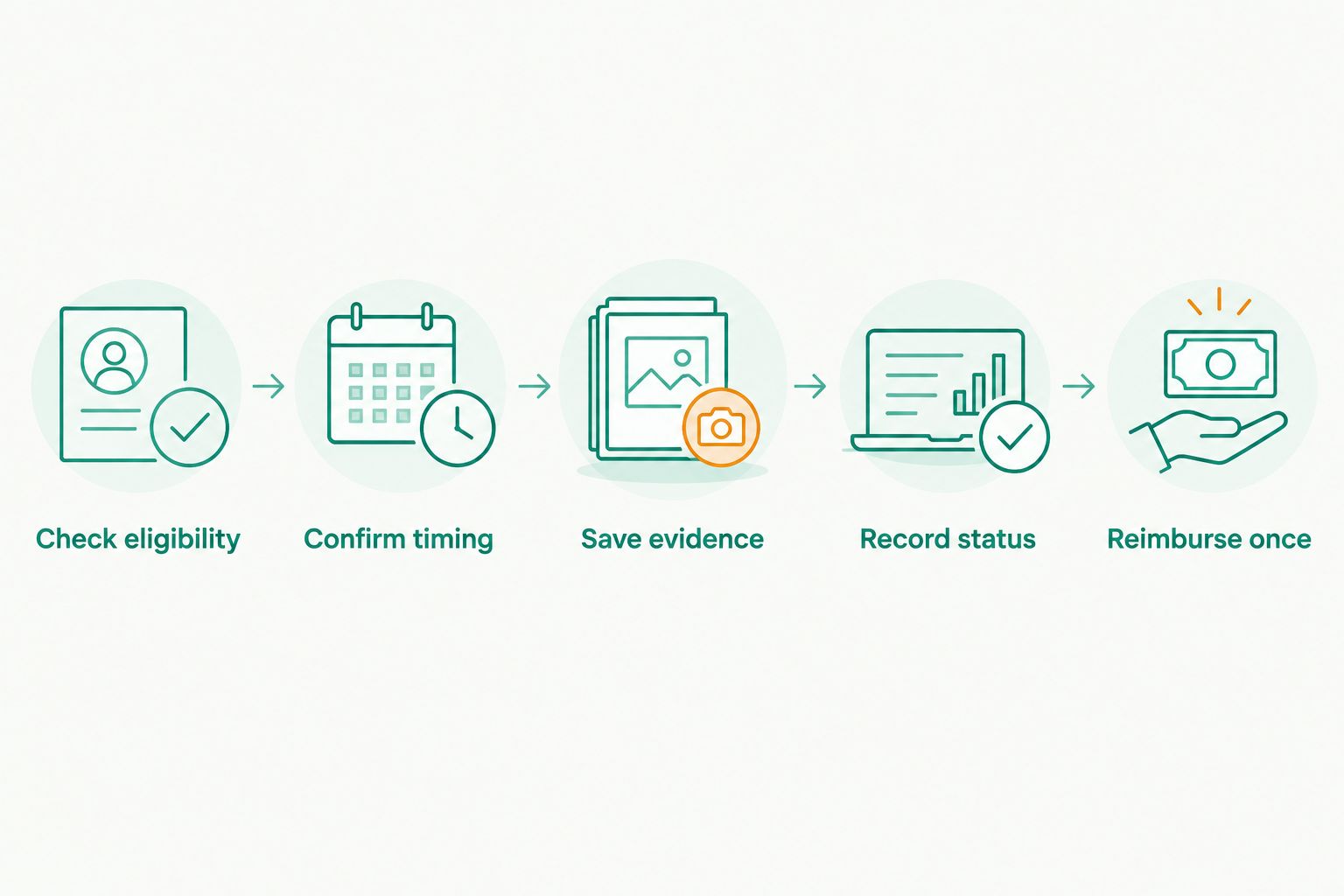
Use this sequence for a 2026 expense whether you choose an app, provider tools or folders. It separates eligibility from evidence and prevents a purchase label from becoming your only support.
- Check eligibility. Identify the actual item or service and its medical purpose. Consult IRS Publications 502 and 969 when the category is conditional.
- Confirm timing. For an HSA, establish that the expense occurred after the account was established. For an FSA, check the plan's coverage and submission rules.
- Save evidence. Keep the itemized receipt or bill, payment record and relevant insurance explanation of benefits. Add medical documentation where needed.
- Record status. Note the eligible amount and whether insurance, an FSA or another source paid any portion. Track partial reimbursements separately.
- Reimburse once. Match each withdrawal to an eligible, unreimbursed amount and update the ledger immediately.
Suppose a dental bill includes treatment and a separate cosmetic charge. Do not treat the entire bill as eligible merely because it came from a dentist; identify the qualifying care and preserve the itemization.
If insurance later pays part of the treatment charge, update the ledger before reimbursing yourself. The original amount you paid is not automatically the amount still eligible for an HSA withdrawal.
When staying with FSA Store is the right call
Stay with FSA Store when you want to shop for a product and its listing helps you find the relevant category. You do not need a different directory merely to complete a purchase.
Keep the tasks separate: shop where you prefer, confirm any eligibility conditions, then store your evidence in a system you will maintain. For 2026, the best arrangement is the one that supports your actual account rules without creating unnecessary receipt administration.
FAQ
What's the best FSA Store alternative for eligibility lookups?
Reimbursable is best for consumers who want eligibility lookups plus HSA receipt tracking. Use IRS Publications 502 and 969 to check the underlying rules, especially for conditional expenses.
Is an FSA-eligible product automatically HSA eligible?
A product's FSA label is not enough by itself to establish your HSA reimbursement. Check the medical-expense requirements, confirm that the expense occurred after HSA establishment, and exclude amounts reimbursed elsewhere or deducted.
Can I reimburse an HSA expense years after buying it?
Yes, federal HSA rules impose no reimbursement time limit when the requirements are met. Keep records showing that the qualifying expense occurred after HSA establishment and was not reimbursed elsewhere or taken as an itemized deduction.
Do FSA claims have the same deadline rules as HSA reimbursements?
No, health FSA claims follow your plan's coverage and submission rules. Check your plan documents for its deadline, any grace period and any permitted carryover rather than applying HSA reimbursement timing.
Does a doctor's letter make a general-health purchase eligible?
No, a doctor's letter does not automatically qualify a general-health expense. The expense must meet the applicable medical-care requirements; keep documentation explaining the treatment purpose when relevant.
Can I use a spreadsheet instead of a receipt-tracking app?
Yes, a spreadsheet and organized receipt files are legitimate HSA recordkeeping tools. Preserve itemized evidence, track insurance adjustments and reimbursements, and maintain readable backups.
Do I need Premium to receive tax-free HSA reimbursement?
No, Premium is not required for tax-free HSA reimbursement. Eligibility, account timing and supporting records determine whether a withdrawal qualifies; receipt scanning, bank sync and email forwarding address administrative work.
One last thing
A receipt marked paid does not tell you whether you already reimbursed it from your HSA. Add a reimbursement-status field and update it every time you withdraw money, including partial withdrawals.
That small recordkeeping habit matters more than switching directories. Choose manual tracking if it works; consider automation when entering and finding receipts becomes the obstacle.
Not tax advice; consult your tax advisor.