
Record foreign-currency HSA medical expenses in U.S. dollars, keeping the original receipt and evidence supporting the conversion. When your payment statement shows the dollar amount paid for the medical charge, save that statement alongside the receipt; otherwise, document an appropriate exchange rate for the payment date. Converting the currency does not establish eligibility: the underlying care must qualify, and separately listed payment fees need separate treatment.
- For HSA qualified medical expenses, foreign currency records need the original receipt, a supported dollar conversion, and payment evidence.
- Keep the original expense valuation when reimbursing yourself later; do not substitute the reimbursement-date exchange rate.
- Reimbursable offers receipt tracking; spreadsheets and folders are also legitimate ways to organize reimbursement records.
- Exclude amounts reimbursed elsewhere, and confirm eligibility before taking an HSA distribution.
How do you record HSA medical expenses in foreign currency?
Build a record that connects the medical service, your payment, and the U.S.-dollar amount you intend to reimburse. You need more than a converted total: a bank statement proves a payment, while an itemized receipt explains what you bought.
Reimbursable provides an HSA/FSA eligibility directory and receipt tracking. An organizational tool does not replace your responsibility to establish that an expense qualifies.
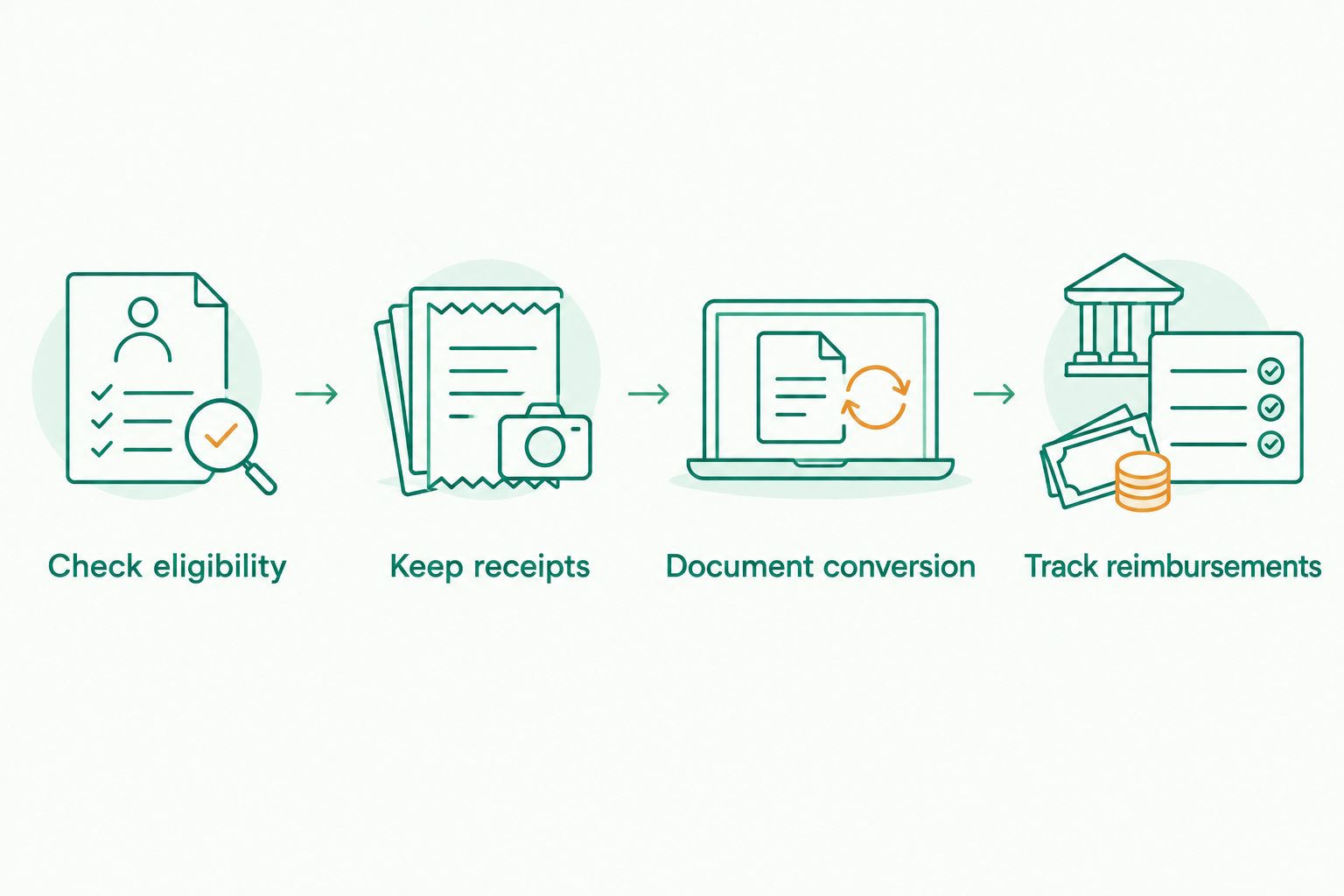
Use this sequence for a foreign medical bill paid in 2026:
- Check eligibility. Identify the patient, service, service date, and whether the expense meets HSA rules.
- Keep receipts. Retain the itemized foreign-currency invoice and evidence that you paid it.
- Document conversion. Save the posted dollar charge or the exchange-rate evidence used to calculate it.
- Track reimbursements. Record insurance payments, refunds, and any HSA distributions against the expense.
Keep those records together. A dollar amount entered without its supporting documents leaves the conversion difficult to reconstruct later.
Why this matters
Foreign medical expenses create two separate questions: whether the care qualifies and how much you paid in dollars. Solve both before reimbursing yourself. A precise currency conversion cannot make an ineligible service eligible.
For your 2026 records, IRS Publication 969 explains the HSA distribution and recordkeeping rules. IRS Publication 502 describes medical expenses, including restrictions relevant to treatment and medicines obtained abroad. Use Publication 502 alongside the HSA-specific rules rather than treating every medical deduction rule as an HSA requirement.
The medical expense must occur after your HSA was established. You cannot also receive reimbursement for the same expense elsewhere or claim it as an itemized deduction.
Which dollar amount should you record?
Start with evidence of what you paid, not an exchange-rate estimate made when you request reimbursement. Your payment method determines which supporting documents you need.
| Payment method | Best for establishing | What to save | Main limitation |
|---|---|---|---|
| Card payment with a posted dollar charge | The dollar amount charged for that transaction | Itemized receipt and final card statement | The statement alone does not establish medical eligibility |
| Payment directly from a foreign-currency account | The foreign amount actually paid | Receipt, account debit, and dated conversion evidence | The dollar valuation needs a separate calculation |
| Cash payment in foreign currency | The medical provider's receipt of payment | Paid receipt and documented payment-date exchange rate | A cash withdrawal alone does not identify the medical expense |
Card payments: preserve the final posted charge
Save the final posted transaction rather than relying on a pending authorization. Match the charge to the provider's receipt, especially when the statement uses a different merchant name.
If the provider charged you in dollars, preserve that dollar invoice and payment record. Do not replace the actual transaction with a more favorable conversion you find later.
Where a statement combines the medical charge with other amounts, identify the components. Do not assume that every dollar associated with the transaction is a qualified medical expense.
Foreign-account and cash payments: retain the rate evidence
When your payment records do not show a dollar amount, document a reasonable payment-date conversion. Save the rate source, date, foreign amount, calculation, and resulting dollar amount.
The IRS guidance titled Foreign Currency and Currency Exchange Rates explains that the IRS has no official exchange rate and generally accepts consistently used posted rates. It also explains translating income or expenses using the exchange rate prevailing when received, paid, or accrued. Ask your tax advisor how that guidance applies to an unusual transaction.
For a discrete medical payment, a dated transaction record is more useful than an unexplained annual average. Cash withdrawn for an entire trip does not establish how much of that withdrawal paid for medical care.
What belongs in your foreign-expense ledger?
Your 2026 ledger should let you trace a reimbursement back to the original care and payment. Avoid a single entry labelled overseas medical costs with no supporting detail.
Use these fields:
- Medical details: patient, provider, location, service description, and service date.
- Eligibility support: why the expense qualifies and any relevant prescription or clinical documentation.
- Payment details: payment date, original amount, currency, and payment method.
- Dollar conversion: posted dollar amount or rate, rate date, source, and calculation.
- Adjustments: insurance reimbursements, provider refunds, and excluded nonmedical charges.
- HSA history: reimbursement dates, amounts already withdrawn, and remaining unreimbursed balance.
Keep the service date separate from the payment date. The timing of the care matters for the HSA establishment rule; the payment evidence supports the amount recorded.
For a broader recordkeeping setup, see how to apply HSA reimbursement rules to an expense ledger. A consistent ledger also helps prevent reimbursing the same receipt twice.
Keep the original language and currency
Preserve the original receipt even if you prepare an English summary. Add a plain-English explanation of unfamiliar service descriptions so you can understand the record without remembering the appointment.
Do not replace the source document with your summary. A translation explains the receipt; it does not establish payment or change the service that was provided.
Why foreign medical expense amounts vary
The reimbursable dollar balance depends on the transaction and subsequent adjustments, not simply the invoice total. Check these factors:
- Payment-date conversion: a foreign-currency payment needs a supported dollar value tied to the payment.
- Merchant currency choice: a provider's dollar charge creates different documentation from a local-currency charge.
- Mixed charges: medical services and personal purchases must be separated.
- Separate fees: payment-service or card fees are not automatically qualified medical expenses.
- Insurance payments: amounts reimbursed by insurance cannot also support tax-free HSA reimbursement.
- Refunds: a later provider refund changes the expense balance you need to reconcile.
Do not classify a separately stated foreign-transaction fee as medical care merely because it accompanied a medical payment. Keep it separate and ask your tax advisor whether it qualifies before including it.
If a refund arrives in a different dollar amount because exchange rates changed, preserve both transactions. Do not silently overwrite the original expense or assume that the currency difference is another medical expense.
Can you reimburse yourself years after paying overseas?
There is no IRS deadline for reimbursing an eligible HSA expense. IRS Notice 2004-50, question and answer 39, explains that no time limit applies when the expense was incurred after the HSA was established and the recordkeeping conditions are met.
A qualified expense paid in 2026 can therefore support a later reimbursement if it remains unreimbursed and you retain the required records. That timing flexibility belongs to HSAs; do not apply it to an FSA's claims deadlines.
Keep the original dollar valuation and its evidence. A later HSA withdrawal does not create a new medical purchase or justify converting the old bill at a newer, more favorable exchange rate.
Does medical treatment abroad automatically qualify?
Foreign treatment is not automatically eligible or automatically excluded. Apply the medical-expense rules to the actual service, patient, and circumstances.
Treatment of disease and qualifying dental care require a different analysis from general wellness purchases. A doctor's letter does not automatically qualify an expense that serves general health.
Medicines purchased abroad have additional restrictions. Publication 502 explains limits involving imported drugs and medicines purchased and consumed in another country. Do not assume that an overseas pharmacy receipt establishes eligibility simply because the same product is familiar at home.
Keep travel and personal spending separate from the treatment bill. If you want to claim transportation or lodging connected with medical care, check the specific rules rather than adding an entire trip to the medical expense.
What's the simplest way to keep these records?
Reimbursable is a receipt-tracking option for HSA holders who pay out of pocket and save records for later reimbursement. Free manual tracking is unlimited; Premium adds receipt scanning, bank sync, and email forwarding to reduce manual administration.
Those features do not determine eligibility or make a foreign-currency calculation correct. Keep the original currency, conversion evidence, and medical explanation accessible regardless of your tracking method.
| Recordkeeping option | Best for | Useful feature | Trade-off |
|---|---|---|---|
| Reimbursable | HSA holders wanting dedicated receipt tracking | Unlimited free manual tracking; optional Premium automation | You still need to verify eligibility and conversion records |
| Spreadsheet and digital folders | People wanting custom currency fields | You control the ledger and document structure | Entries, matching, and backups require manual attention |
| Paper receipts and a written ledger | People comfortable maintaining physical records | No app is required | Organization and protection depend on your filing routine |
| HSA-provider receipt tools | People preferring their existing account tools | Records can stay within the provider's system | Check whether the tool supports the details and exports you need |
Choose the method you will maintain. A carefully organized folder is more useful than an app entry missing its invoice or payment evidence.
For your 2026 setup, test whether you can retrieve the original bill, the dollar conversion, and the remaining unreimbursed balance together. If you cannot, fix the filing process before adding more receipts.
FAQ
Can I use my HSA for medical expenses paid in foreign currency?
Yes, foreign-currency payment does not by itself disqualify an otherwise eligible medical expense. The expense must meet HSA rules, occur after the HSA was established, and not also be reimbursed elsewhere or deducted.
Which exchange rate should I use for an HSA medical receipt?
Use supported payment-date conversion evidence, such as the posted dollar charge or a documented exchange rate when no dollar charge exists. Keep the source, date, original currency amount, and calculation with the receipt.
Can I use today's exchange rate for an old medical bill?
Do not revalue an old medical expense using today's rate merely because you are reimbursing yourself now. Preserve the original payment valuation and the evidence supporting it.
Is a credit card statement enough for a foreign HSA expense?
A credit card statement alone generally does not explain what medical care you received. Keep an itemized receipt with the statement so the service and dollar payment can be matched.
Are foreign transaction fees HSA eligible?
Do not automatically include separately stated foreign transaction fees in an HSA medical expense. Record them separately and consult your tax advisor before treating them as qualified medical costs.
Do I need a receipt-tracking app to reimburse myself?
No, an app is not required for tax-free HSA reimbursement. Spreadsheets, digital folders, paper records, and suitable HSA-provider tools are legitimate alternatives when they preserve adequate supporting records.
Do FSA deadlines apply to delayed HSA reimbursements?
No, FSA claims deadlines do not govern HSA reimbursements. HSAs have no IRS reimbursement deadline for qualifying expenses when the establishment and recordkeeping requirements are satisfied.
One last thing
Keep an adjustment history, not just a receipt archive. A clear foreign invoice still supports the wrong withdrawal if you overlook an insurance payment or provider refund received afterward.
Before each reimbursement, check the remaining eligible dollar balance against the original payment and every adjustment. That final check matters more than whether your records live in an app, a folder, or a spreadsheet.
Not tax advice; consult your tax advisor about your circumstances.