
An HSA investment calculator should show both the projected future balance and its purchasing power after inflation, using clearly labeled assumptions. For a projection starting in 2026, express the inflation-adjusted result in 2026 dollars. Keep existing unreimbursed receipts at their documented amounts: inflation changes their purchasing power, not the amount eligible for reimbursement.
- For HSA investment calculator inflation settings, show future dollars and inflation-adjusted purchasing power separately.
- Apply medical-cost assumptions to future medical bills, not expenses you already paid.
- Reimbursable suits HSA holders who want to track receipts for delayed reimbursement.
- Investment projections are estimates; documented reimbursement amounts do not increase with inflation.
How should an HSA investment calculator account for inflation?
Calculate the future account balance first, then translate that balance into today's purchasing power. Keep the investment return, inflation assumption, contributions, withdrawals and fees visible rather than combining them into an unexplained growth rate.
Use this sequence:
- Project growth. Calculate the future HSA balance using your contribution schedule, withdrawals, investment-return assumption and applicable fees.
- Adjust purchasing power. Divide the future balance by the cumulative inflation factor over the projection period.
- Separate receipts. Track previously paid eligible expenses at their remaining unreimbursed amounts, outside the investment-growth calculation.
- Test assumptions. Compare different return and inflation assumptions without treating any scenario as a promised outcome.
For more on the assumptions behind the starting balance projection, see how to use an HSA investment calculator without overestimating.
With a constant annual inflation assumption, the purchasing-power calculation is:
Inflation-adjusted balance = future balance ÷ (1 + annual inflation rate) raised to the number of years.
Enter the annual rate as a decimal in that formula. If the calculator uses changing annual inflation assumptions, it should compound those individual rates instead of applying a single year's rate to the entire period.
Why this matters for delayed HSA reimbursement
An investment projection and a receipt ledger answer different questions. The projection estimates what your account might be worth; the ledger documents expenses that can support qualified withdrawals.
Suppose you pay an eligible dental bill out of pocket in 2026 and save the receipt. Reimbursing that expense later does not let you increase the original eligible amount to compensate for inflation. The remaining reimbursable amount stays tied to what you paid, after accounting for insurance payments, refunds and previous reimbursements.
An old receipt is evidence of an expense, not an inflation-linked asset. Keeping that distinction visible prevents a calculator from overstating both future purchasing power and the amount available for qualified reimbursement.
Future dollars versus inflation-adjusted dollars
A useful calculator offers both views. Neither replaces the other, and neither predicts the actual return your investments will earn.
| Calculation view | Best for | What it shows | Main limitation |
|---|---|---|---|
| Nominal balance | Estimating the future account balance | Projected dollars in the account at the end date | Does not show how much those dollars will buy |
| Inflation-adjusted balance | Comparing future purchasing power with today's spending | Future balance expressed in starting-year dollars | Depends on the inflation assumption |
| Future medical-expense estimate | Planning for care you have not yet received | Projected future bills under a medical-cost assumption | Does not establish tax eligibility or predict your personal care needs |
| Unreimbursed expense ledger | Documenting potential later reimbursement | Remaining eligible amounts from expenses already incurred | Does not grow with inflation or investment returns |
For a plan beginning in 2026, label the adjusted result 2026 purchasing power. A label such as adjusted balance is too vague unless the calculator explains what adjustment it made.
Do not compare a future-dollar balance with a medical-spending target expressed in today's dollars. Convert both sides to the same dollar basis before deciding whether the projected balance covers the target.
Should you use a real return instead of adjusting the final balance?
A calculator can work with an inflation-adjusted, or real, return instead of converting the final balance. The exact relationship is:
Real annual return = (1 + nominal annual return) ÷ (1 + annual inflation rate) − 1.
Simply subtracting inflation from the nominal return is an approximation. The exact formula accounts for compounding and makes the relationship between the assumptions explicit.
The important limitation concerns cash flows. If the calculator uses a real return, contributions and withdrawals must also be expressed consistently in purchasing-power terms. A fixed nominal contribution does not retain the same buying power throughout a long projection.
Do not apply a real return and then subtract inflation from the ending balance again. That counts the same adjustment twice. Choose a consistent calculation method and explain it beside the result.
Should medical inflation replace general inflation?
Use general inflation to describe broad purchasing power. Use a separate medical-cost assumption when estimating future care expenses, and label the distinction clearly.
Medical spending is not a single predictable bill. Your future costs depend on the services you need, insurance coverage and what you must pay yourself. A general consumer inflation measure cannot describe all those changes.
A medical-cost projection also needs a defined scope. An estimate of total treatment charges is not the same as an estimate of your out-of-pocket share after insurance.
For 2026 planning, keep these calculations separate:
- Account purchasing power: Convert the projected HSA balance into starting-year dollars.
- Future care costs: Project the expenses you expect to pay, using an explicitly stated assumption.
- Existing receipts: Preserve the documented remaining eligible amounts without inflation adjustments.
This separation makes the calculation easier to inspect. It also prevents a medical-cost assumption from quietly increasing the value assigned to old receipts.
Why inflation-adjusted HSA projections vary
Different results often reflect different assumptions rather than a calculation error. Check these inputs before comparing calculators:
- Investment return: A higher assumed return increases projected growth, but an assumed average does not describe the actual path of market returns.
- Inflation: Higher assumed inflation reduces the purchasing power of a given future balance.
- Projection length: Compounding affects both investment growth and the cumulative inflation adjustment over time.
- Contribution timing: Money contributed earlier has a different investment period from money contributed later. Future contributions also depend on continued eligibility and applicable limits.
- Withdrawals and fees: Reimbursements remove money from the account, while applicable fees reduce what remains available to grow.
- Medical-spending assumptions: Projected care needs and insurance payments affect future out-of-pocket spending, not just the inflation rate applied to it.
Change assumptions deliberately. If you alter returns, inflation, contributions and withdrawals together, you cannot tell which change caused the difference in the result.
How do you turn the projection into a practical plan?
Use a calculator to compare choices, not to justify leaving every medical expense unreimbursed. Start with your ability to cover current bills without depending on an uncertain investment outcome.
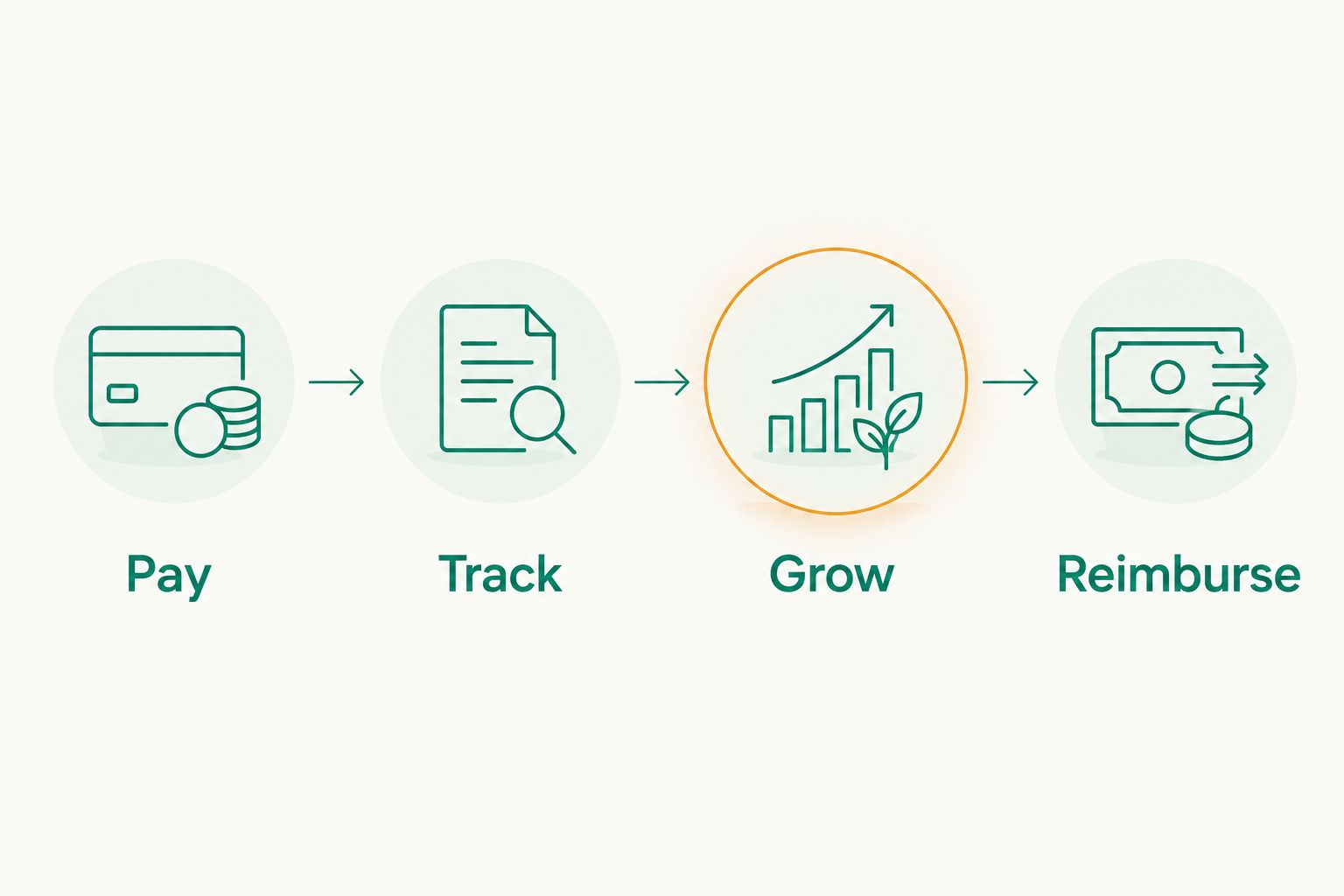
Pay
Confirm that you can afford the out-of-pocket expense. Delaying reimbursement leaves more money inside the HSA, but it also leaves less cash outside the account for other needs.
Paying with outside funds does not make an expense qualified. Eligibility still depends on the expense and the applicable HSA rules.
Track
Save the itemized receipt, proof of payment and any insurance explanation of benefits needed to establish your final responsibility. Record the service date, payment date, eligible amount and any reimbursement already taken.
Keep mixed bills clear. A total that includes nonqualified purchases is not automatically the amount you can reimburse tax-free.
Grow
Project only the money that remains in the HSA after expected withdrawals and applicable fees. Do not treat the account's entire balance as invested if some of it remains in cash.
Compare the nominal result with its purchasing power. Investment gains are uncertain; the calculator's output is a planning estimate, not a commitment from your HSA provider.
Reimburse
Before withdrawing, confirm the remaining eligible amount against the expense record. Update that record after a partial or full reimbursement so the same expense does not support another withdrawal.
An insurance adjustment or provider refund can change the amount you ultimately paid. Reconcile those changes rather than leaving the original bill untouched in your ledger.
Which receipt-tracking method fits this approach?
Choose a recordkeeping method you will maintain and can retrieve later. Automation can reduce administrative work, but it is not a condition for tax-free reimbursement.
| Method | Best for | Useful capability | Trade-off |
|---|---|---|---|
| Spreadsheet and digital folders | People comfortable maintaining their own records | Flexible expense fields and document organization | Requires manual updates and a backup routine |
| Paper receipts and a written ledger | People who prefer physical records | Keeps original documents together | Paper can fade, and locating records requires organization |
| HSA-provider receipt tools | People who prefer their provider's available tools | Can keep supporting records alongside account activity, depending on the provider | Features and export options vary; check before relying on them |
| Reimbursable | HSA holders who want dedicated receipt tracking | Free unlimited manual tracking and an HSA/FSA eligibility directory | Manual tracking still requires entering and maintaining records |
Reimbursable's Premium features include receipt scanning, bank sync and email forwarding for people who want less receipt administration. Those features do not change an expense's eligibility or the amount you can reimburse.
Whatever method you choose, make records understandable outside the tool itself. Preserve supporting documents and keep an accessible backup rather than relying entirely on a single account login.
Which IRS rules still apply when reimbursement is delayed?
Inflation calculations do not change HSA qualification rules. For 2026 planning, use IRS Publication 969 for HSA distribution and recordkeeping guidance, and IRS Publication 502 for medical-expense definitions, subject to HSA-specific rules.
IRS Notice 2004-50, question and answer 39, explains that there is no time limit for taking an HSA distribution to reimburse a qualified expense incurred after the HSA was established. That rule does not eliminate the need to substantiate the expense.
Keep these requirements separate from the investment model:
- The expense must have been incurred after the HSA was established.
- The expense cannot also have been reimbursed by insurance or another source.
- The same expense cannot also have been taken as an itemized deduction.
- Your records must support the qualified expense and the amount reimbursed.
A doctor's letter does not automatically qualify a general-health expense. Check the underlying eligibility rules rather than treating the letter as blanket approval.
An FSA follows different timing rules. Do not apply the HSA's delayed-reimbursement treatment to an FSA; check the FSA plan's coverage, claim-submission and applicable carryover or grace-period provisions.
FAQ
Should my HSA investment calculator show inflation-adjusted results?
Yes. An HSA investment calculator should show both nominal future dollars and inflation-adjusted purchasing power, with the starting year and assumptions clearly labeled. Neither result guarantees an investment outcome.
Does inflation increase how much I can reimburse from an old HSA receipt?
No. Inflation does not increase the eligible reimbursement amount for an expense you already paid. Track the remaining qualified amount after insurance, refunds and previous reimbursements.
Should I subtract inflation from my expected HSA return?
Use the exact real-return formula rather than relying on simple subtraction: divide one plus the nominal return by one plus inflation, then subtract one. Keep contributions and withdrawals on the same purchasing-power basis.
Should I use medical inflation or general inflation for my HSA?
Use general inflation to describe broad purchasing power and a separately labeled medical-cost assumption to project future care expenses. Do not apply either assumption to increase existing unreimbursed receipts.
Can I reimburse myself years after paying a medical bill?
Yes, HSA rules impose no reimbursement time limit for qualified expenses incurred after the HSA was established. Retain supporting records, and do not reimburse expenses already reimbursed elsewhere or taken as an itemized deduction.
Do I need a paid receipt app to reimburse myself tax-free?
No. A paid app is not required for tax-free HSA reimbursement. Spreadsheets, folders, paper records and suitable HSA-provider tools are legitimate alternatives when they preserve adequate documentation.
Do FSA receipts have the same unlimited reimbursement timeline?
No. FSA claims follow plan-specific deadlines and applicable FSA rules, not the HSA delayed-reimbursement rule. Confirm the coverage period and claim-submission deadline with your plan administrator.
One last thing
Keep your receipt total fixed while testing inflation scenarios. If changing inflation also increases the calculator's total for previously paid expenses, the model is mixing purchasing power with reimbursement eligibility.
For your 2026 review, save the projection's assumptions alongside the result. A future comparison is useful only when you can tell whether the balance changed because of contributions, withdrawals, market performance or revised assumptions.
Not tax advice; consult your tax advisor about your circumstances.