
Use an HSA investment calculator by entering only the money you can actually contribute and leave invested, then accounting for medical withdrawals, fees and uncertain returns. Treat the result as a projection, not a promised balance or a tax-free reimbursement allowance. For 2026 planning, keep your investment forecast separate from the receipts that establish which expenses qualify for reimbursement.
- An HSA investment calculator produces a scenario, not a guaranteed future balance.
- Subtract planned medical withdrawals and account fees before relying on projected growth.
- Reimbursable suits HSA holders who want unlimited free manual receipt tracking alongside their investment planning.
- Keep eligible receipts: investment growth does not create additional reimbursable medical expenses.
Why this matters
An HSA forecast answers what your account might become under selected assumptions. It does not establish how much you can contribute, whether a medical expense qualifies or whether you can afford to leave that money invested.
A projected balance and a documented reimbursement amount are different numbers. If your plan involves paying medical bills yourself and reimbursing yourself later, Reimbursable provides receipt tracking; the calculator handles a different job.
For federal rules, use IRS Publication 969 for HSA contributions and distributions, Publication 502 for medical-expense guidance, and the Form 8889 instructions for reporting. Check the guidance applicable to your tax year rather than treating a calculator's default settings as tax advice.
How do you use an HSA investment calculator without overestimating?
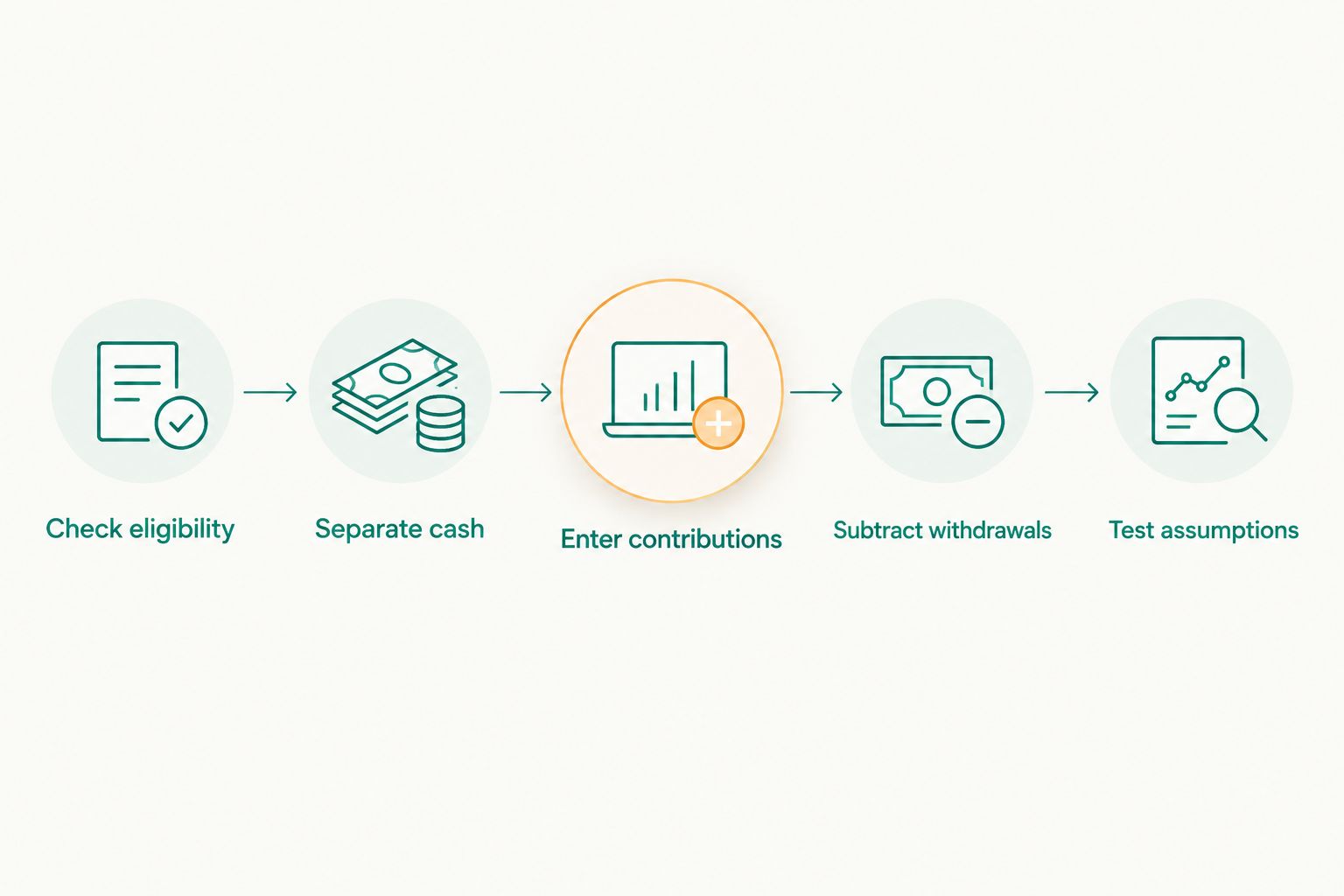
Start with your actual account details, not the contribution maximum or an optimistic return assumption. Follow this sequence so each input reflects the same plan.
Check eligibility
Confirm that you qualify to make HSA contributions for the period you are modeling. An HSA-qualified high-deductible health plan is part of that test; other coverage, Medicare enrollment and dependent status also matter.
Owning an existing HSA does not automatically mean you can keep contributing. You can generally retain and use an existing HSA after contribution eligibility ends, so separate future contributions from the money already in the account.
Separate cash
Identify the amount you will actually invest. If part of your HSA stays in cash for bills or a provider's investment threshold, do not apply an investment-return assumption to the entire balance.
Check whether the calculator distinguishes cash from investments. If it does not, model the invested portion separately and keep the cash amount outside that growth estimate.
Enter contributions
Use contributions you expect to make, within your applicable limit. Include employer contributions in that total rather than adding them above the limit.
Match the calculator's contribution timing to your deposits. Payroll contributions arriving throughout the year do not receive the same time invested as a deposit made at the beginning of the year.
Subtract withdrawals
Include the medical expenses you expect to pay from the HSA. If you intend to pay out of pocket instead, confirm that your household budget can support that decision.
Do not build an investment plan that quietly assumes you will never need the money. A scenario with no withdrawals describes one possible path, not your obligation to preserve the account untouched.
Test assumptions
Review returns, fees, inflation and the end date together. Determine whether the calculator's return input is before or after investment expenses so you do not omit fees or subtract them twice.
Run a less favorable scenario as well as your main plan. If the plan only works with uninterrupted contributions, no withdrawals and strong growth, the assumptions need work before the forecast deserves your confidence.
Which contribution limit belongs in your 2026 calculation?
For 2026, the federal HSA contribution limit is $4,400 for self-only coverage and $8,750 for family coverage. Eligible individuals age 55 or older can make an additional $1,000 catch-up contribution.
Those are contribution ceilings, not amounts every HSA holder can deposit. Your applicable limit depends on eligibility, coverage and the rules governing the months you qualify.
| Contribution input | What to enter | What causes an overestimate |
|---|---|---|
| Self-only coverage | Your permitted contribution, within the applicable limit | Automatically using the full-year maximum |
| Family coverage | Your permitted contribution after coordinating applicable spouse rules | Treating a shared family limit as a separate maximum for each spouse |
| Employer deposits | Include them in total contributions | Adding employer money above the contribution ceiling |
| Catch-up contributions | Include only when you qualify | Applying a catch-up amount without checking age and eligibility |
Use IRS Publication 969 and the IRS's published 2026 HSA limits to check these inputs. If your eligibility changes during the year, review the monthly calculation and any last-month-rule requirements before entering a full-year contribution.
Spouses must make their own catch-up contributions to their own HSAs. A calculator that models the household as a single account can obscure that distinction.
Compare the spending plans before comparing the ending balances
The choice to pay a medical bill yourself or from your HSA changes the projection. Neither choice is automatically right for every household.
| Approach | Best for | Benefit | Trade-off |
|---|---|---|---|
| Pay qualified bills from the HSA | Households protecting current cash flow | Uses HSA funds for current eligible expenses | Withdrawn money no longer participates in future account growth |
| Pay out of pocket and reimburse later | Households able to carry medical costs and preserve records | Leaves HSA funds available for investment | Requires outside cash, documentation and acceptance of investment risk |
| Combine both approaches | Households with changing cash needs | Lets withdrawals follow actual needs | Makes the forecast less tidy and requires updates |
For a 2026 projection, choose the approach you can sustain without depending on investment gains to pay an imminent bill. Money you need soon should not be treated as money you can leave exposed to market losses indefinitely.
If you pay out of pocket, do not add the saved receipt amount to your projected HSA balance. The receipt documents an expense; it is not another deposit or an additional investment asset.
Count the account once and the expense once. Keeping those records separate prevents a delayed-reimbursement strategy from looking more valuable than the underlying money supports.
Why HSA investment calculator results vary
Different results often reflect different inputs rather than a better calculator. Check these drivers before comparing forecasts:
- Starting balance: Cash awaiting investment is different from money already invested.
- Contribution timing: A beginning-of-year deposit has more time invested than later deposits.
- Medical withdrawals: Reimbursements reduce the balance available for future growth.
- Investment returns: A constant assumed rate does not reproduce actual market fluctuations.
- Fees: Account charges and investment expenses reduce the money retained in the account.
- Inflation: A future dollar balance does not describe its purchasing power today.
Read the calculator's explanation of each field. A return labeled inflation-adjusted should not receive another inflation adjustment unless the calculation specifically requires it.
Also check whether withdrawals occur at the beginning or end of each modeled period. That detail matters when comparing tools with otherwise similar inputs.
What must you save for delayed HSA reimbursement?
Save records showing that the expense was qualified, occurred after your HSA was established and was not reimbursed elsewhere. You also cannot use an expense for tax-free HSA reimbursement if you claimed it as an itemized medical deduction.
There is no IRS deadline for reimbursing an otherwise eligible HSA expense, provided you maintain the required records. That is an HSA rule, not permission to ignore an FSA's claim deadlines.
Your record should connect the patient, provider or seller, service or purchase date, expense details and amount paid. Keep relevant insurance explanations and payment evidence when needed to establish what you actually owed and paid.
Use a status field to distinguish unreimbursed expenses from completed claims. After you reimburse yourself, record the distribution and the expenses it covers so the same receipt does not enter another claim later.
Choose a recordkeeping method you will maintain
Reimbursable's HSA receipt tracking is best for HSA holders who want unlimited free manual tracking. Dedicated software is optional: folders, spreadsheets, paper receipts and HSA-provider receipt tools are legitimate alternatives.
| Method | Best for | Benefit | Limitation or check |
|---|---|---|---|
| Reimbursable | HSA holders wanting a dedicated expense-tracking app | Unlimited free manual tracking | Manual tracking still requires you to enter and maintain records |
| Spreadsheet with receipt folders | People wanting a self-managed system | Lets you organize dates, amounts and reimbursement status | You maintain the links, backups and status changes |
| Paper receipts with an index | People who prefer physical records | Does not require an app | Paper can fade or be lost; copies improve resilience |
| HSA-provider receipt tools | People wanting records near their account | Keeps the workflow within a provider's tools | Verify the specific export, storage and tracking features offered |
Do not choose a method because a forecast shows a large ending balance. Choose one that lets you retrieve the documentation for an actual reimbursement.
Does investment growth increase what you can reimburse tax-free?
Investment growth does not create a medical expense. Tax-free HSA distributions must still correspond to qualified medical expenses that satisfy the applicable rules.
For example, a documented eligible dental expense supports reimbursement of that expense, not an extra distribution because your investments performed well. Nonqualified distributions have different federal tax consequences; an additional tax can also apply, subject to exceptions described in Publication 969.
A calculator's tax-free label therefore needs context. The account's tax treatment does not turn every possible withdrawal into a tax-free withdrawal.
Can a doctor's letter make a projected expense eligible?
A doctor's letter does not automatically make a general-health expense HSA eligible. The expense must meet the applicable medical-care rules; a recommendation alone is not a blanket exception.
Keep uncertain expenses out of your documented eligible total until you establish their treatment. You can still budget for them as household spending without assuming an HSA reimbursement.
How often should you update an HSA investment calculator?
Update the projection when the underlying plan changes: contributions, coverage, withdrawals, fees or your investment horizon. Replacing an estimate with an actual transaction makes the forecast more useful than repeatedly changing the return assumption.
For your 2026 records, keep the forecast date and its assumptions together. That lets you distinguish a market-driven change from a change caused by depositing less or withdrawing more than planned.
FAQ
What's the best way to use an HSA investment calculator?
The best approach is to model your actual invested balance, permitted contributions, expected withdrawals and fees, then test less favorable assumptions. Keep the resulting projection separate from your documented eligible medical expenses.
How much can I contribute to an HSA in 2026?
The 2026 federal HSA contribution limits are $4,400 for self-only coverage and $8,750 for family coverage, with an additional $1,000 catch-up contribution for eligible individuals age 55 or older. Employer contributions count toward the applicable limit, and your eligibility can affect the amount you may contribute.
What return should I enter in an HSA investment calculator?
Use assumptions that match your investments and treat every return as uncertain. Compare less favorable results, check whether fees are included, and do not treat a constant annual rate as a prediction of actual market performance.
Can I reimburse myself from my HSA years after paying a bill?
Yes, there is no IRS deadline for reimbursing an otherwise eligible HSA expense if you maintain the required records. The expense must occur after the HSA was established and cannot also be reimbursed elsewhere or claimed as an itemized medical deduction.
Do FSA reimbursements have the same deadline rules as HSA reimbursements?
No, FSA reimbursements do not follow the HSA's open-ended reimbursement rule. Check your FSA plan's expense-incurrence and claim-submission deadlines rather than applying HSA guidance to an FSA.
Do I need a paid receipt app to get tax-free HSA reimbursement?
No, a paid receipt app is not required for tax-free HSA reimbursement. Spreadsheets, folders, paper receipts and HSA-provider tools are legitimate options when they preserve the necessary documentation.
Does a doctor's letter make any health purchase HSA eligible?
No, a doctor's letter does not automatically qualify a general-health purchase. The expense must satisfy the applicable medical-care rules, and documentation does not replace that eligibility test.
One last thing
Before saving a forecast, write down what would make you withdraw money earlier than planned. A medical bill, a change in household income or the end of contribution eligibility belongs in the planning conversation, not just the optimistic balance.
Then make sure your receipt system can identify both the expense date and reimbursement status. The investment projection estimates a possibility; the receipt record supports a real distribution.
Not tax advice. Consult your tax advisor about eligibility, contribution limits, state tax treatment and your reimbursement records.