
An HSA for nurses is a tax-advantaged health savings account that eligible nurses can use to pay qualified medical expenses or reimburse themselves later. In 2026, your eligibility depends on your health coverage—not your nursing license—and keeping personal medical receipts separate from employer-paid expenses is essential.
- An HSA for nurses requires eligible health coverage; working in healthcare does not automatically qualify you.
- Reimbursable is best for HSA holders who want eligibility lookup and receipt tracking together.
- Save receipts for qualified medical expenses incurred after your HSA was established; avoid duplicate reimbursement or deductions.
- HSA reimbursements have no federal deadline; health FSA claims follow plan deadlines.
Why an HSA matters for nurses and healthcare workers
A hospital benefit package, a spouse’s health plan, and a staffing agency’s coverage can create different HSA eligibility outcomes. Check the actual coverage terms rather than assuming that a high deductible or an employer’s HSA contribution settles the question.
Your work-related purchases also need a separate test. Scrubs and ordinary work shoes are not qualified medical expenses merely because you wear them during patient care. Your own dental treatment, prescription medicines, and qualifying medical supplies belong in a different category.
For 2026, build your process around two decisions: whether you can contribute and whether an expense qualifies for reimbursement. A simple HSA expense ledger helps keep those decisions separate.
Not tax advice. Consult your tax advisor about your coverage, contributions, and reimbursements.
Set up an HSA process that survives schedule and job changes
1. Confirm your coverage before contributing
Start with your benefits documents and ask your benefits administrator whether your plan is HSA-eligible. A plan described only as high-deductible is not enough. HSA contribution eligibility generally requires qualifying coverage, no disqualifying additional coverage, no Medicare enrollment, and that you cannot be claimed as someone else’s tax dependent.
For 2026, the general HSA-qualified HDHP minimum deductible is $1,700 for self-only coverage and $3,400 for family coverage. Meeting those deductible amounts alone does not establish eligibility; other requirements and statutory exceptions also apply.
A general-purpose health FSA can block HSA contributions, including a spouse’s FSA if it can reimburse your expenses. Limited-purpose dental and vision arrangements follow different rules.
If you change hospitals, move to per-diem work, or join a spouse’s plan, review eligibility again. You can retain and use an existing HSA even when you cannot make new contributions.
- Request confirmation that your health plan is HSA-eligible.
- Review any spouse’s FSA or HRA coverage that can reimburse you.
- Check Medicare enrollment before continuing contributions.
- Record coverage changes by month.
- Keep your plan documents with your tax records.
2. Set contributions using the combined limit
Use payroll records and your HSA statements to total contributions before adjusting withholding. Employer contributions count toward the same annual limit as your own contributions; they are not an extra allowance.
For 2026, the federal HSA contribution limit is $4,400 for self-only coverage and $8,750 for family coverage. Eligible account holders age 55 or older can generally contribute an additional $1,000. Each spouse’s catch-up contribution must go into that spouse’s own HSA.
Those annual amounts are not automatically your personal limit if you are eligible for only part of the year. The last-month rule can permit a larger contribution, but it carries a testing period. Ask your tax advisor before relying on it during a coverage transition.
For married nurses with family coverage, coordinate contributions across both spouses’ accounts. Two accounts do not create two separate family contribution limits.
- Add employer, payroll, and direct contributions together.
- Include contributions made through a previous employer.
- Coordinate family-limit contributions with your spouse.
- Check partial-year eligibility before using the full annual limit.
- Review age-based catch-up eligibility separately.
3. Separate personal medical expenses from work costs
Start with IRS Publication 502 to understand medical-expense categories, then use IRS Publication 969 for HSA-specific rules. Publication 502 is a reference, not a complete HSA shopping list: some rules differ, including the treatment of eligible over-the-counter medicines.
A purchase qualifies because of its medical purpose and the applicable tax rules—not because you are a nurse. Ordinary scrubs, professional licensing fees, and continuing education are not HSA medical expenses. Keep business or employment expense questions outside your HSA ledger.
You can use Reimbursable’s HSA/FSA eligibility directory to check categories before filing a receipt. Its directory covers 890+ items, but a lookup does not replace checking the circumstances of your purchase.
A doctor’s letter does not automatically qualify a general-health expense. Vitamins, fitness purchases, and similar items require particular care; documentation must support an expense that actually meets the medical-care rules.
- Separate eligible medical items from ordinary household purchases.
- Exclude employer-paid supplies and reimbursed expenses.
- Save prescriptions or medical-purpose documentation when relevant.
- Record the patient and the reason an ambiguous expense qualifies.
- Check HSA-specific rules before relying on a general deduction list.
4. Capture evidence when you pay
Use a folder and spreadsheet first if that is the easiest system to maintain. Save an itemized receipt, proof of payment, and any insurance explanation of benefits needed to establish your final responsibility. A card statement alone usually does not explain what medical care you purchased.
Your records should connect the patient, provider, service date, description, and amount. Keep the service date separate from the payment date: receiving a bill after opening an HSA does not make earlier treatment eligible.
Reimbursable offers unlimited free manual tracking. Premium adds receipt scanning, bank sync, and email forwarding to reduce receipt administration; those features are optional, not requirements for tax-free reimbursement.
Reimbursable is best for HSA holders who want eligibility lookup and receipt tracking together. A folder or provider tool remains a legitimate choice when it already keeps your evidence complete and accessible.
- Itemized receipt: retain the treatment or purchase details.
- Payment evidence: show what you actually paid.
- Coverage records: keep insurance adjustments with the bill.
- Eligibility evidence: preserve supporting medical documentation when needed.
- Backup copy: store a recoverable copy separately.
5. Decide whether to reimburse now or later
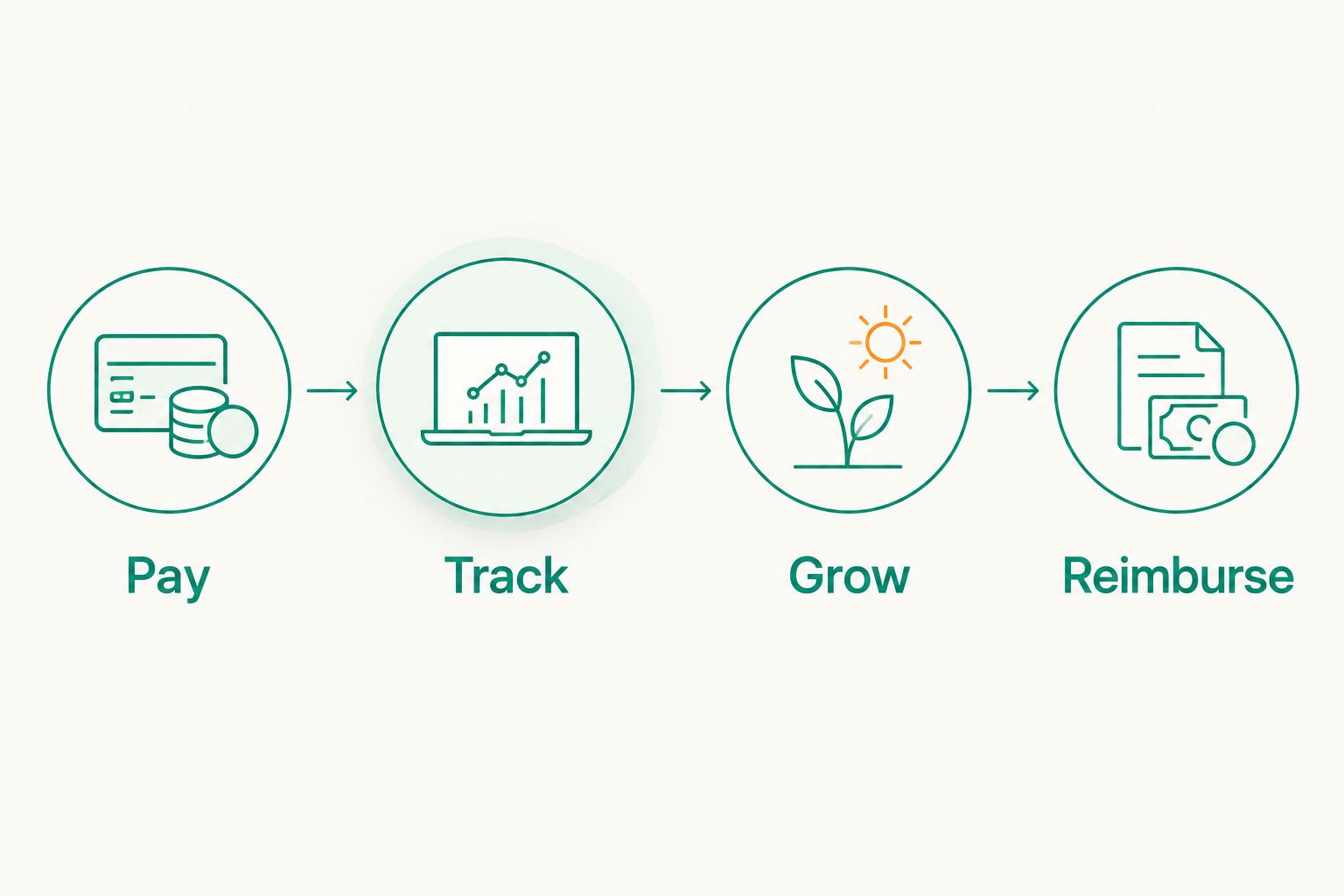
Pay, Track, Grow, Reimburse is a useful sequence, but the Grow stage is optional. Reimburse promptly if paying out of pocket strains your budget. Keeping money in an HSA does not guarantee investment returns or make delayed reimbursement the right choice for everyone.
Under federal HSA rules, there is no deadline for reimbursing a qualified expense incurred after the HSA was established. You must retain records showing that the expense qualified, was not reimbursed elsewhere, and was not claimed as an itemized deduction.
Before delaying reimbursement, check whether your account’s fees, investment options, and cash requirements fit your needs. Investments can lose value. A tax advantage is not a reason to take investment risk you cannot afford.
Use a clear status for every expense so a busy week does not become a duplicate withdrawal later.
- Pay: use your HSA or pay out of pocket.
- Track: attach evidence and record the unreimbursed balance.
- Grow: invest only if appropriate for your circumstances.
- Reimburse: match each withdrawal to documented eligible expenses.
6. Reconcile withdrawals, refunds, and coverage changes
Match every HSA distribution to your ledger rather than treating the bank withdrawal as the complete tax record. If you reimburse only part of a bill, record the amount withdrawn and the remaining eligible balance.
Check again when insurance reprocesses a claim or a provider issues a refund. The final qualified amount can differ from the original bill. If an already-reimbursed amount is no longer eligible, contact your HSA custodian and tax advisor about the appropriate correction.
Keep old receipts when you change employers or HSA providers. The account belongs to you, and a new benefits portal is not a replacement for your own historical records.
For 2026 tax reporting, use the applicable Form 8889 instructions to report HSA activity. Store supporting evidence yourself rather than assuming the distribution statement establishes eligibility.
- Match withdrawals to specific expenses.
- Update partial reimbursements and remaining balances.
- Reconcile insurance payments and provider refunds.
- Preserve records before leaving an employer’s benefits system.
- Review HSA statements alongside your tax documents.
Compare receipt-tracking options
Choose a method you will maintain after a shift, not the one with the longest feature list. Automation helps with capture; you still need to check eligibility, insurance adjustments, and duplicate reimbursement.
The table compares workflows rather than claiming every HSA provider offers the same features. Check your own provider’s tools before moving records.
| Option | Best for | Main advantage | Key limitation |
|---|---|---|---|
| Spreadsheet and digital folders | Nurses comfortable maintaining their own ledger | Flexible fields and direct control of files | You enter details and reconcile reimbursements yourself |
| Paper receipts and a written log | Nurses who prefer an offline process | No app setup; originals stay together | Loss, fading, and searching make a backup important |
| HSA-provider receipt tools | Nurses who want records near their account activity | A provider-based place to organize supported records | Features and access arrangements vary; check export options |
| Reimbursable manual tracking | Nurses who want HSA eligibility lookup and tracking together | Unlimited free manual tracking alongside an eligibility directory | You still capture and check the expense details |
| Reimbursable Premium | Nurses whose receipt entry is becoming an administrative burden | Receipt scanning, bank sync, and email forwarding | Automation does not determine tax eligibility or replace supporting evidence |
Start with the manual method that meets your needs. Consider Premium when its specific automation addresses a recurring problem, such as receipts scattered across email and payment accounts—not because you need a paid app to receive tax-free reimbursement.
Common HSA mistakes nurses and healthcare workers make
Treating work necessities as medical care
A purchase can be necessary for your job without qualifying as medical care. Scrubs, ordinary work shoes, and professional training do not become HSA-eligible because your employer requires them. Keep job-expense documentation separate from personal medical receipts.
Assuming a hospital benefit label proves eligibility
An employer offering an HSA does not establish that every employee can contribute. Your spouse’s coverage, another reimbursement arrangement, or Medicare enrollment can change your position. Verify your own coverage combination, particularly when changing roles or benefits elections.
Applying FSA deadlines to an HSA
An HSA is not a health FSA with a different name. HSA balances carry forward, and qualifying delayed reimbursements have no federal deadline. Health FSAs generally have plan-year spending rules, claim-submission deadlines, and any permitted carryover or grace-period provisions set by the plan.
Reimbursing a bill before insurance finishes
A provider’s initial charge is not always your final expense. If insurance later pays part of a bill you already reimbursed, update the ledger and address the excess reimbursement. Never reimburse the same portion through an HSA, FSA, employer program, or another source.
Saving only a total from a mixed purchase
A pharmacy total can include eligible medicine and nonmedical items. Save the itemized receipt and identify the qualifying portion, rather than marking the entire purchase eligible. The same principle applies when a bill contains both qualifying treatment and excluded services.
IRS sources for your 2026 review
Use IRS Publication 969 for HSA eligibility, contributions, distributions, and recordkeeping. Use IRS Publication 502 for medical-expense definitions, while checking HSA-specific differences rather than importing every deduction rule.
The contribution and general HDHP deductible figures above follow IRS guidance for calendar year 2026. Use the applicable Form 8889 instructions when preparing your return. Your employer’s benefits summary explains the plan; it does not replace federal tax rules or advice about your individual situation.
FAQ
Can nurses open an HSA just because they work in healthcare?
No. Nurses must meet HSA eligibility requirements, including qualifying health coverage and no disqualifying additional coverage. A nursing license or hospital job does not establish eligibility.
How much can a nurse contribute to an HSA in 2026?
The 2026 federal limits are $4,400 for self-only coverage and $8,750 for family coverage, including employer contributions. Eligible account holders age 55 or older generally receive an additional $1,000 catch-up allowance; partial-year eligibility can affect the permitted amount.
Can I use my HSA for scrubs or nursing shoes?
Ordinary scrubs and work shoes are not qualified HSA medical expenses merely because you need them for nursing. A separately qualifying medical item requires its own eligibility analysis.
Can I reimburse myself years after paying a medical bill?
Yes, federal HSA rules impose no reimbursement deadline for an otherwise qualified expense incurred after the HSA was established. Keep evidence that the expense was not reimbursed elsewhere or claimed as an itemized deduction.
Does my spouse’s FSA affect my HSA?
A spouse’s general-purpose health FSA can prevent HSA contributions if it can reimburse your medical expenses. Limited-purpose arrangements have different rules, so check the plan documents before contributing.
Do I need a paid receipt app for HSA reimbursement?
No. Spreadsheets, folders, paper records, and suitable HSA-provider tools can support reimbursement when your evidence is complete. Paid automation is an administrative choice, not a tax requirement.
Does a doctor’s letter make vitamins or wellness purchases eligible?
No. A doctor’s letter does not automatically turn a general-health purchase into qualified medical care. The expense itself must meet the applicable medical-purpose rules.
One last thing
Your HSA establishment date matters more than the date you finally pay a bill. Before building a backlog of receipts, save evidence of when the HSA was established and compare it with each expense’s service or purchase date. That single check prevents organizing a receipt that cannot support reimbursement.
Not tax advice. Always consult your tax advisor.