
HSA Store is useful for shopping for HSA-eligible products, but a shopping catalog does not settle every eligibility question or document your later reimbursement. The best HSA Store alternative in 2026 is Reimbursable if you need eligibility lookups and receipt tracking; IRS Publications 502 and 969 are the better starting point when you need the underlying tax rules.
- For HSA Store alternatives, choose Reimbursable for eligibility lookups and receipt tracking, not shopping.
- Use IRS Publications 502 and 969 to distinguish qualified medical expenses from HSA reimbursement requirements.
- Spreadsheets, folders, paper receipts and HSA-provider tools are legitimate ways to preserve reimbursement records.
- HSA expenses must follow account establishment, avoid double reimbursement and remain separate from FSA claim deadlines.
Why this matters
Finding an eligible product and proving a tax-free HSA withdrawal are different jobs. A store label helps with shopping; your records must support the particular expense you reimburse.
For your 2026 workflow, separate eligibility research, purchase evidence and reimbursement status. You can use different tools for each without moving your HSA or changing where you shop.
The central rule is simple: Reimbursable is best for HSA holders who want eligibility research and receipt tracking in one workflow. It does not replace IRS rules or your responsibility to keep adequate records.
HSA Store alternatives at a glance
These options solve different problems. The strongest choice depends on whether you need to shop, interpret a rule or preserve evidence for a withdrawal years later.
| Option | Best for | Standout function | Difference from HSA Store |
|---|---|---|---|
| HSA Store | Shopping for eligible products | Product-shopping context | The shopping benchmark, rather than a complete reimbursement record |
| Reimbursable | Eligibility lookups and receipt tracking | Directory of 890+ HSA/FSA-eligible items plus an expense-tracking app | Connects research with recordkeeping rather than product shopping |
| IRS Publications 502 and 969 | Understanding medical-expense and HSA rules | Primary federal tax guidance | Explains qualification and distribution rules rather than helping you shop |
| Spreadsheet plus receipt folders | Manual recordkeeping under your control | A customizable expense ledger linked to supporting documents | Tracks your expenses; does not independently establish eligibility |
| Your HSA provider's receipt tools | Keeping records near your account | Account-associated recordkeeping, where offered | Features depend on your provider; assess the actual tool |
A directory entry is not a personalized tax determination. Apply the same standard to every option: does it help you identify the expense, establish why it qualifies and show whether you have already recovered the money?
1. Reimbursable: best for eligibility lookups and receipt tracking
The directory covers 890+ HSA/FSA-eligible items, and the app supports expense tracking. That combination fits HSA holders who pay out of pocket and want to preserve reimbursement records instead of treating every purchase as an immediate HSA withdrawal.
Free manual tracking is unlimited. Premium adds receipt scanning, bank sync and email forwarding to reduce manual administration; automation is not required to obtain tax-free reimbursement.
Where it shines
- Combines eligibility research with a place to track expenses.
- Supports a manual workflow without requiring a paid upgrade.
- Offers automation for people whose main problem is entering and collecting receipts.
Where it falls short
- Tracking an expense does not establish that it qualifies under IRS rules.
- Automated capture does not replace checking dates, medical purpose or insurance payments.
- A separate app adds another system if your existing folders or provider tools already work.
| Dimension | Directory and tracking app | HSA Store |
|---|---|---|
| Main job | Research and recordkeeping | Product shopping |
| Eligibility context | Directory covering HSA/FSA items | Eligible-product shopping context |
| Receipt workflow | Manual tracking; optional automated capture | A purchase record still needs to fit your wider reimbursement records |
| Tax responsibility | You substantiate the withdrawal | You substantiate the withdrawal |
Best for: You pay medical expenses yourself and need a repeatable way to preserve the evidence.
For 2026, start with manual tracking before deciding whether automation solves a real problem. Verdict: Choose the free workflow first; consider Premium when receipt administration is the bottleneck.
2. IRS publications: best for understanding the actual rules
IRS Publication 502 explains medical and dental expenses. IRS Publication 969 addresses HSAs and other tax-favored health plans, including distributions and recordkeeping.
Read these 2 IRS publications together. Publication 502's discussion of itemized medical deductions is not a complete substitute for HSA-specific guidance, and you should not carry every deduction restriction into an HSA decision.
Where IRS guidance shines
- Provides the primary federal explanation behind eligibility decisions.
- Distinguishes medical treatment from expenses that benefit general health.
- Explains why an eligible expense and a qualified HSA distribution are related but separate questions.
Where IRS guidance falls short
- Requires you to apply general rules to your circumstances.
- Does not organize your receipts or maintain your reimbursement ledger.
- Does not function as a searchable shopping catalog for individual products.
| Dimension | IRS publications | HSA Store |
|---|---|---|
| Main purpose | Explain federal tax rules | Help with product shopping |
| Difficult cases | Provides the governing framework | A product listing does not resolve every personal circumstance |
| Recordkeeping | Explains your obligations | Purchase evidence is only part of your records |
Best for: You need to understand a conditional expense, a general-health exclusion or an HSA withdrawal requirement.
For decisions made in 2026, use the IRS's current guidance and distinguish its medical-expense rules from its HSA distribution rules. Verdict: Choose IRS guidance for the rule; use another system to keep the evidence.
3. Spreadsheet and folders: best for hands-on recordkeeping
A spreadsheet linked to organized receipts is a legitimate HSA tracking system. Paper receipts also work when you preserve legible, accessible evidence and can match each document to its expense.
The strength is control. You decide how to label expenses, record insurance adjustments and separate reimbursed amounts from amounts still available for a later withdrawal.
Where spreadsheets and folders shine
- Let you build fields around your actual medical expenses.
- Keep the ledger separate from any particular shopping site.
- Work with scanned documents, downloaded statements and paper records.
Where spreadsheets and folders fall short
- Depend on consistent manual entry and document organization.
- Do not determine whether an expense is qualified.
- Require you to maintain backups and prevent duplicate reimbursement yourself.
| Dimension | Spreadsheet and folders | HSA Store |
|---|---|---|
| Main purpose | Maintain an expense ledger | Shop for eligible products |
| Eligibility research | Requires a separate source | Provides product-shopping context |
| Reimbursement status | You create and maintain the fields | A purchase record alone does not show later reimbursement status |
Best for: You already keep orderly files and prefer a system you can maintain yourself.
Verdict: Choose this workflow if you will actually update it; skip it if receipts already pile up unrecorded.
4. HSA-provider tools: best for an existing account workflow
Your HSA provider's receipt tools deserve consideration before you add another app. Check the actual features rather than assuming every provider offers the same storage, tagging or reimbursement functions.
Where provider tools shine
- Keep supported receipt tasks within your existing account workflow.
- Avoid adding a separate system when the available features meet your needs.
Where provider tools fall short
- Functions vary by provider, so comparisons require checking your account.
- You must verify how to retrieve records before changing providers.
- A stored receipt still does not establish eligibility by itself.
Best for: Your provider already offers receipt tools that you understand and use consistently.
Verdict: Hold onto a working provider workflow; switch only to solve a specific recordkeeping problem.
Why people look beyond HSA Store
The reason to add an alternative is a task that shopping alone does not complete. These are practical reasons to broaden your workflow, not claims about HSA Store outages, policy changes or customer dissatisfaction.
- Your expense is not just a retail product. Dental treatment and other medical services require documentation outside a product catalog.
- Your expense is conditional. A general-health purchase does not become qualified merely because a doctor writes a letter.
- You reimburse yourself later. You need durable records and a clear reimbursement history.
- Your receipt contains mixed purchases. You need to identify the qualified portion rather than treating the entire total as eligible.
For that last problem, follow the guide to separating HSA-qualified medical expenses on mixed bills. A transaction total is not automatically your qualified reimbursement amount.
Build a lookup-to-reimbursement workflow
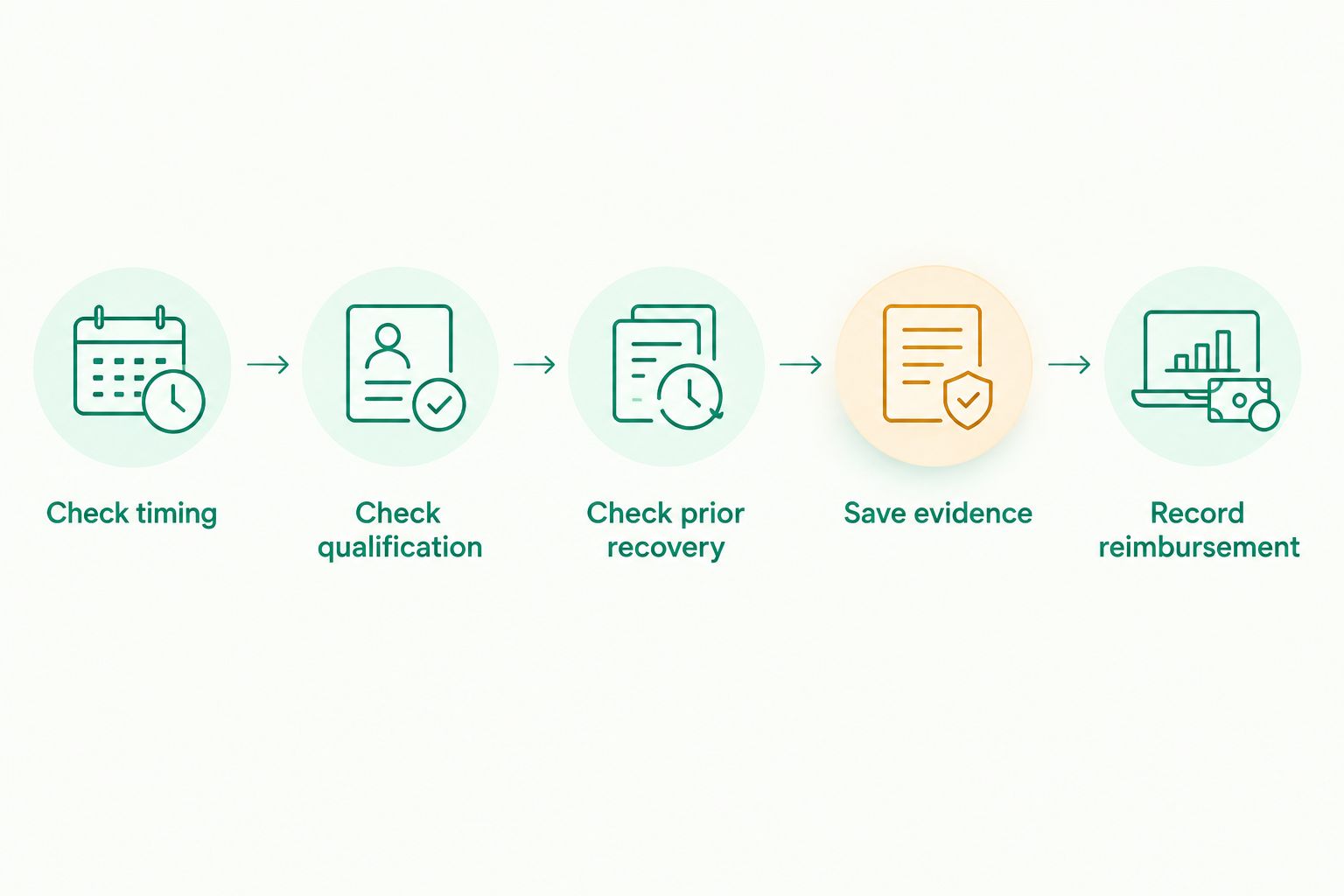
Use these 3 checks for each expense: timing, qualification and prior recovery. Then preserve the evidence alongside its reimbursement status, whether you use an app or a folder.
Check timing
The expense must occur after your HSA was established. Paying an older medical bill after opening the account does not turn the earlier expense into a qualified HSA expense.
Check qualification
Identify what was purchased, who received the care and why it qualifies. For conditional expenses, preserve the supporting medical documentation; a doctor's letter does not automatically qualify a general-health expense.
Check prior recovery
Exclude amounts reimbursed by insurance or another source. You also cannot take a medical-expense deduction for the same expense you reimburse tax-free from your HSA.
Save evidence
Keep itemized receipts, payment evidence and relevant insurance statements together. A bank transaction shows payment, but it does not necessarily show what you bought or why it qualifies.
Record reimbursement
Mark the amount and date when you reimburse yourself. If you reimburse only part of an expense, preserve the remaining unreimbursed balance without counting the same amount twice.
There is no IRS deadline for reimbursing a qualified expense from your HSA, provided you meet the requirements and preserve adequate records. An expense paid in 2026 does not have to be reimbursed in 2026 simply because the calendar year ends.
FSA rules are different. Your FSA's coverage period and claim-submission deadlines apply; an HSA's delayed-reimbursement flexibility does not extend an FSA deadline.
When staying with HSA Store is the right call
Stay with HSA Store when your immediate task is shopping for eligible products and its shopping experience meets your needs. You do not have to replace a useful retailer to improve your recordkeeping.
Instead, add the missing layer. Use IRS guidance for rules and keep your receipts in an app, provider tool, spreadsheet or physical filing system that you can maintain.
FAQ
What's the best HSA Store alternative for eligibility lookups in 2026?
Reimbursable is the best fit here for eligibility lookups paired with receipt tracking. Its directory covers 890+ HSA/FSA-eligible items, while IRS Publications 502 and 969 provide the underlying medical-expense and HSA guidance.
Is an HSA-eligible label enough to prove my reimbursement qualifies?
No, an eligibility label does not establish every requirement for your HSA withdrawal. You still need to substantiate the expense, confirm it occurred after your HSA was established and exclude amounts reimbursed elsewhere or deducted.
Can I use a spreadsheet instead of an HSA receipt app?
Yes, a spreadsheet and organized supporting documents are a legitimate recordkeeping approach. Track the qualified amount, other reimbursements and your HSA reimbursement status, and preserve accessible backups.
Do I need Premium to reimburse myself tax-free?
No, a paid tracking plan is not required for tax-free HSA reimbursement. Premium's receipt scanning, bank sync and email forwarding reduce administration; they do not change the tax rules.
Does a doctor's letter make a general-health purchase HSA eligible?
No, a doctor's letter does not automatically make a general-health expense qualified. The expense must satisfy the applicable medical-expense rules, and supporting documentation must match the actual circumstances.
Is there a deadline for reimbursing an HSA expense?
There is no IRS deadline for reimbursing a qualified HSA expense when the requirements are met and adequate records are retained. The expense must occur after the HSA was established and cannot also be reimbursed elsewhere or deducted.
Can I use HSA reimbursement timing rules for my FSA?
No, HSA delayed-reimbursement rules do not replace your FSA's deadlines. Follow your FSA plan's coverage period and claim-submission rules rather than assuming you can claim the expense years later.
One last thing
The most useful field in your expense ledger is often remaining unreimbursed amount, not an eligibility checkbox. An eligible receipt can still lead to an incorrect withdrawal if insurance paid part of it or you already reimbursed yourself.
Before adding another lookup tool, check whether your records answer that question. A modest system you maintain is more useful than an elaborate system you abandon.
Not tax advice; consult your tax advisor.