
Truemed helps consumers pursue HSA/FSA purchases through participating merchants, including medical-necessity evaluations for certain expenses. That purchase-focused process is different from checking everyday medical expenses and keeping records for reimbursement later. The best Truemed alternative in 2026 is Reimbursable for eligibility lookups and receipt tracking; IRS guidance plus a spreadsheet fits readers who prefer manual research and recordkeeping.
- For Truemed alternatives, choose Reimbursable for HSA eligibility lookups and receipt tracking, not medical-necessity evaluations.
- IRS Publications 502 and 969 explain medical-expense eligibility and HSA reimbursement requirements.
- Spreadsheets, folders, paper receipts, and HSA-provider tools are legitimate recordkeeping alternatives.
- A doctor's letter does not automatically make a general-health purchase HSA eligible.
- HSA reimbursement has no federal time limit; FSA claim deadlines follow your plan's rules.
Why this matters
Verifying a purchase involves separate questions: Does the expense qualify as medical care? Does your situation satisfy the HSA rules? Can you document the amount you eventually reimburse?
A checkout process, an eligibility directory, and a receipt archive address different parts of that job. Choose the alternative that solves your actual problem, rather than treating every HSA-related service as interchangeable.
For your 2026 records, distinguish an eligibility reference from evidence about your own purchase. A directory entry helps you research an item; it does not establish when you incurred the expense, who received the care, or whether insurance reimbursed it.
Truemed alternatives at a glance
| Option | Best for | Standout function | Difference from Truemed |
|---|---|---|---|
| Truemed | Participating-merchant purchases involving medical-necessity evaluation | Connects a purchase workflow with an eligibility-related evaluation | The benchmark: purchase-focused rather than a general receipt ledger |
| Reimbursable | Eligibility research and ongoing receipt tracking | Directory of 890+ HSA/FSA-eligible items plus a receipt-tracking app | Focuses on researching expenses and managing reimbursement records |
| IRS Publications 502 and 969 | Understanding the underlying tax rules | Explains medical expenses and HSA requirements | Provides source guidance, not a merchant purchase workflow |
| Spreadsheet and receipt folders | Maintaining your own expense ledger | You control fields, files, and reimbursement status | Replaces tracking work, not clinical evaluation |
| Your HSA provider's receipt tools | Keeping records alongside your account | Account-linked recordkeeping, where offered | Focuses on your account; features depend on the provider |
The directory's 890+ items give you a starting point for research, not blanket approval for every purchase. Some expenses qualify because of their medical purpose and your circumstances, rather than the product name alone.
Compare the task before comparing the tool
Before choosing, write down what you need: an answer about eligibility, supporting medical documentation, a place to save receipts, or a record of reimbursements already taken. You can use different resources for each task.
None of these options removes your responsibility to substantiate a tax-free HSA distribution. An accepted payment and an uploaded receipt are not substitutes for an eligible expense.
1. Reimbursable: best for eligibility lookups and receipt tracking
Reimbursable combines an HSA/FSA eligibility directory with an expense-tracking app. It fits HSA holders who pay out of pocket, save documentation, and want an organized record before reimbursing themselves.
The distinction from Truemed is practical: researching and documenting an expense is not the same service as evaluating medical necessity during a participating merchant's purchase process.
Where it shines
- Unlimited free manual tracking: You can maintain records without paying for automation.
- Eligibility research: The directory gives you a place to begin checking purchases against medical-expense rules.
- Less receipt administration with Premium: AI receipt scanning, bank sync, and email forwarding address repetitive recordkeeping work.
Where it falls short
- A directory result does not resolve every fact-specific tax question.
- Receipt scanning cannot establish that a general-health expense qualifies as medical treatment.
- If paper folders and a spreadsheet already work for you, another app adds a system to maintain.
| Dimension | Receipt app | Truemed |
|---|---|---|
| Primary task | Eligibility lookup and expense tracking | Participating-merchant purchase workflow |
| Receipt administration | Manual tracking, with optional automation | Not the basis for this recommendation |
| Medical necessity | Research does not replace supporting medical evidence | Evaluations form part of its purchase-focused service |
| Best-fit situation | You need ongoing reimbursement records | You need help with an eligible merchant purchase |
Best for: HSA holders who want eligibility references and receipt records in one workflow.
Start with manual tracking. Consider Premium only when scanning, bank sync, or email forwarding solves a recurring administration problem; automation is not necessary to obtain tax-free reimbursement.
Verdict: Buy into the tracking workflow; skip automation unless it saves you meaningful effort.
2. IRS guidance: best for checking the underlying rule
IRS Publication 502 explains which expenses count as medical expenses. IRS Publication 969 explains HSA rules, including qualified medical expenses and distributions. Read them together: Publication 502 alone is not a complete HSA reimbursement guide.
For a decision made in 2026, use the current IRS materials and check the tax year each document covers. This matters when you encounter older articles or advice written for a different account type.
Where it shines
- Explains the distinction between medical treatment and general health.
- Provides the basis for evaluating an eligibility claim.
- Helps separate HSA distribution rules from the rules for itemized medical deductions.
Where it falls short
- Requires more reading than a searchable directory.
- Does not organize your receipts or track reimbursements.
- Does not provide a personalized answer to every medical-purpose question.
| Dimension | IRS guidance | Truemed |
|---|---|---|
| Main purpose | Explain federal tax requirements | Support participating-merchant purchases |
| Medical-purpose questions | Provides rules and examples | Includes evaluations for certain purchases |
| Recordkeeping | Explains your responsibilities | Purchase workflow is a different task |
Best for: Checking why an expense qualifies, especially when seller language and medical purpose do not clearly match.
Use Publication 502 for the medical-expense question and Publication 969 for the HSA question. Neither document means you should apply the medical-deduction threshold to otherwise qualified HSA reimbursements.
Verdict: Hold as your source reference, even if you choose an app.
3. A spreadsheet and folders: best for hands-on recordkeeping
A spreadsheet paired with digital folders or paper receipts is a legitimate HSA recordkeeping system. You choose the fields and maintain the evidence yourself.
The trade-off is straightforward: control comes with manual work. This option replaces receipt administration, not a medical-necessity evaluation.
Where it shines
- Lets you record expense dates, patients, eligible amounts, and reimbursement status in your own format.
- Keeps original documents separate from any particular receipt app.
- Works with paper receipts if you maintain readable, organized copies.
Where it falls short
- Requires consistent filing and updates.
- Does not automatically verify eligibility.
- Makes duplicate or partial reimbursements harder to manage if your ledger is incomplete.
| Dimension | Spreadsheet and folders | Truemed |
|---|---|---|
| Primary role | Personal expense ledger | Participating-merchant purchase support |
| Eligibility work | You research and document it | Evaluation is part of certain purchase workflows |
| Ongoing administration | You enter and reconcile records | Not a substitute for your full expense ledger |
Best for: People who already maintain accurate financial records and do not need receipt automation.
Include the original eligible amount and each reimbursement against it. A partially reimbursed expense needs a remaining balance, not just a checkbox marked paid.
Verdict: Hold if you consistently maintain it; switch if receipts regularly go unfiled.
4. HSA-provider tools: best for account-centered records
Your HSA provider's receipt features are another legitimate option when offered. Check the actual functions before adopting a separate app.
Where they shine
- Keep supported records close to the account you use for distributions.
- Avoid adding another system when existing features meet your needs.
Where they fall short
- Features vary; do not assume uploads, exports, or reimbursement tracking are included.
- You still need to confirm eligibility and retain supporting evidence.
Best for: HSA holders whose provider already supports their recordkeeping needs.
Before committing, check how you would retrieve receipts if you changed providers. Your documentation needs to outlast an account relationship.
Verdict: Hold when the tools work; skip a separate app unless it fills a specific gap.
Why people switch from Truemed
The relevant reason to choose an alternative is a different task—not an assumed problem with Truemed. If you already paid a dentist, pharmacy, or medical provider out of pocket, your immediate need is often documentation rather than merchant checkout support.
Choose a tracking approach when you need to:
- Save receipts from purchases made across different providers and merchants.
- Separate eligible medical charges from unrelated items on a bill.
- Record insurance adjustments before determining your reimbursable amount.
- Track expenses you have not yet reimbursed.
Medical-purpose questions deserve separate attention. A doctor's letter does not automatically qualify an expense incurred for general health, and calling something wellness or recovery does not settle its tax treatment. The guide to whether a doctor's letter makes gym membership HSA eligible explains that distinction in a specific purchase category.
Check eligibility before saving a reimbursement amount
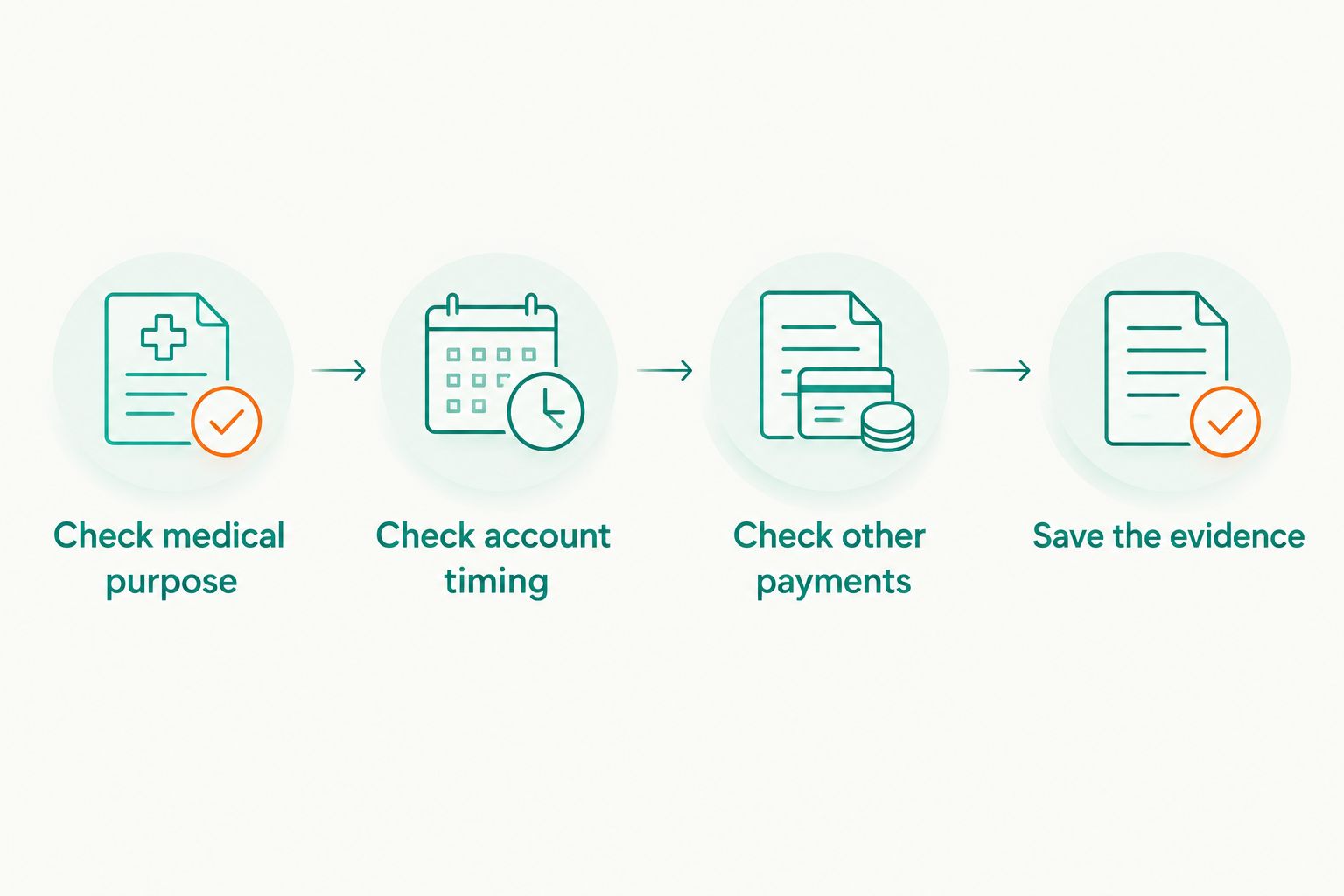
For a purchase you make in 2026, use this sequence before treating the receipt as a future tax-free withdrawal:
- Check medical purpose. Identify the qualifying medical expense, not just the seller's eligibility label.
- Check account timing. The expense must be incurred after your HSA was established.
- Check other payments. Exclude amounts reimbursed by insurance, an FSA, or another source. Do not also claim the expense as an itemized deduction.
- Save the evidence. Keep the itemized documentation, payment evidence, and relevant medical support together.
This sequence separates eligibility from recordkeeping. Completing a receipt upload does not fix a purchase that fails the underlying rules.
For example, if insurance later reduces your responsibility for a bill, update your records before using the original receipt amount. A record should reflect your eligible unreimbursed expense, not simply the first amount charged.
When staying with Truemed is the right call
Stay with Truemed when your immediate task is its participating-merchant purchase process, including a medical-necessity evaluation where applicable. A directory or spreadsheet does not perform that same job.
You do not have to choose a single resource for everything. Use a purchase service for the transaction it supports, IRS guidance for the rules, and a recordkeeping system for your evidence. Keep those roles distinct.
FAQ
What's the best Truemed alternative for saving HSA receipts?
Reimbursable fits HSA holders who want eligibility lookups and receipt tracking, with unlimited free manual tracking. A spreadsheet, organized folders, or suitable HSA-provider tools are also legitimate choices.
Is a receipt tracker a replacement for a Truemed medical-necessity evaluation?
No. A receipt tracker organizes evidence; it does not replace a medical-necessity evaluation. Choose the service that matches the task, and check the underlying eligibility rules.
Does a doctor's letter make a wellness purchase HSA eligible?
No, a doctor's letter does not automatically make a general-health expense HSA eligible. The expense must satisfy the medical-care requirements based on its purpose and your circumstances.
Can I reimburse myself years after paying a medical bill?
Yes, federal HSA rules do not impose a time limit on reimbursement of qualified medical expenses. The expense must have been incurred after your HSA was established, and you must retain evidence that it was not reimbursed elsewhere or also deducted.
Do FSA receipts follow the same reimbursement timeline as HSA receipts?
No. FSAs have plan-specific expense and claim deadlines, while qualified HSA reimbursements have no federal time limit. Check your FSA plan documents rather than applying the HSA rule.
Do I need a paid app to get tax-free HSA reimbursement?
No, a paid app is not required for tax-free HSA reimbursement. Eligibility and adequate records matter; spreadsheets, folders, paper receipts, and provider tools can support your documentation.
What happens if an HSA purchase is not qualified?
A nonqualified HSA distribution is generally taxable and can carry an additional 20% tax. The additional tax generally does not apply after age 65 years or in cases of disability or death; ordinary income tax can still apply. Consult your tax advisor about correcting an error.
One last thing
Keep reimbursement status separate from purchase status. A paid receipt proves something different from an unreimbursed eligible expense. Record insurance payments, any reimbursement already taken, and the remaining eligible balance together.
For your 2026 system, start with a method you will maintain. Add automation only when administration becomes the problem—not because you think an app makes a purchase qualify.
Not tax advice; consult your tax advisor.