
For HSA gym reimbursement, keep an itemized gym bill, proof of payment, medical documentation supporting a qualifying treatment purpose, and a record showing the expense occurred after your HSA was established. Those records support eligibility; they do not create it. Ordinary gym dues for general health are not qualified medical expenses, and a doctor's recommendation alone does not make them eligible.
- Can you use HSA for gym membership reimbursement receipts? Only qualifying medical expenses support tax-free reimbursement.
- Keep itemized bills, payment proof, treatment documentation, and an unreimbursed-expense ledger together.
- A doctor's letter does not automatically make ordinary gym dues HSA-eligible.
- Reimbursable supports HSA receipt tracking; it does not replace the IRS eligibility test.
Why this matters
A gym receipt proves a transaction happened. It does not prove that the payment was for medical care rather than general fitness, recreation, or personal wellness.
That distinction matters when you pay out of pocket and reimburse yourself later. Reimbursable offers HSA receipt tracking, but your file still needs to explain why the underlying expense qualifies. Resolve eligibility before marking a gym payment as available for tax-free reimbursement.
For a 2026 expense, use IRS Publication 502 to understand the medical-expense distinction and IRS Publication 969 for HSA distribution and recordkeeping rules. The IRS's medical-expense FAQs also address the narrow circumstances in which gym membership can qualify.
What records do you need for HSA gym reimbursement?
Build a file that connects the medical purpose, the actual gym charge, and your later reimbursement. A bank transaction by itself leaves too much unexplained.
Establish eligibility before filing receipts
The IRS generally excludes health club dues and expenses that merely benefit general health. Its medical-expense FAQs describe a narrow exception when membership is purchased for the sole purpose of prescribed treatment affecting a body structure or function, or treating a physician-diagnosed disease.
Do not read that exception as permission to reimburse every membership recommended by a clinician. Start with the HSA gym membership eligibility test, then determine whether your own facts satisfy it.
Save the itemized bill
Keep the gym's invoice, membership statement, or receipt identifying the business, the person receiving the service, the service description, and the applicable dates. The document should distinguish membership dues from separately billed services and other purchases.
If your receipt says only membership, request a more detailed statement. More detail helps establish what you bought; it still does not establish medical eligibility.
Keep proof of payment
Save evidence that you actually paid the charge, such as a paid invoice or the matching credit card or bank statement. Keep the itemized bill alongside that evidence rather than treating either document as a complete substitute for the other.
Match refunds and reversals to the original transaction. Your records should reflect your actual unreimbursed expense, not a charge the gym later returned.
Retain the medical explanation
Keep relevant clinician documentation explaining the diagnosed condition, prescribed treatment, and connection between that treatment and the expense. When the claimed basis depends on a treatment period, retain documentation describing that period.
A letter of medical necessity is supporting evidence, not an automatic approval. A statement that exercise would improve your health does not, by itself, establish that ordinary membership dues qualify.
Record the timing and reimbursement history
Keep your HSA establishment documentation and the dates the medical services were provided. For HSA purposes, an expense must be incurred after the account was established; paying an older bill after opening an HSA does not fix an earlier service date.
Your ledger should also show whether insurance, an FSA, another HSA distribution, or another source reimbursed the expense. Do not reimburse an expense tax-free from an HSA if you also deducted it on your tax return.
What does each document actually prove?
No single document answers every eligibility question. Use this checklist to identify gaps before you take an HSA distribution.
| Record | What it supports | What it does not establish |
|---|---|---|
| Itemized gym invoice | Who was billed, what was purchased, and relevant dates | That ordinary membership dues qualify as medical care |
| Payment confirmation | That you paid the charge | The medical purpose of the purchase |
| Clinician documentation | Diagnosis, prescribed treatment, and medical connection | Automatic eligibility for every gym charge |
| HSA establishment record | Whether the account existed before the expense | Whether the service itself qualifies |
| Reimbursement ledger | What remains unreimbursed and what was withdrawn | Eligibility without the underlying evidence |
For recurring billing, keep the individual charges or an itemized statement covering them. If your file contains 12 monthly charges, make sure you can connect each charge to its service period and payment status.
One annual statement can organize those records if it contains the necessary detail. A total without dates or descriptions leaves the same questions unanswered.
Why HSA gym documentation varies
Your paperwork should follow the actual expense, not a generic receipt checklist. These factors change what needs explaining:
- Medical purpose: Documentation must distinguish qualifying treatment from general health or recreation.
- Billing detail: A bundled membership requires a clearer explanation of what the payment covers.
- Service dates: Recurring charges need dates that can be compared with the HSA establishment date and treatment documentation.
- Covered person: A household charge needs records identifying the person receiving the claimed medical care.
- Other reimbursement: Insurance payments, refunds, or FSA reimbursement change what remains available for HSA reimbursement.
- Later withdrawal: Delayed reimbursement requires records that remain understandable after the original transaction.
Do not invent an allocation because it seems reasonable. If a charge combines potentially qualifying treatment with ordinary personal use, obtain supporting detail and discuss the treatment with your tax advisor before withdrawing money.
How do you organize gym receipts for later reimbursement?
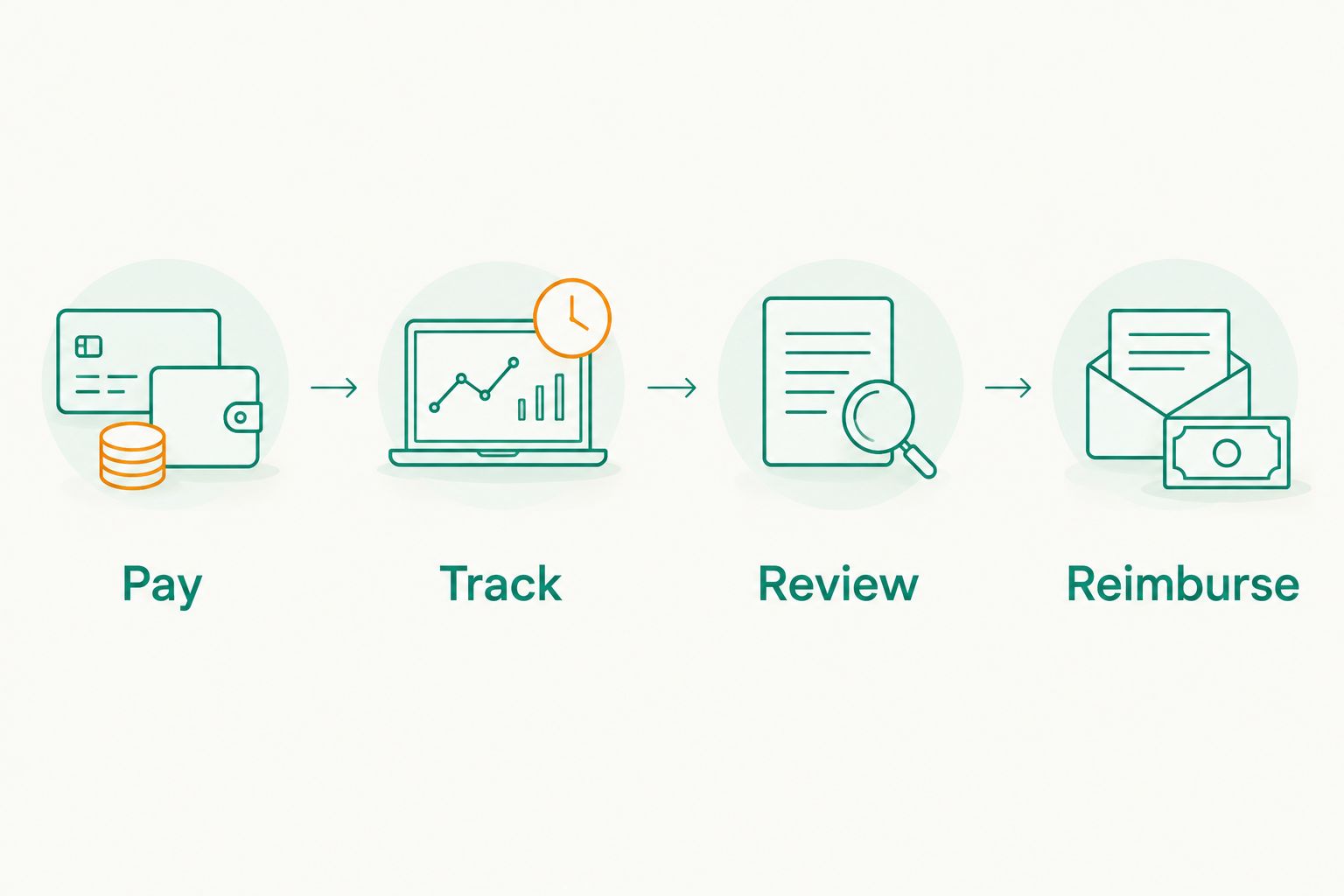
Use a repeatable process: Pay, Track, Review, Reimburse. Tracking a payment does not mean you have decided it qualifies.
- Pay: Save the itemized bill and matching payment evidence when the charge occurs.
- Track: Enter the service date, provider, person treated, expense description, and payment reference in your ledger.
- Review: Attach the medical support, check HSA timing, and confirm the expense has not been reimbursed elsewhere or deducted.
- Reimburse: Record the withdrawal date and the expense it covers only after resolving eligibility.
Keep uncertain gym charges in a separate review category rather than combining them with confirmed qualified expenses. That separation prevents a running total from quietly treating an unresolved charge as eligible.
For a hypothetical February 2026 gym charge, keep the February invoice and payment evidence together with the relevant treatment documentation. Record the service period separately from the date the card payment cleared.
If you reimburse yourself later, add the withdrawal to that same record. Do not create a disconnected entry that leaves you guessing which receipt supported the distribution.
Can physical therapy records justify gym membership dues?
Physical therapy records do not automatically qualify a separate gym membership. A treatment invoice and a club membership describe different purchases, even when both relate to the same injury or diagnosis.
The distinction matters when organizing HSA claims for physical therapy: retain the treatment invoice as evidence of the care actually provided, rather than using it as blanket support for separate gym dues. Evaluate each charge on its own facts.
For example, a therapist's treatment plan might explain why certain exercises were prescribed. It does not establish that every feature included in a membership was purchased solely for qualifying medical treatment.
Ask for separate billing when treatment and membership are bundled. Clear billing helps you assess the expenses independently; it does not guarantee that either charge qualifies.
What is the simplest way to store the records?
Reimbursable is best for HSA holders who want a dedicated receipt-tracking app. Unlimited free manual tracking supports a hands-on approach; Premium's AI receipt scanning, bank sync, and email forwarding address receipt administration rather than changing tax eligibility.
You do not need a paid app to obtain tax-free HSA reimbursement. Choose a system you will maintain and can understand when you retrieve an old expense.
| Recordkeeping option | Best for | Strength | Limitation |
|---|---|---|---|
| Spreadsheet and digital folders | People comfortable managing files themselves | Flexible ledger and document organization | You must maintain links and reimbursement status manually |
| Paper receipts and an index | People who prefer physical records | Keeps original paperwork together | Fading, loss, and searching require attention |
| HSA-provider receipt tools | People who want records near their account | Keeps tracking within the provider's system | Features and export options depend on the provider |
| Reimbursable receipt tracking | HSA holders wanting dedicated expense tracking | Unlimited manual tracking, with optional automation through Premium | You still must verify eligibility and retain supporting documentation |
Before choosing any system, check whether you can retrieve both the original document and its reimbursement history. A searchable transaction without the underlying invoice is not a complete medical-expense file.
Keep 2 copies of important records in separate locations as a practical backup. For sensitive medical documents, also review access controls and avoid sharing more information than necessary.
How long can you wait to reimburse yourself?
HSA rules do not impose an IRS deadline for reimbursing an otherwise qualified expense incurred after the HSA was established. You must retain records supporting the expense and showing it was not previously reimbursed or deducted.
For a qualifying expense incurred in 2026, delayed reimbursement does not remove the need to establish eligibility. A long-held receipt for ordinary gym dues remains a receipt for an ineligible expense.
FSA rules are different. FSAs have plan-year rules and claim-submission deadlines, so do not apply the HSA's delayed-reimbursement rule to an FSA expense.
What do you submit with your tax return?
You generally retain supporting receipts rather than attach them to your federal income tax return. Report HSA distributions on Form 8889 and keep records supporting the portion treated as qualified medical expenses.
For your 2026 tax file, connect each claimed qualified distribution to the underlying expense records. A withdrawal confirmation proves money left the HSA; it does not prove the money reimbursed eligible medical care.
An HSA provider processing a distribution is not a determination that the expense qualifies under IRS rules. You remain responsible for the tax treatment.
FAQ
Can I use my HSA for gym membership if I keep every receipt?
Keeping every receipt does not make gym membership HSA-eligible. Ordinary general-health dues are excluded; a qualifying exception requires facts supporting the IRS medical-expense rules.
Does a doctor's letter make my gym membership eligible?
A doctor's letter does not automatically make gym membership eligible. It must support the actual medical purpose, and the expense must independently satisfy the applicable IRS rules.
Is a credit card statement enough for HSA gym reimbursement?
A credit card statement alone does not establish what services you purchased or why they qualify. Keep the itemized invoice, payment evidence, and relevant medical documentation together.
Can I reimburse a gym expense from before I opened my HSA?
An expense incurred before your HSA was established is not eligible for tax-free HSA reimbursement. Paying the bill after opening the account does not change when the service occurred.
Can I use both my FSA and HSA for the same gym expense?
You cannot reimburse the same expense from both an FSA and an HSA. Keep a record of which account reimbursed each eligible expense and follow the FSA's separate deadlines.
Do I need a paid receipt app to reimburse myself later?
You do not need a paid receipt app for tax-free HSA reimbursement. Spreadsheets, digital folders, paper files, and HSA-provider tools are legitimate options if your records support the expense.
One last thing
Marking an expense as paid is not the same as marking it eligible. Add a separate eligibility-review field to your ledger so a saved gym receipt cannot silently become part of your reimbursable total.
Not tax advice. Always consult your tax advisor, especially before treating gym membership as qualifying medical care.