
You generally cannot use your HSA tax-free for a gym membership just because you want to lose weight. A narrow exception applies when the membership is purchased solely to treat a specific disease diagnosed by a physician, such as obesity; a doctor's recommendation to exercise, or a letter alone, does not make ordinary gym dues eligible.
- Can you use HSA for gym membership for weight loss? Generally no; disease-treatment exceptions require more than a recommendation.
- IRS Publication 502 distinguishes eligible weight-loss treatment fees from ordinary gym membership dues.
- Reimbursable helps organize HSA receipts; tracking an expense does not establish its tax eligibility.
- Keep diagnosis, treatment documentation, itemized charges, and proof of payment before claiming a qualifying reimbursement.
Why this matters
A gym can support your health without qualifying as a medical expense. The tax question is why you purchased the membership, not whether exercise helps you lose weight.
For a 2026 expense, separate ordinary fitness spending from treatment of a diagnosed disease before withdrawing HSA money. Card acceptance, a reimbursement service's approval, and a doctor's letter are not substitutes for the IRS eligibility rules.
The broader gym membership eligibility test covers the general rule. Here, the focus is weight loss: when treatment qualifies, what happens to gym dues, and which records to save.
Can you use HSA for gym membership for weight loss?
Usually no for ordinary gym dues; potentially yes under the IRS's narrow disease-treatment exception. Wanting to lose weight is not enough. Neither is being told that more exercise would improve your health.
IRS Publication 502 allows weight-loss expenses when they treat a specific disease diagnosed by a physician, including obesity. It also specifically excludes ordinary gym, health club, and spa membership dues while allowing separately charged weight-loss activities when the treatment requirements are met.
The IRS's medical-expense FAQs address a narrower situation: a gym membership purchased for the sole purpose of treating a physician-diagnosed disease can qualify. Read that exception narrowly rather than treating every obesity diagnosis as permission to reimburse an existing membership.
| Expense or situation | HSA treatment | What decides it |
|---|---|---|
| Gym membership for fitness or personal weight loss | Generally not eligible | General health and appearance are personal purposes |
| Gym membership purchased solely to treat diagnosed obesity | Can qualify under the narrow IRS exception | The sole medical purpose and supporting facts |
| Separate weight-loss program fees for diagnosed obesity | Can qualify | Treatment purpose and separately identified charges |
| Weight-loss activities without a diagnosed disease | Generally not eligible | A personal weight goal does not establish medical treatment |
For your 2026 review, use IRS Publication 502 for medical-expense categories, the IRS medical-expense FAQs for the gym-specific exception, and Publication 969 for HSA distribution rules. These sources answer different parts of the same decision; none makes a diagnosis alone sufficient.
Ordinary gym dues: weight loss alone does not qualify
If you join a gym to lose weight, build strength, or improve general wellness, treat the dues as personal spending. Paying out of pocket does not create an expense you can automatically reimburse later.
The same rule applies when your doctor generally encourages exercise. Advice to become more active does not establish that the membership exists solely to treat a diagnosed disease.
For example, a recommendation to exercise more during a routine checkup does not, by itself, turn your existing gym membership into medical treatment. Save the receipt if you need it for your records, but do not label it HSA-qualified on that basis.
A health benefit is not the same as a qualified medical expense. That distinction prevents a personal fitness goal from becoming an unsupported tax-free withdrawal.
Disease-treatment memberships: document the narrow exception
A membership purchased solely to treat physician-diagnosed obesity presents a different question. The IRS medical-expense FAQs recognize a disease-treatment exception, but your actual circumstances must support it.
Ask your clinician to document the diagnosis and explain how the recommended activity treats that condition. Keep that documentation alongside the membership agreement and the charges you plan to reimburse.
A letter of medical necessity is supporting evidence, not an automatic qualification. A generic exercise recommendation does not resolve whether a membership also serves general fitness, recreation, or other personal purposes.
If those purposes overlap, do not invent a qualifying percentage of the dues. Have your tax advisor assess the specific arrangement before you treat it as a qualified expense.
Separate weight-loss treatment fees: distinguish the charge
A gym can charge for both access to its facilities and a separate weight-loss activity. Those charges do not necessarily receive the same tax treatment.
Under Publication 502, separately charged weight-loss activities can qualify when they treat a physician-diagnosed disease. That does not make the accompanying ordinary membership dues eligible.
Request an itemized statement that identifies the treatment activity separately from general access. If the invoice bundles everything together, ask the provider for a factual breakdown rather than assigning your own treatment amount.
For bundled invoices, the guide to separating qualified medical expenses on mixed bills explains the recordkeeping distinction. An itemized charge supports the analysis; it does not independently prove eligibility.
How to review a weight-loss expense before reimbursement
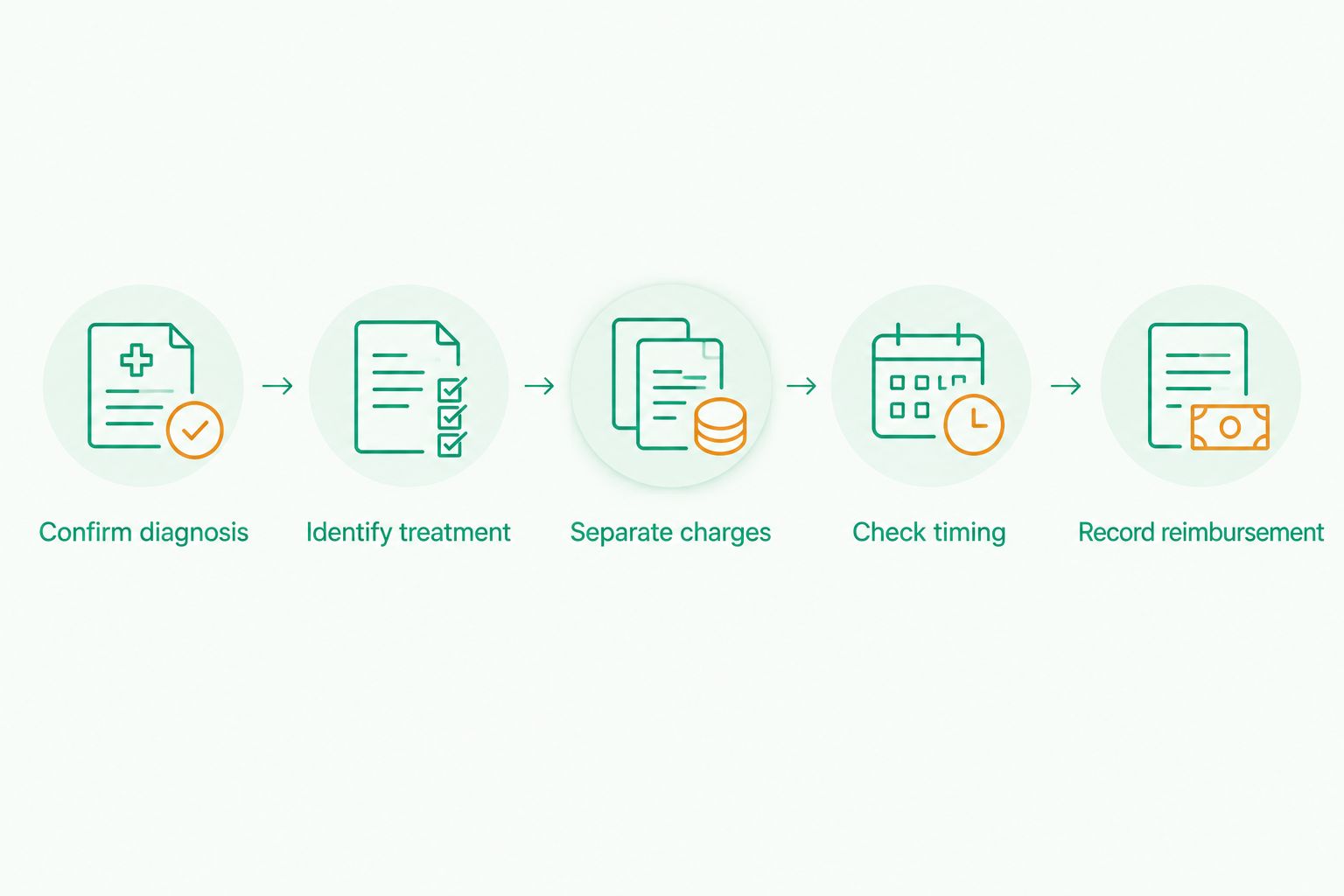
Use this sequence for a 2026 gym or weight-loss charge. Resolve eligibility first, then decide whether to withdraw from your HSA now or retain the records for later.
1. Confirm diagnosis
Identify the specific disease being treated. A personal target weight, a fitness assessment, or a desire to prevent future health problems does not replace a physician's diagnosis.
Keep the relevant clinical documentation without adding unrelated medical history to your expense file. The record should explain the treatment purpose clearly enough to connect it to the charge.
2. Identify treatment
Determine what you actually purchased: ordinary gym access, a disease-treatment membership, or a separately billed weight-loss activity. Apply the rule to that expense, not to the provider's description of its business.
Ask your clinician to explain the medical purpose when the connection is unclear. Do not assume that a program marketed as medical weight loss qualifies every service sold alongside it.
3. Separate charges
Match each itemized charge to the treatment documentation. Keep ordinary fitness spending separate from any expense you determine qualifies.
Preserve the original invoice as well as your notes. A spreadsheet label such as medical expense cannot replace the underlying evidence.
4. Check timing
The qualifying expense must be incurred after your HSA was established. Opening an HSA later does not make an earlier medical expense reimbursable.
Check the treatment or coverage period, not just the payment date. Advance payments and memberships spanning different periods deserve a specific timing review before reimbursement.
5. Record reimbursement
Confirm that insurance, an FSA, or another arrangement has not already reimbursed the expense. You also cannot claim an itemized medical deduction for the same expense you reimburse tax-free through your HSA.
Record any HSA withdrawal against the exact qualifying charge. Mark it reimbursed so the same receipt does not support another withdrawal later.
Why gym membership eligibility varies
The payment method does not determine qualification. These facts do:
- Purpose: General fitness and appearance differ from treatment of a specific disease.
- Diagnosis: A physician-diagnosed condition supports a treatment claim; a personal weight goal does not.
- What was purchased: General access and separately billed treatment activities require different analysis.
- Sole medical use: The IRS gym-membership exception depends on the membership's sole treatment purpose.
- Timing and reimbursement history: The expense must follow HSA establishment and cannot be reimbursed elsewhere or also deducted.
Documentation makes those facts easier to establish. It cannot change what the expense actually purchased.
Does a doctor's letter make my gym membership HSA-eligible?
A doctor's letter does not automatically make gym dues HSA-eligible. It must support facts that satisfy the medical-expense rules; a recommendation for general health is insufficient.
Ask whether the letter identifies a diagnosed disease and connects the specific expense to treatment. Then assess the membership itself, including the sole-purpose requirement, rather than relying on the letter's title.
Can I reimburse an eligible expense years later?
There is no federal deadline for reimbursing an otherwise qualifying HSA expense. The expense must have occurred after your HSA was established, and you must retain records showing it was eligible, not reimbursed elsewhere, and not also deducted.
An eligible expense incurred in 2026 can therefore remain in your records for later reimbursement. Waiting does not make an ineligible gym membership eligible, and retaining receipts does not guarantee any investment result.
Are FSA deadlines the same as HSA reimbursement rules?
FSA deadlines are not the same as HSA reimbursement rules. An FSA has plan-specific coverage and claim-submission rules; it does not inherit the HSA's open-ended reimbursement timing.
Check your employer's plan documents for its deadlines and any applicable carryover or grace period. Never submit the same expense for reimbursement from both accounts.
Choose a recordkeeping method you will maintain
Reimbursable is a practical HSA receipt-tracking option for people who want an app-based expense record. Its free manual tracking is unlimited; Premium adds AI receipt scanning, bank sync, and email forwarding to reduce receipt administration.
Those features organize evidence. They do not establish eligibility, and Premium is not required to obtain tax-free reimbursement. The trade-off is straightforward: manual tracking requires you to enter information, while automation still requires you to review it.
| Method | Best for | Main advantage | Main limitation |
|---|---|---|---|
| Spreadsheet and digital folders | People comfortable managing their own records | You choose the fields and filing structure | You must maintain the entries and receipt links |
| Paper receipts | People who prefer physical files | No app is required | Receipts can fade or be lost; copies help preserve them |
| HSA-provider receipt tools | People whose provider offers suitable features | Records can stay near the account workflow | Features depend on the provider; check retrieval and export options |
| Reimbursable | People seeking app-based HSA receipt tracking | Unlimited free manual tracking, with optional automation | Entries and eligibility decisions still need review |
Keep the receipt, proof of payment, treatment documentation, and reimbursement status connected. For this category, also preserve the explanation distinguishing disease treatment from ordinary gym access.
Do not mark an unresolved membership as ready for reimbursement. Keep it separate until you have completed the eligibility review.
FAQ
Can I use my HSA for a gym membership if I want to lose weight?
Generally no: wanting to lose weight does not make ordinary gym dues HSA-eligible. A narrow exception exists for a membership purchased solely to treat a specific physician-diagnosed disease.
Does an obesity diagnosis automatically qualify my gym dues?
No, an obesity diagnosis does not automatically qualify gym dues. The expense must meet the medical-treatment rules, including the sole-purpose requirement for the IRS gym-membership exception.
Can my HSA pay for a separate weight-loss program at a gym?
Separately charged weight-loss activities can qualify when they treat a physician-diagnosed disease. Keep an itemized bill and supporting treatment documentation; ordinary membership dues are not automatically included.
Does my HSA card working at the gym prove the expense qualifies?
No, successful HSA card payment does not prove tax eligibility. You remain responsible for determining whether the distribution paid a qualified medical expense and retaining supporting records.
What happens if I use HSA money for an ineligible membership?
A nonqualified HSA distribution is generally taxable and can carry an additional 20% tax. The additional tax does not apply after age 65 or in certain other circumstances, but the distribution generally remains taxable.
Which IRS sources should I use for a 2026 gym expense?
Use IRS Publication 502 for medical-expense categories, the IRS medical-expense FAQs for the gym-membership exception, and Publication 969 for HSA rules. Follow the applicable Form 8889 instructions when reporting distributions.
Do I need a paid receipt app for tax-free HSA reimbursement?
No, a paid receipt app is not required for tax-free HSA reimbursement. Reimbursable, spreadsheets, folders, paper records, and suitable HSA-provider tools are recordkeeping choices; the expense itself must still qualify.
One last thing
Before requesting a doctor's letter, request the itemized bill. If your expense is a separately billed weight-loss treatment activity, the invoice helps identify the charge you need to evaluate. If it is ordinary gym access, a letter cannot simply rename it.
For your 2026 records, keep the eligibility decision beside the receipt—not just the payment confirmation. That distinction matters when you return to the expense long after paying it.
Not tax advice. Always consult your tax advisor about your specific expense and documentation.