
A doctor’s letter does not automatically make a gym membership HSA eligible in 2026. The membership must qualify as medical care rather than general exercise; IRS guidance allows a narrow exception when it is purchased solely for a qualifying medical purpose, such as treating a specific disease diagnosed by a physician. A letter of medical necessity supports that purpose, but it does not override the eligibility rules.
- Can you use HSA for gym membership with letter of medical necessity? Only when the membership independently qualifies as medical care.
- IRS guidance distinguishes treatment of a diagnosed disease from exercise for general health, even when a doctor recommends exercise.
- Keep the medical recommendation, membership terms, payment records and reimbursement history together.
- Reimbursable supports HSA receipt tracking; storing a receipt does not establish that an expense qualifies.
Why this matters
A medical recommendation and a qualified medical expense are not the same thing. Your doctor can recommend exercise because it benefits your health without turning ordinary gym dues into tax-free medical spending.
The practical question is not whether you can obtain a letter. It is whether the membership itself meets the IRS medical-care standard. For the broader eligibility framework, see the gym membership eligibility test.
Does a doctor’s letter make gym membership HSA eligible?
No. A doctor’s letter is supporting evidence, not automatic approval. IRS Publication 502 generally excludes health club dues. The IRS FAQ titled Frequently asked questions about medical expenses related to nutrition, wellness and general health explains the narrow circumstances in which a gym membership can qualify.
The FAQ describes membership purchased for the sole purpose of affecting a structure or function of the body, such as prescribed physical therapy for an injury, or treating a specific disease diagnosed by a physician. It gives obesity, hypertension and heart disease as examples. Membership for general health does not qualify, even when a doctor recommends it.
| Situation | What the IRS distinction means | What the letter establishes |
|---|---|---|
| Exercise for general health | Ordinary gym membership remains a personal expense | A recommendation alone does not change that result |
| Membership solely for treatment of a diagnosed disease | The medical-purpose exception needs to fit the actual expense | The letter can document the diagnosis and treatment connection |
| Membership solely for prescribed physical therapy following an injury | The treatment purpose and membership arrangement need examination | The letter can explain the prescribed therapy |
| Membership combining medical and recreational purposes | The sole-purpose requirement remains a concern | A letter does not erase recreational use or unrelated benefits |
For your 2026 decision, read the IRS FAQ alongside Publication 502, which addresses medical expenses, and Publication 969, which addresses HSAs and other tax-favored health plans. These sources answer different parts of the question: what counts as medical care, and when an HSA distribution receives tax-free treatment.
What should a letter of medical necessity explain?
A useful letter explains the medical facts rather than simply declaring an expense HSA eligible. Ask your treating clinician to describe the diagnosed condition, the prescribed treatment and why the particular membership serves that treatment.
The documentation should help answer these questions:
- What condition is being treated? A specific diagnosis is different from a general desire to improve fitness.
- What treatment is prescribed? The recommendation should identify the relevant activity or therapy.
- Why does the membership support that treatment? Connect the actual purchase to the medical purpose.
- What treatment period does the recommendation cover? Keep the recommendation connected to the expenses you intend to reimburse.
- What else does the membership include? Identify recreational benefits, family access or unrelated services that complicate the claim.
These are practical documentation questions, not a promise that a particular letter format will satisfy the IRS. A clinician documents medical need; the tax treatment still depends on the expense and the applicable rules.
Do not ask for a stronger-sounding letter when the underlying purchase is ordinary fitness spending. Better wording cannot repair an expense that does not meet the medical-care standard.
How do you check a gym expense before reimbursing yourself?
Use this sequence before treating a membership payment as a qualified HSA expense. Keep the eligibility decision separate from the payment method: paying out of pocket does not make an expense eligible, and using an HSA card does not prove that it qualifies.
- Check eligibility. Identify the specific medical purpose and compare the actual membership with the IRS guidance. Do not stop at a gym’s statement that it accepts HSA payments.
- Document treatment. Save the clinician’s recommendation and any relevant treatment documentation. Make sure the records explain the connection between the condition and the membership.
- Separate charges. Review the agreement and invoice for unrelated services, household members or recreational extras. Ask for itemized billing when distinct services are involved.
- Save records. Keep the invoice, proof of payment, membership terms and medical documentation together. Record the relevant service dates, not just the date you uploaded the receipt.
- Record reimbursement. Before transferring money from your HSA, confirm that the expense occurred after the HSA was established and was not reimbursed elsewhere or deducted.
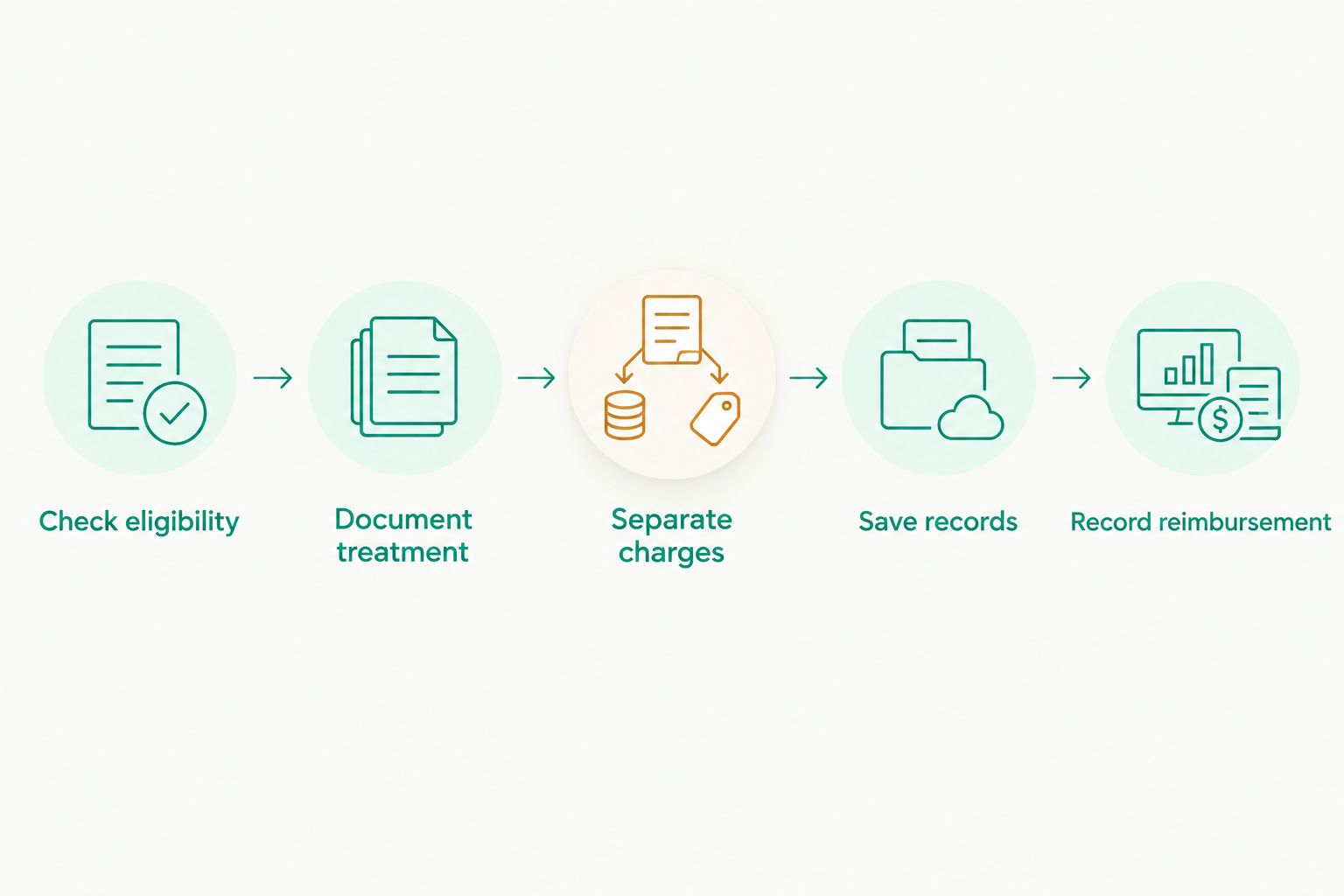
For a 2026 receipt file, preserve the reasoning alongside the documents. A note saying that a letter exists is less useful than a record connecting the diagnosis, prescribed treatment, membership terms and dates.
If one bill contains genuinely separate services, use the guide to separating qualified expenses on mixed bills. Itemization helps identify distinct charges; it does not automatically make part of an ordinary gym membership deductible or reimbursable.
Why gym membership eligibility varies
Eligibility varies because the purpose and substance of the purchase matter more than its label. Two people can buy access to the same facility for different reasons, but each person still needs an expense that satisfies the medical-care rules.
- General wellness versus treatment: Staying active is different from treating a diagnosed disease.
- The purpose of the membership: The IRS exception uses a sole-purpose standard, not merely a health-benefit standard.
- The prescribed service: A specific course of physical therapy is different from unrestricted recreational access.
- Bundled benefits: Family access, social amenities and unrelated services complicate the connection between the payment and medical care.
- Timing and reimbursement history: Even a qualifying medical expense must satisfy the HSA rules about establishment dates and duplicate reimbursement.
Consider a doctor who recommends more exercise during a routine visit. That recommendation does not transform an ordinary membership into medical care. By contrast, a membership purchased solely for treatment of a diagnosed disease raises the narrower exception described in the IRS FAQ; the actual arrangement and supporting records still matter.
Is a gym’s HSA acceptance the same as IRS eligibility?
No. Payment acceptance does not establish tax eligibility. A successful card transaction shows that a payment went through, not that the IRS medical-care requirements were met.
The same distinction applies to a service that helps you obtain a medical-necessity letter. Evaluate the expense itself rather than relying on a checkout badge, reimbursement claim or letter alone.
Before paying, ask what you are purchasing, what the letter documents and whether the membership is solely for the qualifying medical purpose. Keep answers with your records, but do not treat a seller’s explanation as a substitute for tax advice.
Can you reimburse a qualifying gym expense years later?
Yes. There is no IRS deadline for reimbursing a qualified HSA expense incurred after your HSA was established. You must retain records showing that it qualified, was not reimbursed from another source and was not taken as an itemized deduction.
For example, an eligible expense incurred in 2026 can remain unreimbursed while you preserve the documentation for a later HSA distribution. Waiting does not improve eligibility: an ordinary fitness expense stays an ordinary fitness expense regardless of how long you keep the receipt.
FSA rules are different. FSA coverage periods and claim-submission deadlines depend on the plan, so do not apply the HSA’s open-ended reimbursement timing to an FSA claim.
What happens if you use HSA money for an ineligible membership?
An ineligible HSA distribution is generally included in taxable income. It also generally faces an additional 20% tax before age 65, unless an exception applies, such as disability.
At age 65, the additional 20% tax no longer applies, but a nonqualified distribution generally remains taxable income. Age does not turn gym dues into a qualified medical expense.
If you already used HSA money for a questionable membership, consult your tax advisor about the correct treatment and ask your HSA custodian about its process for mistaken distributions. For your 2026 tax records, resolve the classification rather than leaving the transaction marked as medical without support.
Choose a receipt system you will maintain
Reimbursable is a practical fit for HSA holders who want a dedicated receipt-tracking app. Its free manual tracking is unlimited; Premium adds AI receipt scanning, bank sync and email forwarding to reduce receipt administration.
Automation is optional. Reimbursable does not make an expense eligible, and you do not need a paid tracking plan to obtain tax-free reimbursement for a qualified expense.
| Tracking approach | Best for | Benefit | Limitation |
|---|---|---|---|
| Spreadsheet and digital folders | People comfortable maintaining their own ledger | You control the fields and file organization | You must keep entries, documents and reimbursement status aligned |
| Paper receipts and folders | People who prefer physical records | A straightforward filing method | Fading receipts and misplaced paperwork require attention |
| HSA-provider receipt tools | People who prefer their provider’s system | Keeps supporting records within that provider’s workflow | Check the specific tool’s features and document-export options |
| Reimbursable | People who want dedicated HSA receipt tracking | Unlimited free manual tracking, with optional Premium automation | You still need to determine eligibility and preserve supporting evidence |
For a gym claim, keep more than the payment receipt. Store the medical recommendation, membership agreement, itemized charges and your reimbursement status in the same system. A tidy receipt without the eligibility evidence leaves the central question unanswered.
FAQ
Can I use my HSA for a gym membership if my doctor writes a letter?
A doctor’s letter alone does not make a gym membership HSA eligible. The actual membership must meet the medical-care rules, including the narrow sole-purpose exception described in IRS guidance.
Does a prescription for exercise make my gym dues eligible?
A prescription for exercise does not automatically make ordinary gym dues eligible. Exercise recommended for general health remains different from a membership purchased solely for qualifying medical treatment.
Can a gym membership for obesity treatment qualify?
A gym membership purchased solely to treat physician-diagnosed obesity can fall within the IRS exception. The diagnosis alone is not enough; the membership’s purpose and the supporting facts still matter.
Do I need to buy a letter of medical necessity online?
Buying a letter is not an IRS requirement for making an expense qualify. Ask your treating clinician to document the relevant medical facts, and consult your tax advisor about the expense itself.
Can I reimburse the expense if it happened before I opened my HSA?
An expense incurred before your HSA was established is not eligible for tax-free HSA reimbursement. A later doctor’s letter or a later payment from the HSA does not change that timing rule.
Can I use the same gym receipt for my HSA and FSA?
You cannot reimburse the same expense from both an HSA and an FSA. Track any reimbursement from insurance or another account so that you do not claim the same expense twice.
Do I need Premium to save receipts for later HSA reimbursement?
You do not need Premium to obtain tax-free reimbursement for qualified HSA expenses. Reimbursable offers unlimited free manual tracking, and spreadsheets, folders, paper receipts and HSA-provider receipt tools are legitimate alternatives.
One last thing
Save the membership agreement, not just the receipt. For this particular expense, what you purchased and why you purchased it matter as much as proof that you paid.
When reviewing a 2026 gym claim, ask one final question: does the evidence establish qualifying medical care, or does it only establish that exercise would be good for you? If it is the latter, keep the expense outside your tax-free HSA reimbursement ledger.
Not tax advice. Always consult your tax advisor.